Book Reviews
pp. 93-95 · Read in the full issue
A new PIYB— to read or to girdle the Equator twice
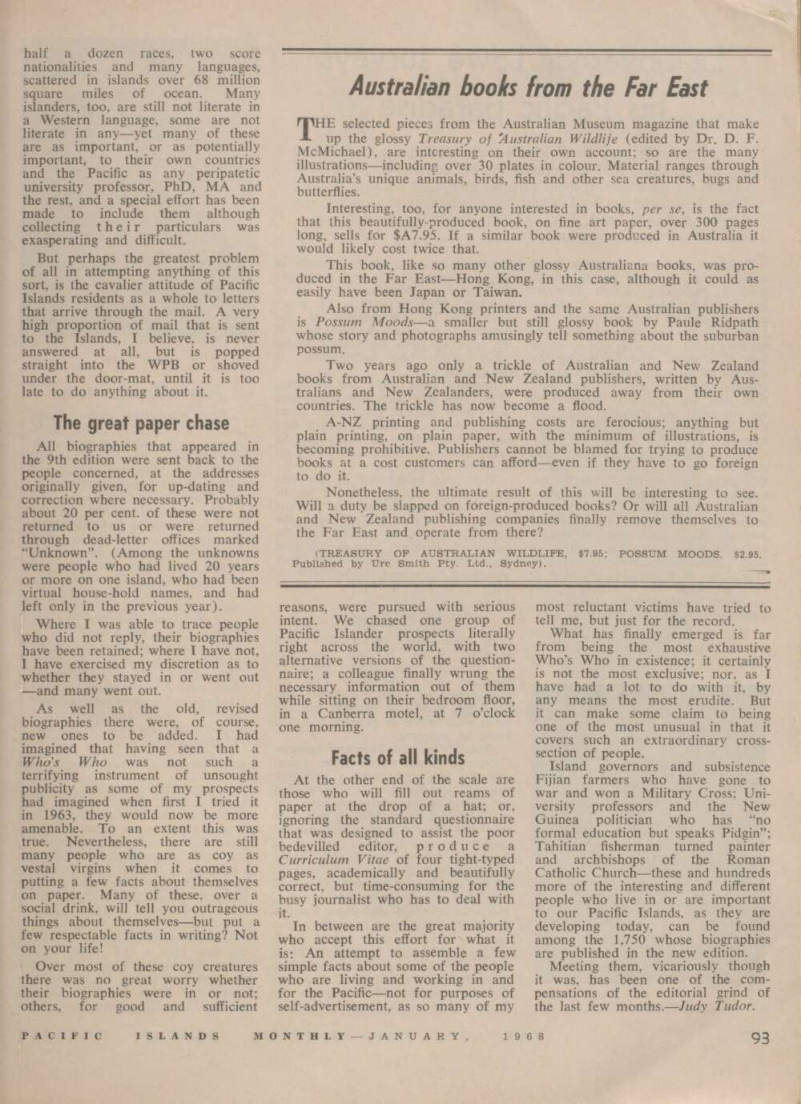
The triennial travail is over; the mice have laboured and if they haven’t exactly brought forth a mountain they have at least brought forth a 720-page book (plus 152 pages of ad vertising): The tenth edition of the Pacific Islands Year Book and Who’s Who.
Like everything else these days, the Year Book tends to get bigger and bigger—about 100 pages longer than the 9th edition. Those of us who have had to work with it calculate that if all the small type in the book were set end-to-end it would probably go twice round the equator.
It is, in its way, symptomatic of the Pacific Islands today. As each of them get up and go, there is more to be said about them and more pages required to do it, so that the PIYB turns out to be not one book, but about two dozen books of various sizes, all bound into one.
The general section of the book— that which deals with Pacific Islands as a whole—still takes up only about 64 pages in the front. Approximately another 460 pages are required to deal with the islands and territories as individual entities.
That Islands flavour
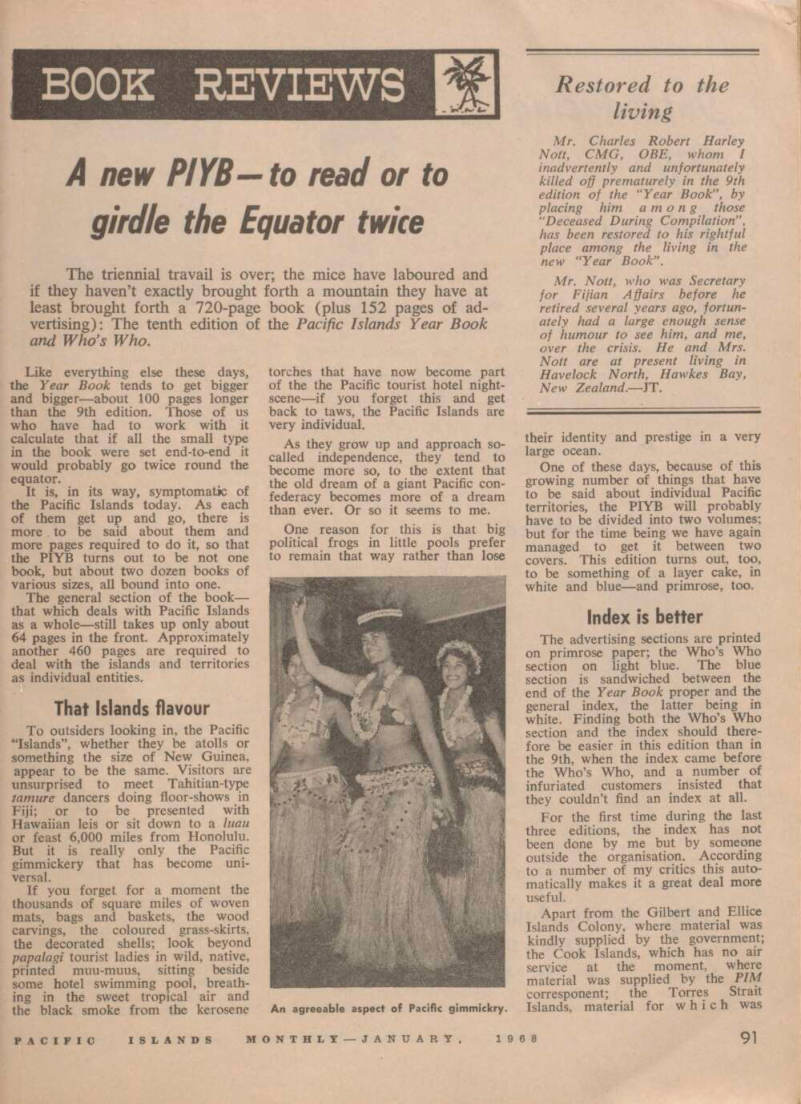
To outsiders looking in, the Pacific “Islands”, whether they be atolls or something the size of New Guinea, appear to be the same. Visitors are unsurprised to meet Tahitian-type tamure dancers doing floor-shows in Fiji; or to be presented with Hawaiian leis or sit down to a luau or feast 6,000 miles from Honolulu.
But it is really only the Pacific gimmickery that has become uni versal.
If you forget for a moment the thousands of square miles of woven mats, bags and baskets, the wood carvings, the coloured grass-skirts, the decorated shells; look beyond papalagi tourist ladies in wild, native, printed muu-muus, sitting beside some hotel swimming pool, breath ing in the sweet tropical air and the black smoke from the kerosene
torches that have now become part of the the Pacific tourist hotel night scene—if you forget this and get back to taws, the Pacific Islands are very individual.
As they grow up and approach so called independence, they tend to become more so, to the extent that the old dream of a giant Pacific con federacy becomes more of a dream than ever. Or so it seems to me.
One reason for this is that big political frogs in little pools prefer to remain that way rather than lose
their identity and prestige in a very large ocean.
One of these days, because of this growing number of things that have to be said about individual Pacific territories, the PIYB will probably have to be divided into two volumes; but for the time being we have again managed to get it between two covers. This edition turns out, too, to be something of a layer cake, in white and blue—and primrose, too.
Index is better
The advertising sections are printed on primrose paper; the Who’s Who section on light blue. The blue section is sandwiched between the end of the Year Book proper and the general index, the latter being in white. Finding both the Who’s Who section and the index should there fore be easier in this edition than in the 9th, when the index came before the Who’s Who, and a number of infuriated customers insisted that they couldn’t find an index at all.
For the first time during the last three editions, the index has not been done by me but by someone outside the organisation. According to a number of my critics this auto matically makes it a great deal more useful.
Apart from the Gilbert and Ellice Islands Colony, where material was kindly supplied by the government; the Cook Islands, which has no air service at the moment, where material was supplied by the PIM corresponent; the Torres Strait Islands, material for which was
An agreeable aspect of Pacific gimmickry.
supplied by the Deputy Director of Aboriginal and Island Affairs; and some small individual islands—apart from these we went out and got the raw material for this edition.
This has involved many thousands of miles of air travel and, naturally, adds considerably to the cost of pro duction. But most governments are so inundated with paper-work them selves these days that few are willing to devote time to supplying, by mail order as it were, the kind of in formation in depth that is required for the PIYB.
When they find you on their door step, however, it is a different matter.
With almost no exception we have had the utmost co-operation from public servants and others, all the way from Honolulu to Canberra and from Papeete to New Guinea. They happily made records and material available to us.
Hunting big names
Apart from a general expansion all along the way, the 10th edition has two new sections. One deals with the countries along the western periphery of the Pacific Ocean—i.e., Japan and South-East Asia—all of which are having an increasing impact on Islands trade, politics and life in general; and another section, in the front of the book, gives a summary of each of the main Pacific Islands prepared especially for people who want a few vital facts and figures in a hurry. The islands in this section are treated in alpha betical order.
Finally, the Who’s Who section.
This was first introduced in the 9th edition and, in many respects, proved to be the most exasperating task I ever tackled. I assumed that the second time round would be easier, but this has not been the case.
All the old problems were there for the second edition: People of
half a dozen races, two score nationalities and many languages, scattered in islands over 68 million square miles of ocean. Many islanders, too, are still not literate in a Western language, some are not literate in any—yet many of these are as important, or as potentially important, to their own countries and the Pacific as any peripatetic university professor, PhD, MA and the rest, and a special effort has been made to include them although collecting their particulars was exasperating and difficult.
But perhaps the greatest problem of all in attempting anything of this sort, is the cavalier attitude of Pacific Islands residents as a whole to letters that arrive through the mail. A very high proportion of mail that is sent to the Islands, I believe, is never answered at all, but is popped straight into the WPB or shoved under the door-mat, until it is too late to do anything about it.
The great paper chase
All biographies that appeared in the 9th edition were sent back to the people concerned, at the addresses originally given, for up-dating and correction where necessary. Probably about 20 per cent, of these were not returned to us or were returned through dead-letter offices marked “Unknown”. (Among the unknowns were people who had lived 20 years or more on one island, who had been virtual house-hold names, and had left only in the previous year).
Where I was able to trace people who did not reply, their biographies have been retained; where I have not, I have exercised my discretion as to whether they stayed in or went out —and many went out.
As well as the old, revised biographies there were, of course, new ones to be added. I had imagined that having seen that a Who’s Who was not such a terrifying instrument of unsought publicity as some of my prospects had imagined when first I tried it in 1963, they would now be more amenable. To an extent this was true. Nevertheless, there are still many people who are as coy as vestal virgins when it comes to putting a few facts about themselves on paper. Many of these, over a social drink, will tell you outrageous things about themselves—but put a few respectable facts in writing? Not on your life!
Over most of these coy creatures there was no great worry whether their biographies were in or not; others, for good and sufficient
reasons, were pursued with serious intent. We chased one group of Pacific Islander prospects literally right across the world, with two alternative versions of the questionnaire; a colleague finally wrung the necessary information out of them while sitting on their bedroom floor, in a Canberra motel, at 7 o’clock one morning.
Facts of all kinds
rdLTS OT dll Kinub At the other end of the scale are those who will fill out reams of paper at the drop of a hat; or, ignoring the standard questionnaire that was designed to assist the poor bedevilled editor, produce a Curriculum Vitae of four tight-typed pages, academically and beautifully correct, but time-consuming for the busy journalist who has to deal with it.
In between are the great majority who accept this effort for what it is: An attempt to assemble a few simple facts about some of the people who are living and working in and for the Pacific—not for purposes of self-advertisement, as so many of my
most reluctant victims have tried to tell me, but just for the record.
What has finally emerged is far from being the most exhaustive Who’s Who in existence; it certainly is not the most exclusive; nor, as I have had a lot to do with it, by any means the most erudite. But it can make some claim to being one of the most unusual in that it covers such an extraordinary cross section of people.
Island governors and subsistence Fijian farmers who have gone to war and won a Military Cross; Uni versity professors and the New Guinea politician who has “no formal education but speaks Pidgin”; Tahitian fisherman turned painter and archbishops of the Roman Catholic Church—these and hundreds more of the interesting and different people who live in or are important to our Pacific Islands, as they are developing today, can be found among the 1,750 whose biographies are published in the new edition.
Meeting them, vicariously though it was, has been one of the com pensations of the editorial grind of
the last few months.-
Judy Tudor.