Magazine Section
pp. 83-87 · Read in the full issue

Pacific Islands Monthly
Wily New Hebridean
Outlaw Led Condominium
Police On Many
A Fruitless Chase
By Robert Langdon
At 4 a.m. on the morning of March 22, 1911, an armed posse of four Europeans and about 80 New Hebrideans crept cautiously and silently along a narrow path in the dense bush behind Hog Harbour, on the New Hebridean island of Santo.
Their objective' was a big leaf house in a clearing—the home of a notorious New Hebridean bushman called Thingaru, who had been ter rorising the Sakau Peninsula of Santo for several months.
The posse hoped to find Thingaru at home, and, if possible, to capture him either dead or alive. But when they got within 400 yards of the house, Thingaru and his men, who were hidden in the bush a few yards from the road, opened fire and stopped the posse in its tracks.
The first shot wounded the posse’s guide; but the posse returned the fire with such spirit that the bushmen had to retreat deeper into the jungle.
A lively gunfight subsequently took place between the posse and the bushmen, and several of the partici pants on both sides were killed.
But Thingaru, the scourge of Sakau, escaped unscathed, as he did in a number of subsequent attempts to kill or capture him.
Fascinating diary
The story of Thingaru and of the various attempts to end his Ned Kelly-like career is an ever-recurring theme in a fascinating, 50-year-old diary that I have recently been read ing.
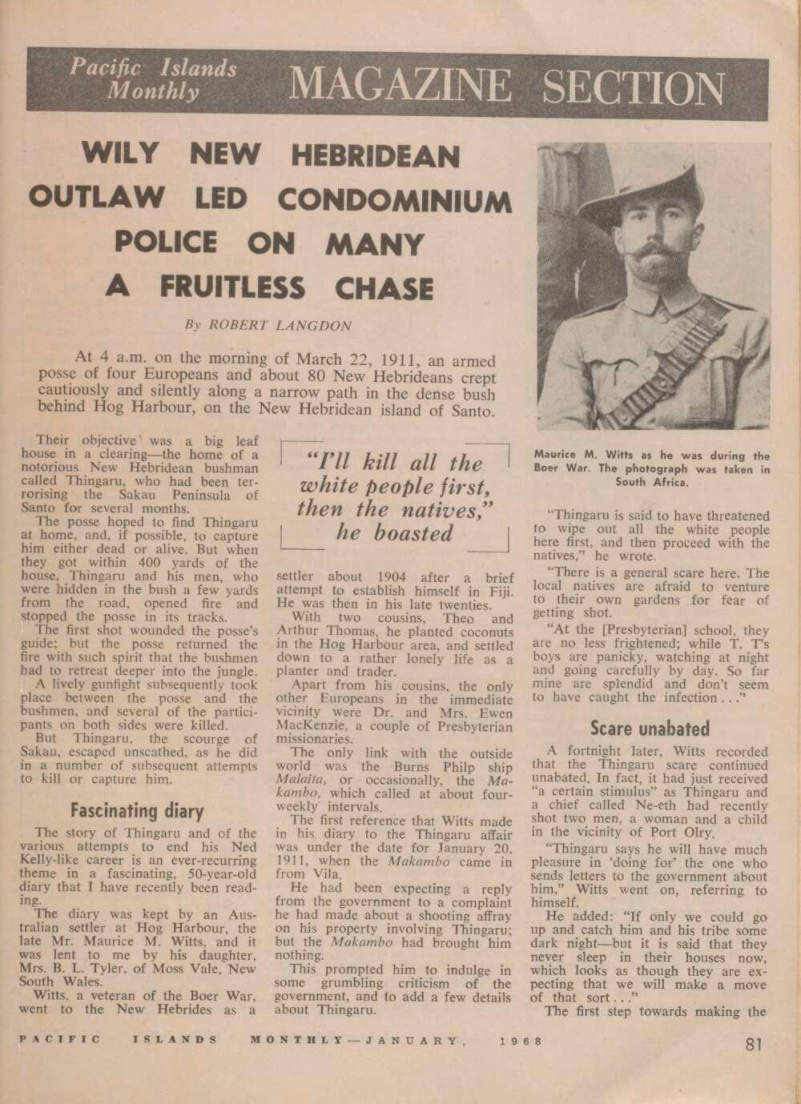
The diary was kept by an Aus tralian settler at Hog Harbour, the late Mr. Maurice M. Witts, and it was lent to me by his daughter, Mrs. B. L. Tyler, of Moss Vale, New South Wales.
Witts, a veteran of the Boer War, went to the New Hebrides as a
‘Til kill all the white people first , then the natives ” he boasted
settler about 1904 after a brief attempt to establish himself in Fiji.
He was then in his late twenties.
With two cousins, Theo and Arthur Thomas, he planted coconuts in the Hog Harbour area, and settled down to a rather lonely life as a planter and trader.
Apart from his cousins, the only other Europeans in the immediate vicinity were Dr. and Mrs. Ewen MacKenzie, a couple of Presbyterian missionaries.
The only link with the outside world was the Burns Philp ship Malaita, or occasionally, the Ma kambo, which called at about four weekly intervals.
The first reference that Witts made in his, diary to the Thingaru affair was under the date for lanuary 20, 1911, when the Makambo came in from Vila.
He had been expecting a reply from the government to a complaint he had made about a shooting affray on his property involving Thingaru; but the Makambo had brought him nothing.
This prompted him to indulge in some grumbling criticism of the government, and to add a few details about Thingaru.
“Thingaru is said to have threatened to wipe out all the white people here first, and then proceed with the natives,” he wrote.
“There is a general scare here. The local natives are afraid to venture to their own gardens for fear of getting shot.
“At the [Presbyterian] school, they are no less frightened; while T. T’s boys are panicky, watching at night and going carefully by day. So far mine are splendid and don’t seem to have caught the infection ..
Scare unabated
A fortnight later, Witts recorded that the Thingaru scare continued unabated. In fact, it had just received “a certain stimulus” as Thingaru and a chief called Ne-eth had recently shot two men, a woman and a child in the vicinity of Port Olry.
“Thingaru says he will have much pleasure in ‘doing for’ the one who sends letters to the government about him,” Witts went on, referring to himself.
He added: “If only we could go up and catch him and his tribe some dark night—but it is said that they never sleep in their houses now, which looks as though they are ex pecting that we will make a move of that sort..
The first step towards making the
Maurice M. Witts as he was during the Boer War. The photograph was taken in South Africa.
move that Thingaru and Co. ap parently visualised came on February 4, 1911, when a French police boat, with Captain Jancker, the French police commandant, arrived in Hog Harbour.
Five people killed
Captain Jancker held a conference on board with Witts and his two cousins to decide what should be done about Thingaru, whose gang by this time had killed five people and wounded one.
It was apparently agreed that the best plan was to hunt Thingaru down.
But as Captain Jancker had only half a dozen policemen with him, it was decided that he should run down to Vila and come back as soon as possible with as many British and French native police as could be spared.
Captain Jancker, with his British counterpart, Captain Harrowell, plus 10 British and 10 French native police, returned to Hog Harbour on March 17. A plan of action was immediately decided upon.
Jancker, with his 10 police and a number of native volunteers, were to go up by boat after nightfall to Port Olry, where, under the guidance of a French Catholic priest, Father Bochu, they would march on Ne eth’s village and capture him.
Meanwhile, Captain Harrowell, Witts, the Thomases, the 10 British police and such native volunteers who cared to go were to march in land from Hog Harbour and capture Thingaru.
It all seemed easy enough in theory, but it didn’t work out that way.
Jancker’s party was quietly sur rounding Ne-eth’s village when a dog barked, alarming Ne-eth and Co. and enabling them to escape into the safety of the bush, firing as they went.
"All for nothing"
Harrowell’s party was even less successful. After finding their way by “a maze of very bad bush tracks by feeble moonlight” for seven hours, the posse reached a village where the natives were thought to be friendly.
There, because no one in the posse knew the onward route to Thingaru’s, they “called out persuasively” in the hope of hiring a guide. However, instead of getting aid, the natives stampeded out of their sleeping houses into the bush, and as nothing would persuade them to come out again, and as it was getting too late
to surprise Thingaru, anyway, the posse had no option but to march empty-handed back to Hog Harbour.
They were on the road for a total of 18 hours, 16 of which were solid walking—and it was “all for nothing,” as Witts sourly confided to his diary.
But the police and the European settlers were determined to get Thingaru, and four days later, at three in the afternoon, they set out again.
This time the posse consisted of the two police commandants, Witts, Theo Thomas, the 20 native police, and about 60 native volunteers.
Each commandant took charge of his own police and about 20 volunteers; while Witts was given command of the remaining volunteers, whom he dubbed the Buffalo Brigade.
After marching through drizzling rain for three hours and getting thoroughly soaked, the posse made camp and tried unsuccessfully to get some sleep until midnight.
They then marched on towards Thingaru’s—with their native guide tied to a rope so that he would not run away.
“At four o’clock in the morning,”
Witts recorded in his diary, “we were within 400 yards of Thingaru’s house, creeping along in single file, very cautiously, very silently.
“I was in the extreme rear and
fancied I could hear twigs oc casionally snapping behind. I thought we were perhaps being followed.
“But just then from the front came the hollow, echoing report of two guns fired almost together, followed by a volley from the police.
“Again we had failed. The bush men were waiting for us, planted within 10 paces of the road. The first shot had wounded our guide, but the firing from our line caused the planners of this pretty little ambush to draw off a bit.
“We waited just where we were until daylight and then took possess ion of Thingaru’s house and yam garden. The house was from 25 to 30 yards long, and had sleeping ac commodation for about 15 men.
“After destroying the yams, we set alight to this big leaf house, and during most of the time thus oc cupied, we were being fired at from the thick bush nearby by a larger number of men than we would have thought possible.
“Three times I put my Buffaloes round the outer fence as a picket for the front, and each time they ran in. We could hear the bushmen talking 30 yards away, but could not see any of them. But we fired away in the direction of the voices and two of them were killed for a certainty.
“We had nearly finished our work of demolition when I was called in from the outer fence to find that T.
Thomas had been knocked over by two bullets—one of which had passed the lower extremity of the left lung, the other having lodged in the upper thigh.
“Beside him was a mission boy, still alive, but badly smashed.
“Hastily constructing what we could in the way of stretchers, we commenced our retreat. The bush men (seeing our move) made a determined attempt to cut us off.
“The Buffalo Brigade was getting quite panic-stricken and it was with difficulty that I could get sufficient men to carry the stretchers.
“When, soon afterwards, Wus, another mission native fell, the Buffaloes, with one impulse, rushed past him and no less than 40 of them took to the bush. Nor did we see any more of them until we got back home.
“Of the 20 who remained, they one and all did excellent work.
“But the horror of that return march!
“Four wounded men had to be taken a distance of 15 miles over an awful road. More than once I had
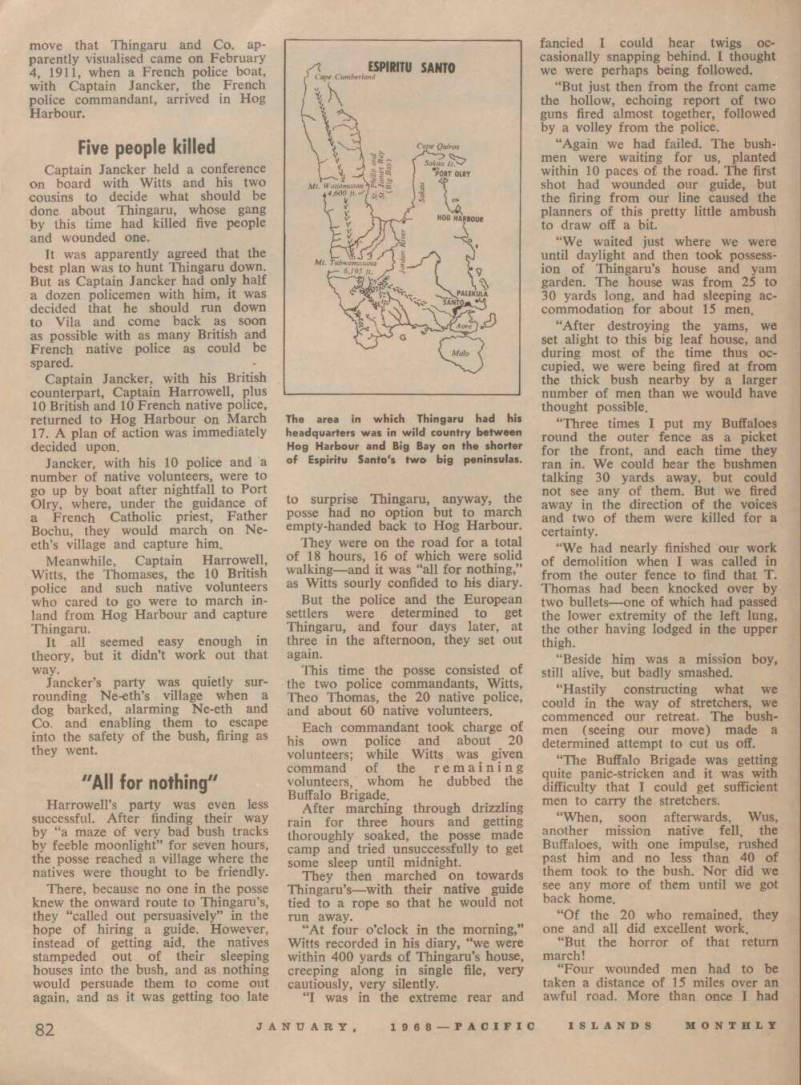
The area in which Thingaru had his headquarters was in wild country between Hog Harbour and Big Bay on the shorter of Espiritu Santo's two big peninsulas.
to shoulder a man myself and stagger along a few hundred yards.
“Wus and Sairsair died on the road.
“The sun was low when we reached the mission station, where Dr. and Mrs. MacKenzie at once took charge of Theo and the wounded guide. I toddled off home, where I drank in numerable cups of tea, as we had had neither water for food since 6 o’clock the previous evening ...”
Sentries posted
Back in Hog Harbour, however, no one could really rest, as word came through from a friendly native that Thingaru was gathering all the men he could get to make an attack on the mission station.
The message was taken seriously, as Thingaru had been heard to say, when his village was under attack, that he would repay the Europeans’ call.
Captain Harrowell therefore had the scrub cleared in the vicinity of the mission compound and a guard was appointed to watch over it.
Meanwhile, the Makambo came in and Harrowell got her to take a message, apparently asking for rein forcements, to the French cruiser Kersaint, which he knew to be anchored in the Segond Channel.
The Kersaint steamed up to Hog Harbour next day, put ashore a detachment of 20 marines in case of trouble, and sailed south again.
“It seems very strange the mission station being turned into a garrison post, with sentries out and armed men sleeping in the reserve,” Witts observed in his diary.
The sentries, however, had no shooting to do, for Thingaru ap parently soon learned of the strength of the mission station and kept well clear of it.
Everything, in fact, was so quiet that Witts’ diary is a blank from the day of the Kersaint’s departure until her return from Vila 11 days later with the British and French Resident Commissioners, Messrs.
Merton King and Martin, who had come to investigate the Thingaru problem in person.
Proclamation
Soon after their arrival, they drew up a proclamation offering a reward of £3O each for the capture of Thingaru, Ne-eth and another chief called Roneal.
They also decided to make Hog Harbour a police post for the time being—Witts being appointed its
commandant on a salary of £2OO a year.
Witts was given a detachment of six British and six French native police, including a corporal from both divisions. He was also authorised to recruit eight mission natives as auxiliary police for a term of six months, at the rate of £1 per month and “find for themselves”.
All this having been arranged, the Kersaint sailed south again with the two Resident Commissioners, Cap tains Harrowell and Jancker, eight of their policemen, and the detach ment of marines.
Contraband
Witts immediately recruited the eight auxiliary police he had been authorised to hire, and within a few days, amid rumours from all quarters about the whereabouts of Thingaru, Ne-eth and Co., he set out to track them down.
On April 15, with two British and two French native police, he went up in a dinghy to Port Olry in the hope of catching Ne-eth, but found on arrival that he was in the wilds of Cape Quiros, no one knew exactly where.
A fortnight later Witts went over land from Hog Harbour to Shark Bay where he found the French ship
Guadeloupe illicitly selling cartridges and gunpowder to the natives.
Going aboard, he made a search for contraband and found no less than 18 Snider rifles and 181 tins of gunpowder.
As he feared that this material might find its way to Thingaru and Co., he placed it under seal and addressed it to an official in Vila.
This action eventually brought a rebuke from the British police com mandant as being an unwarranted piece of interference in French affairs. But Witts felt he had been completely within his rights.
“Being as much a French official as a British,” he wrote in his diary, “why should I not search a French vessel, particularly when the safety of white residents, both British and French, would have been endangered by my not having done so?”
Ne-eth afraid
Meanwhile, Witts made another expedition to Port Olry in the hope of coming to grips with Ne-eth.
Striking into the bush with two guides, he eventually reached a native village, from which he sent word to Ne-eth asking him to come to him, and promising that he would neither be taken prisoner nor shot.
When Ne-eth replied that he was
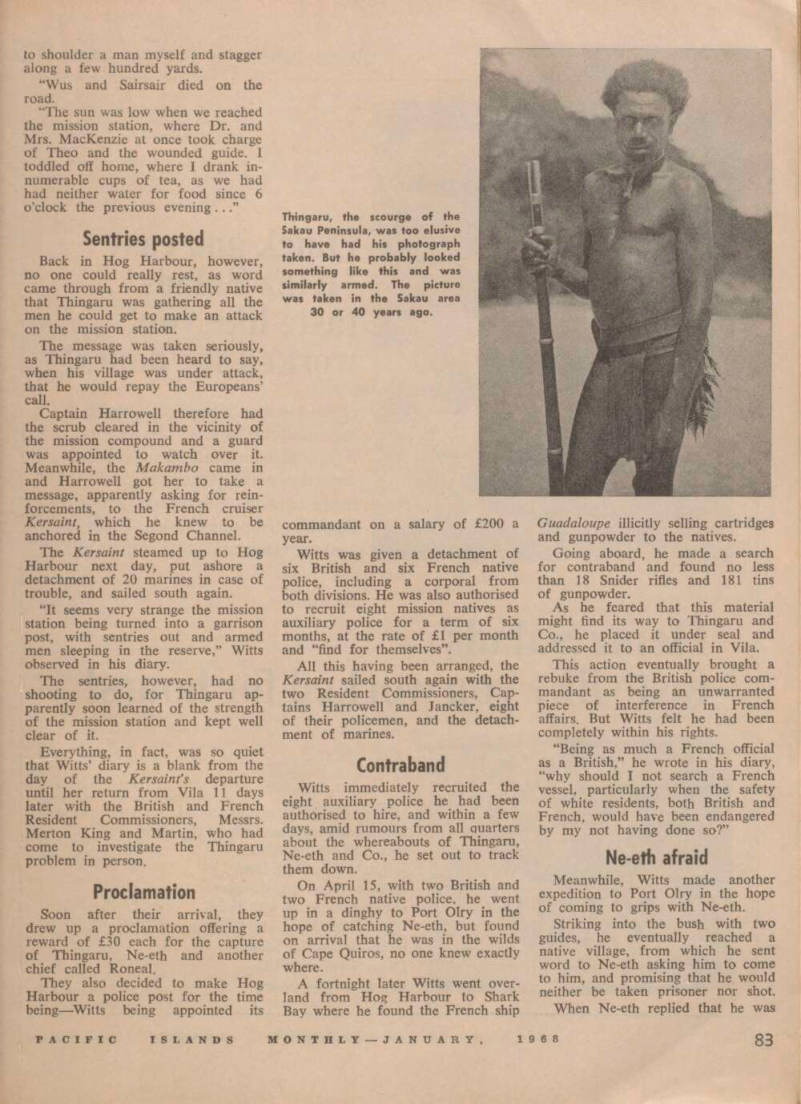
Thingaru, the scourge of the Sakau Peninsula, was too elusive to have had his photograph taken. But he probably looked something like this and was similarly armed. The picture was taken in the Sakau area 30 or 40 years ago.
250 miles on foot without results
afraid to come, Witts sent word to him again that if he didn’t come out quickly, he (Witts) would return to Hog Harbour to get reinforcements to capture him.
This threat brought Ne-eth into the open, where, in the presence of 25 witnesses, Witts made him “sign” a paper promising—on condition that he received a pardon for what he had done—that he would never again shoot or cause anyone to be shot nor take part in any action against the government.
Shooting threat
Witts also got Ne-eth to agree that he would “come up whenever called upon to do so by those in authority,” and that he would do everything in his power to help capture Thingaru.
“All of this was carefully trans lated to him so that he will have no excuse if he breaks his promise,”
Witts wrote in his diary.
He added: “After seeing him sign the paper, I drew a revolver from my haversack and put it to his head explaining that if he ever dared to ‘gammon’ again that I would shoot him with every one of the six cartridges the revolver contained.”
Ne-eth having thus been brought “under control,” Witts returned to Hog Harbour where he learned that Thingaru was to attend a sing-sing and pig-killing at a certain village a few days hence.
This news spurred him into a flurry of activity in an attempt to get other European planters on the Sakau Peninsult to help him ambush Thingaru on his way to the sing sing.
But all of his plans to get his fellow Europeans to co-operate came unstuck, and Witts spent weeks in the bush on his own getting now here.
Three entries from his diary give an idea of his frustrations and difficulties at this time: June 10: Made attempt to be up to Thingaru’s house by moonlight, but got blocked by bad roads. Cut my way for two miles or more, but had to give it up.
June 16: Went overland to Port Olry. Took three boys with me.
Had to cut our way for miles. Road completely overgrown, or tangled up by late hurricane. Took us eight hours to go 10 miles . ..
June 18: Had another try to get up to Thingaru’s by moonlight. Went as far as Almiror’s during afternoon.
Had supper there and waited until moon rose at 12. Then I made a fresh start but not a man would put me on [i.e. direct me to] the road.
Declared there was no direct road; but last year I came down from Thingaru’s past Almiror’s on a road of a sort. Tried to find it myself, but had no success, so came home at 3 a.m. Am about sick of these night wanderings about the bush to no pur pose. I have now walked somewhere near 250 miles in connection with bush excursions, scouting, etc., and I am about as far ahead as I was at the beginning. Everyone wants to sool me on to Thingaru and Com pany as though I were a public bulldog, but not one person will give the least assistance ...”
Official reluctance
Ten days after this entry, Witts recorded that a British warship, HMS Prometheus, had arrived in Hog Harbour with the British Resident Commissioner, and that he had dis cussed with him and the captain of the ship the idea of “doing some thing” about capturing the hostile chiefs.
Both men, however, seemed reluctant to do anything, although they did promise to shell Thingaru’s village from Big Bay at some time in the future and to send parties in land after him.
It was also apparently agreed on at this meeting that Witts should disband and pay off his auxiliary police—and this he did the following day.
However, he had scarcely done so when a report came in that two men had tried to shoot a native woman within a mile of the mission station.
A few days later, Witts received another report that Thingaru and Roneal had made an attack on the village of Gussoo.
Spurred into activity again, Witts mobilised 10 men and hastened with them to take up positions on a road near Thingaru’s village.
“But though we waited all night until sunrise next morning, no one came,” Witts recorded with his usual disappointement.
Following this fiasco, Witts issued 375 Snider cartridges to the chiefs in several friendly villages in the vicinity of Hog Harbour, observing in his diary that he thought this proceeding was the only way of ensuring the villagers’ safety.
“These villages as they were, without cartridges, were entirely at the mercy of Thingaru and lived in a state of terror,” Witts said. “Now they say they are alright.”
A day or two after making this diary entry, Witts embarked in an inter-island vessel for Vila, where he stayed three days before sailing north again.
His diary, unfortunately, ends abruptly at this point—August 15, 1911—so no clue can be gleaned from it as to whether Thingaru again proved troublesome, whether he was eventually captured, or what, in fact, happened to him in the end.
I have consulted a number of other sources in an attempt to discover his fate. But apart from a news item in a Presbyterian mission magazine for October, 1911, saying that Thingaru was still at large despite the govern ment’s £3O reward for his capture, I have uncovered nothing.
This, I know, is a pretty un satisfactory way to end a story. But I’m hoping that there is a reader somewhere who knows how to end it better.
Footnote: A year or two after the Thingaru crisis, Witts, who had married, moved to New South Wales, He lived in the Moss Vale district until his death in 1966 at the age of 89. His cousin, Theo Thomas, who was seriously wounded in the first concerted effort to capture Thingaru, was successfully operated on in Sydney. He later returned to the New Hebrides, where he remained until the mid-1920’5. He died 10 or 12 years ago.