New University Builds
pp. 73-77 · Read in the full issue
Up One Of The
Great Libraries
On New Guinea
By W. G. Buick.
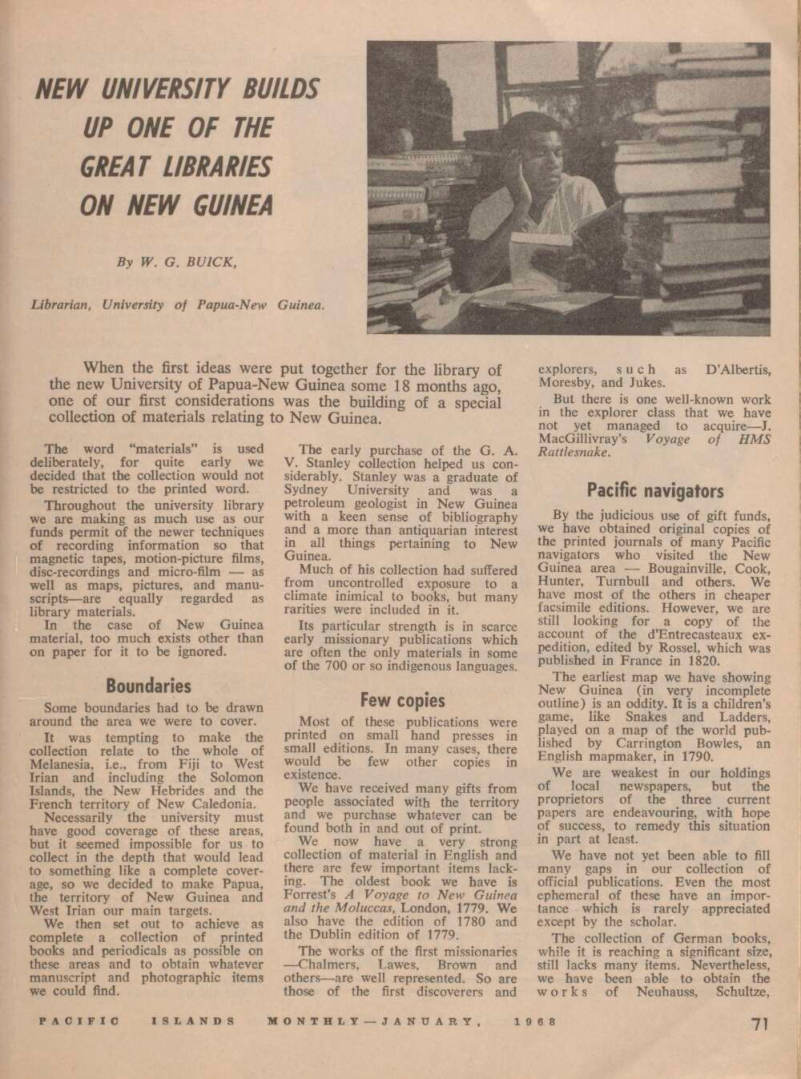
When the first ideas were put together for the library of the new University of Papua-New Guinea some 18 months ago, one of our first considerations was the building of a special collection of materials relating to New Guinea.
The word “materials” is used deliberately, for quite early we decided that the collection would not be restricted to the printed word.
Throughout the university library we are making as much use as our funds permit of the newer techniques of recording information so that magnetic tapes, motion-picture films, disc-recordings and micro-film as well as maps, pictures, and manu scripts—are equally regarded as library materials.
In the case of New Guinea material, too much exists other than on paper for it to be ignored.
Boundaries
Some boundaries had to be drawn around the area we were to cover.
It was tempting to make the collection relate to the whole of Melanesia, i.e., from Fiji to West Irian and including the Solomon Islands, the New Hebrides and the French territory of New Caledonia.
Necessarily the university must have good coverage of these areas, but it seemed impossible for us to collect in the depth that would lead to something like a complete cover age, so we decided to make Papua, the territory of New Guinea and West Irian our main targets.
We then set out to achieve as complete a collection of printed books and periodicals as possible on these areas and to obtain whatever manuscript and photographic items we could find.
The early purchase of the G. A.
V. Stanley collection helped us con siderably. Stanley was a graduate of Sydney University and was a petroleum geologist in New Guinea with a keen sense of bibliography and a more than antiquarian interest in all things pertaining to New Guinea.
Much of his collection had suffered from uncontrolled exposure to a climate inimical to books, but many rarities were included in it.
Its particular strength is in scarce early missionary publications which are often the only materials in some of the 700 or so indigenous languages.
Few copies
Most of these publications were printed on small hand presses in small editions. In many cases, there would be few other copies in existence.
We have received many gifts from people associated with the territory and we purchase whatever can be found both in and out of print.
We now have a very strong collection of material in English and there are few important items lack ing. The oldest book we have is Forrest’s A Voyage to New Guinea and the Moluccas, London, 1779. We also have the edition of 1780 and the Dublin edition of 1779.
The works of the first missionaries —Chalmers, Lawes, Brown and others—are well represented. So are those of the first discoverers and
explorers, such as D’Albertis, Moresby, and Jukes.
But there is one well-known work in the explorer class that we have not yet managed to acquire—J.
MacGillivray’s Voyage of HMS Rattlesnake.
Pacific navigators
By the judicious use of gift funds, we have obtained original copies of the printed journals of many Pacific navigators who visited the New Guinea area Bougainville, Cook, Hunter, Turnbull and others. We have most of the others in cheaper facsimile editions. However, we are still looking for a copy of the account of the d’Entrecasteaux ex pedition, edited by Rossel, which was published in France in 1820.
The earliest map we have showing New Guinea (in very incomplete outline) is an oddity. It is a children’s game, like Snakes and Ladders, played on a map of the world pub lished by Carrington Bowles, an English mapmaker, in 1790.
We are weakest in our holdings of local newspapers, but the proprietors of the three current papers are endeavouring, with hope of success, to remedy this situation in part at least.
We have not yet been able to fill many gaps in our collection of official publications. Even the most ephemeral of these have an impor tance which is rarely appreciated except by the scholar.
The collection of German books, while it is reaching a significant size, still lacks many items. Nevertheless, we have been able to obtain the works of Neuhauss, Schultze,
Librarian, University of Papua-New Guinea.
Parkinson and Finsch, and many other pre-World War I items.
It is not surprising that material in Dutch and Indonesian relating to West Irian is poorly represented.
This material is difficult to locate.
Much of it is very scarce and rarely comes on to the Australian market; and we have not been able to visit any of the centres where it might be discovered. The most significant item in this field is a complete set of the periodical Nova Guinea, which dates back to before World War I. It is the most expensive single item we have bought, the cost being $1,300.
4,000 printed items
There are now about 4,000 printed items in the New Guinea collection, making it the largest collection of its kind in the territory, and one which few other libraries anywhere can surpass.
We cannot report as successful a story with manuscripts, though it is most important that these should be preserved under the best conditions possible and that they should be accessible to scholars and research workers.
With the Stanley collection we obtained a long series of his account books which have not yet been assessed.
Dr. A. G. Price, of Port Moresby, has given a large series of manu scripts relating, for the most part, to the language, genealogy and customs of the Motu-speaking people.
Mr. J. K. McCarthy, the recently retired Director of District Admini stration, gave a valuable series of notebooks relating to the liquor inquiry of 1958 and other papers.
Here, too, should be mentioned a number of magnetic tapes given by Dr. Price and 17.000 feet of motion picture film made during the investigations into Kuru by Dr. D.
C. Gajdusek and others. This is part of a very large series of papers being deposited in the library by arrangement with the territory’s Department of Public Health.
Tape-recordings
The Embassy of West Germany has given us microfilm copy of some of the early German archives relat ing to New Guinea; and arrange ments are in hand for the copying of the remainder of the available material.
Unfortunately, these archives were sundered by the partition of Germany and some of the original material is housed in Potsdam, East Germany.
The library has an active, though
Much folk-lore lost
at present limited, programme of making tape-recordings of important and significant events as they occur.
Mr. Colin Freeman, who is the librarian of the New Guinea collec tion, has, for example, been record ing all of the university’s inaugural addresses. He has also recorded the speeches and singing at the 1967 Papua Ekalesia Bou-Bou ceremony at Pari village.
There is need for much more activity of this kind. There is still an almost unlimited field of oral history, folklore, song, linguistic and other material to be collected.
In many instances it is already too late.
This material is of great impor tance for future university studies, and the day will surely come when it will be an inspiration for a creative, satisfying and valued national life and culture.
This raises the important issue of the copying or even the transfer of maunscripts in other depositories.
Transfer is probably out of the question except for some items which it is understood are in temporary custody pending the provision of adequate facilities in the territory.
Official archives are probably not in our province; but there are very many series of important private papers in libraries in Australia and elsewhere which we should have copied for use in New Guinea.
Photographic records
There are many thousands of feet of magnetic tape and motion picture film available if the funds were at hand to copy them. There is much material in missions within New Guinea itself and other places which should at least be copied for per manent and safe preservation.
As a measure of the amount of material there is the success of Mr.
Cecil Abel in locating several cases of papers relating to his father and the Kwato Mission and the important verbal material which he collected on many feet of tape.
This material is the largest single series of manuscripts to have been given to the library.
At present, the only way in which it seems possible to collect any quantity of oral tradition, with the kind of coverage that is required, is to provide students with portable tape recorders to take home during the long vacations.
There is a need, also, to build up a collection of slides of botanical.
Photographers can help
zoological, palaeontological and anthropological objects, both in the field and in museums.
It is very desirable that we should have adequate photographic records of type-specimens deposited outside the territory- As the best and most representative collections of New Guinea art are in America and Europe, photographs should be made of all items so that, to some extent at least, they can be studied here.
Amateur photographers should be able to help considerably in building up a photographic iconography of New Guinea fauna and flora.
Our only material at present is a set of slides of the plates in Gould’s Birds of New Guinea, which was given by the State Library of South Australia. The book itself, one of the most, if not the most, valuable of all New Guinea books, is not in the collection.
The task of handling this New Guinea material should be men tioned briefly. As there is no national bibliography nor index of New Guinea periodicals, and the biblio graphies and indexes that do exist are very inadequate, this has made the tracing of items difficult.
It is hoped to make an early commencement on remedying these lacks.
No thesaurus or list of subject headings relating to New Guinea topics has ever been compiled and, as far as we have been able to discover, no really satisfactory guide to the names and synonyms of languages or social groupings exists.
This has necessarily meant a con siderable amount of research before cataloguing could be undertaken.
Similarly, place and regional names have caused us difficulty.
Altogether the staff has had problems rarely encountered in the same degree in other libraries.
Far from complete
The New Guinea collection is far from complete, but it will continue to grow. It is very dependent on gifts and it should be known as widely as possible that we are in terested in receiving all items, even the ephemeral.
Besides books, periodicals, pamphlets, papers, maps and govern ment publications, we are anxious to obtain photographs, letters of prominent people, tape recordings, leaflets, circulars, programmes of events, motion picture film and busi ness records.
We are interested in all aspects
of New Guinea and all phases of Papuan and New Guinean life.
These include the plants, animals and geology of New Guinea itself, the anthropology of the region and the work of the government, local councils, missions, institutions, asso ciations, societies, clubs and business houses in, or associated with the Territory of Papua and New Guinea.
Some of these materials will be of immediate use to our staff, students and others, but we are really look ing to the future in preserving much of this material.
In generations to come it will be of inestimable value both for itself and for the light it will shed on the present achievement and on the men who achieved and changed so much of New Guinea life and on the motives that inspired them.
The collection will be properly preserved and organised. It will be stored under the best possible con ditions in an air-conditioned building with adequate provision for fumiga tion.
The material will be properly catalogued by trained staff and, except in special circumstances, will be available to anybody who needs to consult it whether he is a member of the university or not.
With some materials which may be of a confidential nature we are quite prepared to restrict the access to it by putting it under seal for a stipulated number of years or dur ing the lifetimes of named persons.
Alternatively, access may be granted only with the authority of the donor.
We are quite willing to discuss matters of this kind at any time.
Microfilms
Before long we shall have micro filming equipment, and if it is not possible for us to have original documents, we would appreciate hav ing the opportunity of considering the copying of them.
Besides helping the university, microfilming would act as an in surance against accidental loss of the originals.
It should be clear that the New Guinea Collection in the University of Papua and New Guinea Library is a national treasure with already a considerable quantity of valuable and irreplaceable documents.
Like the library of which it is a part, it is as much a power-house in the intellectual world as any hydro-electric scheme is in the physical world.