the Cook Islands
pp. 24-25 · Read in the full issue
Devastating hurricane lashes the Cook Islands
From W. H. PERCIVAL on Rarotonga A hurricane which swept from north-west to south-east through the Cook Islands in mid-December caused widespread devastation and left many people homeless. Emergency supplies had to be sent to some of the affected islands.
The hurricane approached Puka puka Atoll on December 15, then took a southerly course which took it close to the islands of Nassau, Suwarrow, Palmerston, Aitut a k i, Mitiaro, Mauke and Rarotonga.
The hurricane centre was close to Rarotonga on the morning of December 18 and directly over Mangaia the same day.
On the night of December 17, hurricane force winds were experi enced on Palmerston, and winds of up to 50 knots on Aitutaki.
A report from Aitutaki stated that the yacht, Fast Lady, with a crew of Japanese students (see p. 115) was washed ashore there.
An American trimaran also got into trouble near Aitutaki and the crew was taken to the Residency. No casualties were reported.
Atiu’s landings were extensively damaged by very rough and high seas, and two houses were blown down.
Homes destroyed
On Mauke, most of the homes in Kimiangatau village were either de stroyed or very badly damaged. The new meeting house, opened last September, was destroyed, as were the Fruit Control Building and the guest house at the Residency. The whole village community was housed in the government school.
On Mangaia, which experienced high seas and strong winds, the Oneroa packing shed was blown down.
Rarotonga was badly hit by very rough seas and high winds. The seas almost completely demolished Avarua’s wharf, damaged Avatiu harbour, wrecked the beached fishing vessel Hakua Nui, damaged the Union Steam Ship Company’s build ings, eroded the coastal road in Avarua, destroyed houses, further damaged the wrecked brigantine Yankee, and played havoc with the hotel lounge.
Tons of coral rock were swept on to the main road in Avarua and into the hotel grounds. A big wave smashed through the wall of the lounge and carried the coffee bar out to sea.
Big seas swung Yankee com pletely around and swept her almost on to the beach. The vessel, which had been stuck on the reef since July, 1964, lost both masts.
The recently completed sea wall at the mouth of the Takuvaine stream was completely destroyed.
In a nearby bakery, the seas dam aged modern machinery which had been installed only recently and soaked about 200 sacks of flour.
The hospital at Tupapa was evacuated when seas invaded the grounds and buildings. Several people reported to have injuries treated, but none was seriously hurt.
Large boulders were carried on to
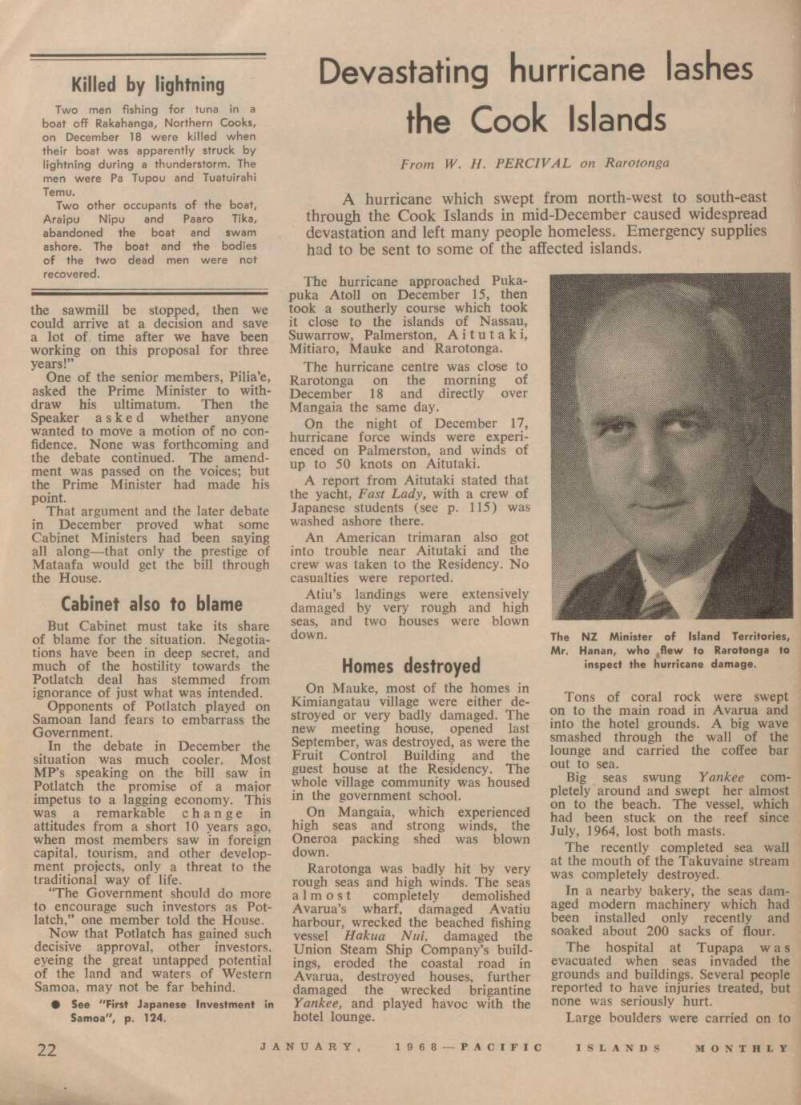
The NZ Minister of Island Territories, Mr. Hanan, who flew to Rarotonga to inspect the hurricane damage.
the coastal road on the island’s northern side.
Heavy rain caused floods in the low-lying areas, and winds gusting up to 82 knots (94 mph) caused further havoc.
In the heavily populated area of Tutakimoa, four houses were de molished and three others unroofed.
Most houses were flooded, and 270 people from the settlement took refuge in a hurricane safety shelter.
Twenty-nine houses were totally destroyed and about 150 were dam aged on Rarotonga, particularly those in the coastal areas of Tupapa, Matavera and Titikaveka, and about 90 people were left homeless. The piped water supply was cut off in some areas. Falling trees and branches brought down telephone and power lines everywhere, and the sheds and garage at the airport were blown down.
Before the “all clear” signal was given, people of the Ngatangiia and Titikaveka districts had started to clear up the wreckage and Public Works teams were clearing fallen trees and coral debris from the busiest sections of the coastal road.
Most Rarotongan homes were without piped water, electric power and telephones on the night of December 18, but Radio Cook Islands remained on the air, and the Cook Islands Premier, Mr. Albert Henry, broadcast an appeal for the people of Te-au-o-Tonga district to assist the government in cleaning up the storm damage in Avarua.
Volunteers clear up
Early the following morning, about 500 volunteers turned up to help men from Public Works. Private truck owners gave their services free, and trading companies gave tins of cabin bread biscuits, tinned meat and soft drinks to help feed the workers.
On the afternoon of December 19, the Minister of Island Territories, Mr. R. Hanan, and the Secretary of the recently-amalgamated Island Ter ritories and Maori Affairs Depart ments, Mr. J. M. McEwen, arrived by air from New Zealand to inspect hurricane damage.
Late report: On December 20, further reports indicated that the hurricane was probably the worst to hit the Cook Islands since 1942.
Aitutaki lost 53 houses and several other buildings; Mangaia’s new harbour was seriously damaged, a 10.000-gallon tank and several build ings were destroyed; Mitiaro’s radio station, Administration block and dispensary were apparently destroyed; and 90 per cent, of Rarotonga’s banana crop was destroyed.