to foreign investment
pp. 23-24 · Read in the full issue
Triumph For Prime Minister
W. Samoa opens the door to foreign investment
Prom an Apia correspondent Three years of negotiation and widespread, sometimes bitter debate, culminated in December with Western Samoa’s Parliament passing the Potlatch Bill without amendment, and without one voice raised in dissent on the final vote.
Apart from minor legislation, which is regarded as a formality, the Potlatch Bill is the final enactment needed to authorise the US firm of Potlatch Forests Inc. to develop the timber industry on the island of Savaii. The Potlatch Bill provides for taxation and other concessions as an incentive to the company to make its multi-million dollar invest ment.
Up to SUSB,OOO,OOO may be in vested over the next five years in developing loading, water supplies, electricity and a mill capable of handling 50-million board feet per year. The exact figure is not known.
The development will be at Asau, which will become the much needed second urban area in Samoa.
It is expected that top Potlatch officials will make the trip to Apia in January for the formal signing of the contract.
The enactment of the Potlatch Bill represents a giant step forward in the development of Western Samoa, for it supplies evidence of a major change in Samoan political attitudes over the past decade. Potlatch, which
itself is making its first venture over seas, will be the first foreign company to make a major investment in Samoan development.
The arguments that surrounded the proposal arose not so much against foreign capital as such, but out of the ingrained fear of Samoans, reinforced by events in Hawaii, Tahiti and to a lesser extent in Fiji and New Zealand, that they might lose their land to outsiders.
Once Prime Minister Fiame Mataafa put these fears to rest the bill had plain sailing. Most of the land in Savaii is customary land which cannot be sold. Forest lands will be leased from the owners by the Government, who will deal with Potlatch.
The development of this timber industry, said Mataafa, would be an ideal way of bettering the lot of the “landed but penniless masses”.
"Triumph"
It was a triumph for the Prime Minister. Only in November, follow ing the critical attitude of the Assembly’s Bills Committee to various pieces of Potlatch legislation, the Prime Minister had finally lost patience.
He told the House then that if an amendment of the Bills Com mittee concerning the Forests Bill was passed he would resign and ask the Head of State to dissolve parlia ment.
That sensational development came after the acting chairman of the Bills Committee, Fuimaono Moasope, said that the committee was guided by what was best for Samoa. This offended Mataafa, who was also angry at a previous remark by Fuimaono that if the bill were passed then “woe unto Samoa”.
The Prime Minister said the words clearly implied that Cabinet was try ing to introduce something damaging to the people. He said he had. naturally, been subject to disagree
able criticism during his eight years as Prime Minister, but “this was too much to take”.
He said that if the particular amendment was passed he would take it as a vote of no-confidence in him self and resign.
The Speaker called for an adjourn ment, seeking guidance from the Almighty in a prayer as he did so.
The meeting resumed briefly and Fuimaono withdrew his offending remarks.
The next morning Mataafa took the floor and said that his action had been entirely within the constitution.
He said he and Cabinet were guided only by what was best for the people as a whole, but that some members were apparently engaged in a whispering campaign, discrediting Cabinet’s actions and causing un certainty among other members.
He said that he had even heard rumours that he was pushing the Potlatch legislation because he had shares in the company.
“This is quite untrue,” the Prime Minister said.
“I wish someone would move that
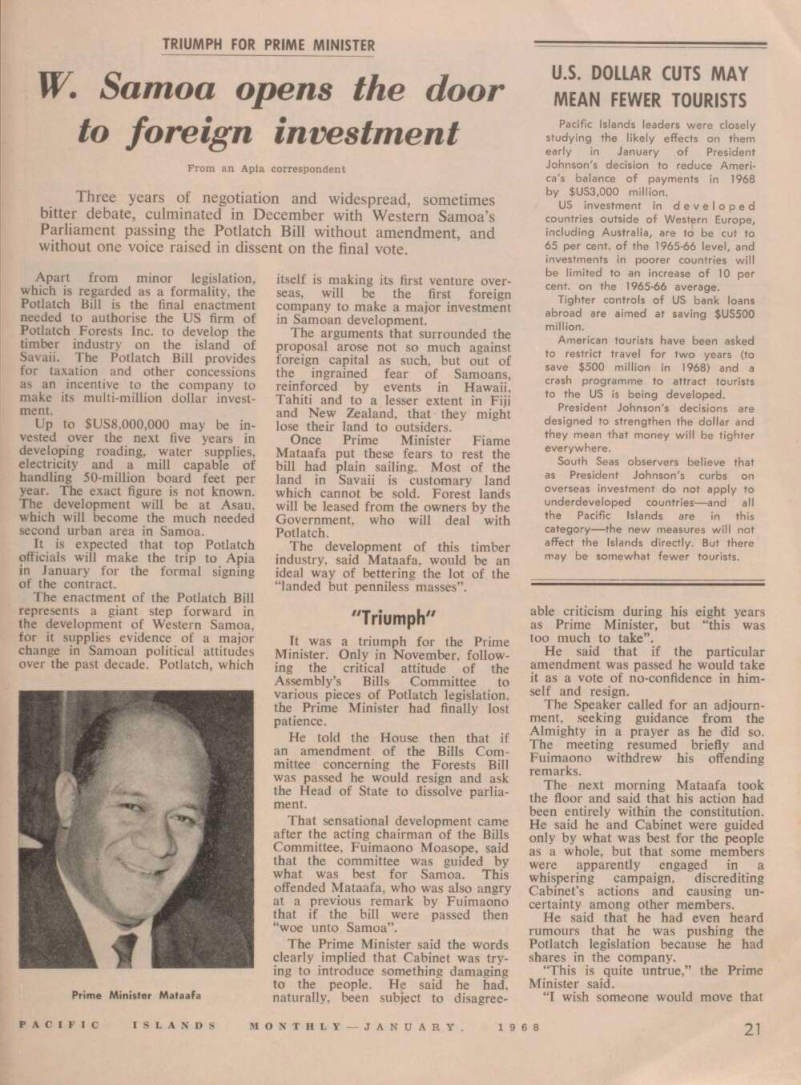
Prime Minister Mataafa
the sawmill be stopped, then we could arrive at a decision and save a lot of time after we have been working on this proposal for three years!”
One of the senior members, Pilia’e, asked the Prime Minister to with draw his ultimatum. Then the Speaker asked whether anyone wanted to move a motion of no con fidence. None was forthcoming and the debate continued. The amend ment was passed on the voices; but the Prime Minister had made his point.
That argument and the later debate in December proved what some Cabinet Ministers had been saying all along—that only the prestige of Mataafa would get the bill through the House.
Cabinet also to blame
But Cabinet must take its share of blame for the situation. Negotia tions have been in deep secret, and much of the hostility towards the Potlatch deal has stemmed from ignorance of just what was intended.
Opponents of Potlatch played on Samoan land fears to embarrass the Government.
In the debate in December the situation was much cooler. Most MP’s speaking on the bill saw in Potlatch the promise of a major impetus to a lagging economy. This was a remarkable change in attitudes from a short 10 years ago, when most members saw in foreign capital, tourism, and other develop ment projects, only a threat to the traditional way of life.
“The Government should do more to encourage such investors as Pot latch,” one member told the House.
Now that Potlatch has gained such decisive approval, other investors, eyeing the great untapped potential of the land and waters of Western Samoa, may not be far behind. See "First Japanese Investment in Samoa", p. 124.