for supersonics
p. 52 · Read in the full issue
Jumbos pave way for supersonics
routes Qantas was talking about was not said, but as the airline is the big gest based in the South Pacific, it is natural that this area should be benefiting from 747 schedules.
BOAC shouldn’t be too far behind, especially as its trans-South Pacific frequencies should be increased by 1970. But BOAC’s heavy trans- Atlantic runs will obviously be the first to use them.
The new Jumbos are about three times the size of the 707’s.
Compared with a big Boeing 707 the 747 will shape like this (747 figures first): cruising speed 625 mph, 575 mph; over 350 passengers, 134 passengers; cargo payload 200.000 lb, 85,000 lb; overall length 22Si ft, 153 ft; wingspan 1951 ft, 145£ ft.
Both planes have the same 6,000mile range but the 747 will fly up to 45.000 ft while the 707’s maximum is 42,000 ft.
Runways are where civil aviation authorities will have to get busy— while the 707 needs a 9,000 ft-odd strip, 747’s will require about 12,500 ft for economic operations over long stage flights.
Test flights in 1969
Building of the 747’s is the biggest commercial aircraft project yet under taken and, for that matter, one of the biggest construction jobs ever.
Assembly of parts and components began in Boeing’s Wichita, Kansas, plant early this year.
May, work began on the com pany’s huge aviation hangar at Everett, Washington, US. The hangar was due for completion this month— its capacity is bigger than the Saturn rocket vertical assembly building at Cape Kennedy, Florida.
May, 1968, is the date when the 747 will start to look like an aero plane and test flights will begin in 1969.
The programme, over a 12-year period, will mean 55,000 jobs in the US and an initial investment of about SUS 2 billion. Jumbos will sell at about SUS2O million each—without spares.
While the jet will fly only slightly faster than present-day jets it will carry many more people and open up opportunities for people who never flew before to take trips.
However, many aviation experts doubt if the airlines will fill their
747’s with people at current high fare prices and feel airlines will have to drop fares drastically to fill all the extra seats.
World-wide fares, including the South Pacific rates, could certainly take a hiding and many feel airlines have admitted this by fare cuts in the form of “Pacesetter Fares” and “Ex cursion Fares” giving a generous cut in air fares on various conditions.
But there is little chance of im mediate fare drops after the 747’s arrive, because, as airlines argue, the huge initial cost of introducing the 747’s must be recouped to some ex tent first. Also, the airlines hope the big aircraft will help them combat the rising costs in other directions.
Sir Giles Guthrie, chairman of BOAC, indicated this when he ar rived in Sydney in November.
He said airlines, through lATA, “should be able to take a look at fare reductions after the first two years of 747 operations”.
The jumbo-jets will fill the period before the arrival of the supersonic aircraft, such as the Concorde and the Boeing 2707, in the mid-70’s.
Qantas has made deposits to main tain delivery positions for six super sonic Boeing 2707’s and four Con cordes.
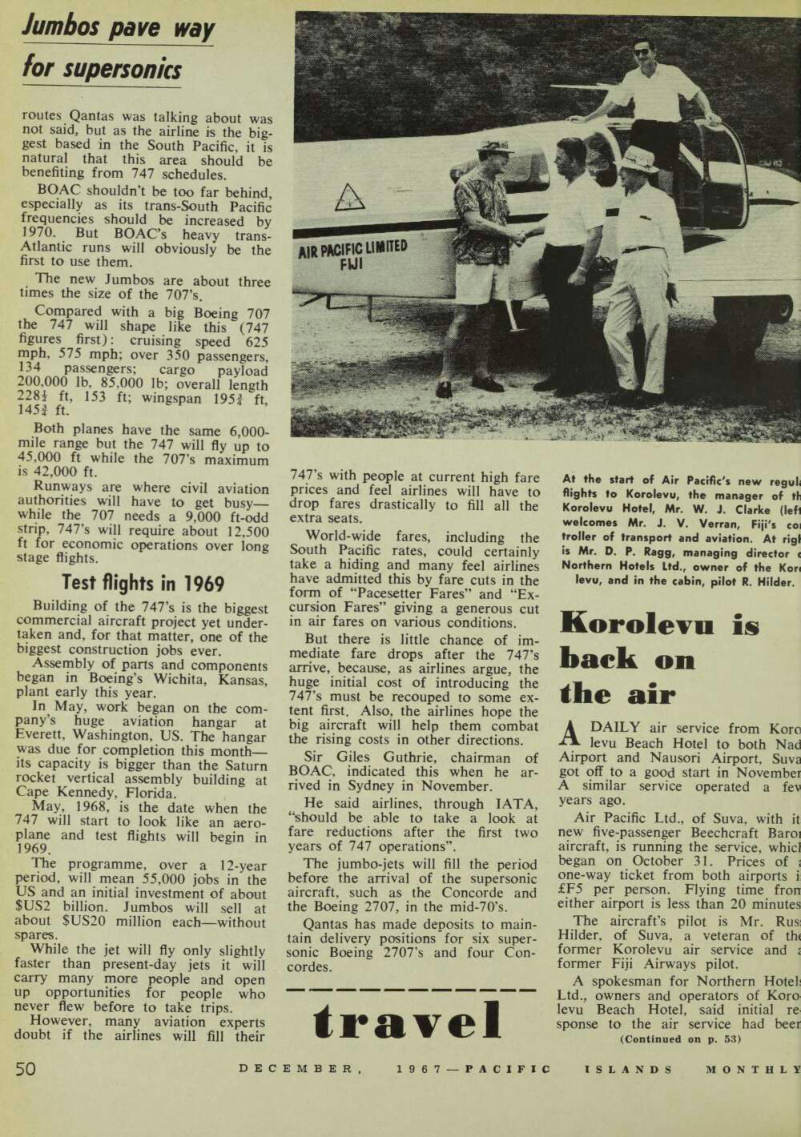
At the start of Air Pacific's new regula flights to Korolevu, the manager of th Korolevu Hotel, Mr. W. J. Clarke (left welcomes Mr. J. V. Verran, Fiji's con troller of transport and aviation. At rig! is Mr. D. P. Ragg, managing director [?] Northern Hotels Ltd., owner of the Koro levu, and in the cabin, pilot R. Hilder.