travel
p. 51 · Read in the full issue
The Jumbos
Are On
Their Way
By staff writer
Ken Mcgregor
First regular flights of the 350-plus passenger Boeing lumbo jets over the South Pacific are likely in mid-1970 on a low-frequency basis. Initially PanAm will fly 747’s once or ;wice a week from Los Angeles to Sydney or Melbourne, via Tonolulu and possibly Nadi Airport, Fiji.
however, before any stopovers of 747’s are made in the South :ific, major extensions will have to made to international airports in Pacific Islands. The four airports the running at this stage are nolulu, Nadi airport, Faaa ipeete) and Tafuna, Pago Pago, 3f these, Nadi and Honolulu stand : because they handle far greater jrnational air traffic in both sengers and freight.
PanAm, because it has lent money Boeing for the massive billion lar project to build the 747’5, will eive first delivery of the new jets late 1969, at least a month or two ore any other airline.
New York-London first
Hie American airline expects to ; the jets initially on its high isity New York-London run and it this trans-Atlantic route which will most capable of accommodating big increase in seats over current 1 jets.
PanAm has agreed to buy 25 747’5, h options for 10 more—an order rth SUS6OO million.
Qantas has ordered four 747’5, rth with extras SAI23 million, for ivery in 1971 and has options to y two more after 1972. BO AC > ordered six for 1970, with Lions to take up to 10 more. The
travel
airline in November received per mission to take delivery in 1972 of five of the 10 on option.
Air India has ordered about four Jumbos, due for delivery in late 1970 and 1971, but it’s not likely the airline will fly these jets on its Sydney-Fiji run because the weekly flights would not warrant such a big carrier. Air India will fly 747’s on its India-London runs.
The other international air carriers in the South Pacific—Air New Zealand, UTA and Canadian Pacific Airlines—have not placed any orders for the 747’s and are unlikely to do so.
Air New Zealand
Air New Zealand is more interested in building up its frequency of ser vices in the South Pacific with rela tively smaller DC9’s, and by the time the 747’s appear it hopes to have the Cook Islands going strong as a tourist centre, its trans-Pacific Tahiti run strengthened and Polynesian Airlines Limited, which it has an important interest in, a strong regional carrier servicing both Samoas, the Cooks, Fiji and Tonga with modern, possibly small-iet aircraft.
UTA would have to show a de
parture from its policy of buying Douglas aircraft instead of Boeing to plump for the 747’5. It also feels it is worth while waiting until the faster supersonic Anglo-French Concorde is in service, probably in 1972. UTA will buy the “stretch” DCS jets mean while.
Like Air New Zealand, UTA will probably prefer building up the fre quency of its runs and adding to the runs in the South Pacific in the next two years. A service from Tahiti to Santiago, Chile, via Easter Island, is not an impossibility for UTA because LAN-Chile, which services Easter Island, would dearly like to fly on to Tahiti to make its run commercial.
A Tahiti stop for Chile would give UTA valuable South American air rights.
Another future UTA run could be a return Noumea-Papeete route.
Canadian Pacific Airlines has ordered the “stretch” DCS jets, capable of carrying more passengers than the conventional DCS’s. With an “infrequency” of fortnightly trans pacific flights there is not a chance of CPA suddenly buying a Jumbo and flying Down Under.
Qantas in 1971
Qantas announced in mid- November it would buy the 747’s and said the “latter half” of 1971 would be the earliest time the jets could be introduced on its routes. Which
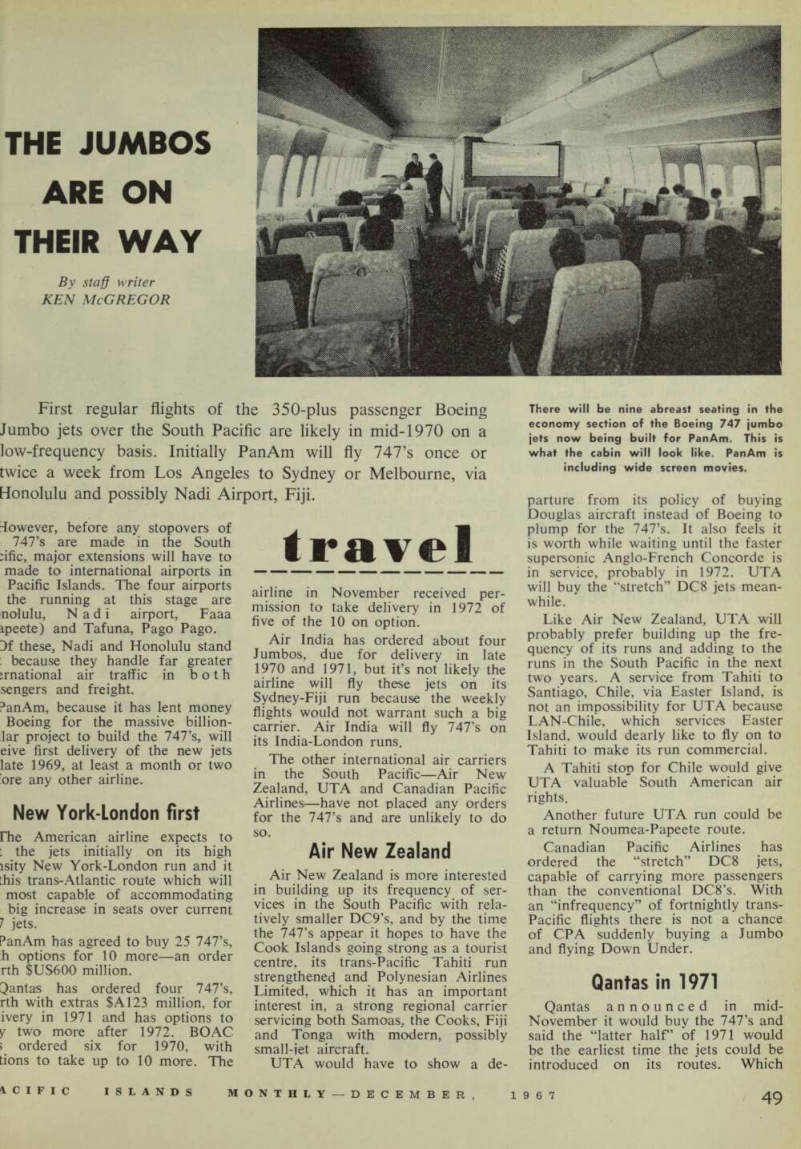
There will be nine abreast seating in the economy section of the Boeing 747 jumbo jets now being built for PanAm. This is what the cabin will look like. PanAm is including wide screen movies.