Lovely, honkytonk,
pp. 34-35 · Read in the full issue
Mehetia's female Crusoe returns
Mrs. Janine Rouillere, a 28-year old Frenchwoman, returned to Tahiti on November 9 after spending 37 days as a female Robinson Crusoe on usually uninhabited Mehetia Island, 60 miles east of Tahiti ( PIM, Nov., p. 30).
Mrs. Rouillere took the role of Robinson Crusoe after the owner of Mehetia, Mr. Terrie, sought a volunteer to live alone on his island for a month to prove that it was hospitable. She was put ashore there on October 3 by the inter-island vessel Tupuai Manu.
Apart from losing about 13 lb in weight and having a sore throat at one time, Mrs. Rouillere suffered no ill effects from her adventure, and said she enjoyed herself.
Meanwhile, two other people, who made news recently because of their desire to get away from it all on an uninhabited South Sea island, sailed from Suva in the inter-island ship Uluilakeba for Kabara Island in the Lau Group.
The couple are Mr. Bruce Johnson, 42, and Miss Shari Quam, 22 of Los Angeles {PIM, Nov., p. 31), who told the Press in Suva that they would spend five weeks at Kabara doing marine research for the Bishop Museum in Honolulu.
Later, they said, they hoped to go to a deserted island in American Samoa and spend three months there.
“Thus the monopoly exercised by the Bank of Western Samoa is a heavy brake upon the economy. It is amply demonstrated by domestic regulations in New Zealand, that the amount of capital available for over seas commitments is severely re stricted, so that any hope of releas ing more reserves for foreign com mercial enterprises, especially small local Samoan interests, must be very remote indeed.
“It is surely high time that the Government of Western Samoa in vited other banks—Australian, Eng lish or even American —to open branches in Western Samoa. Their reserves are enormous and from the increased trade and development that must follow the release of new cap ital which would thus be available to planters and businessmen, the Government of Western Samoa would reap benefits far exceeding those they now derive from their minority hold ing in the Bank of Western Samoa.
“Increased trade and expansion of business means, amongst other benefits, increased Customs revenue, and increased employment; both urgent needs to Samoa at this time.
Apart altogether from the stimulus of competition—a vital element in business—nothing but good can come from a diversification of banking in terests, and it is time that the Gov ernment of Western Samoa and their New Zealand advisers admitted it, and looked further afield than the present shaky situation of New Zea land’s finance at present permits. In deed, it would appear that the Prime Minister, Hon. Fiame Mata’afa, has already appreciated this in seeking capital in the US, Asia and elsewhere for Government projects. But the planters, and the ordinary people who could indirectly bring prosperity to Western Samoa, if given the chance, also need capital. The provision of such capital is the function of the trading banks, and the sooner banks, other than New Zealand-owned, are working in Western Samoa the sooner the economic situation will have a chance to improve.”
Lovely, honkytonk,
tin can Norfolk
IF there is anything Norfolk Island needs right now, it is the full time services of a competent, not necessarily brilliant, town planner— backed up by a strict set of building regulations.
The island needs them before any more “cardboard” stores or tinny duty free shops pop up on corners and cross roads, for the island could well become what one American visitor
described it as—“a great honky-toi village of tin cans”.
One of our men was over there tl other day en route to the Ne Hebrides and the Solomons, and i ported: “I saw tiny shops built eve few yards in the streets of Burnt Pir With garish signs, thin wood* frames and hastily cleared dirt driv ways, Burnt Pine looks more lil an ugly mining town than the sho ping centre of a South Pacific Islai as beautiful as Norfolk.”
Said one councillor: “This is pr gress and tourism at too great price.”
New Zealanders are being blam* for the upsurge of small shops ai flats. New Zealand’s econom squeeze has sent them off to Norfo] which they have found an Eldorat for new business ventures.
Recently the Australian Cover ment, which administers Norfolk one of its territories, finally approvi an immigration ordinance which w make it much harder for New Ze landers and Australians to migra there. The island’s permanent pop lation is now 1.150, which the loc£ say is quite enough.
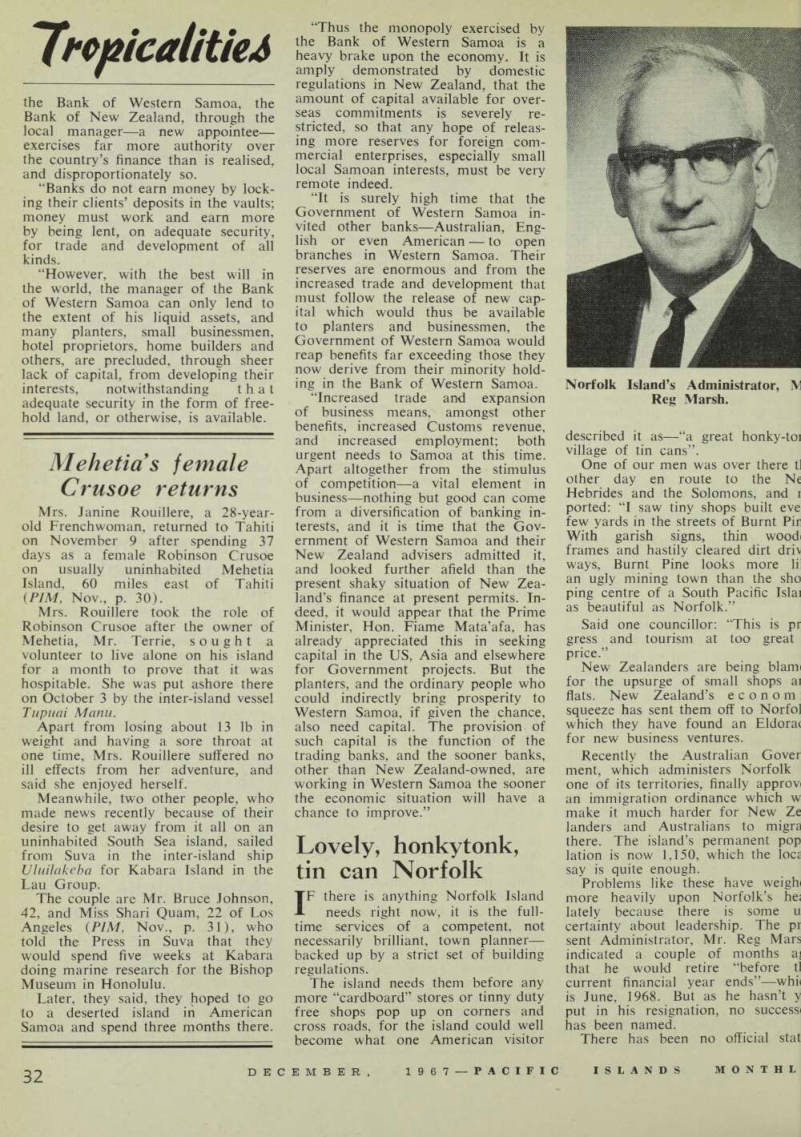
Problems like these have weighi more heavily upon Norfolk’s he; lately because there is some u certainty about leadership. The pr sent Administrator, Mr. Reg Mars indicated a couple of months a 3 that he would retire “before tl current financial year ends”—whi( is June, 1968. But as he hasn’t y put in his resignation, no success* has been named.
There has been no official stat
Norfolk Island’s Administrator, M Reg Marsh.
nt about why he is leaving, but the th seems to be that he has tried please both the Norfolk Islanders 1 Canberra, and pleased neither.
Meanwhile, the attitude on Nor k is moving towards ways of get g a greater say in domestic affairs the council. The locals say that k of a definite policy by Canberra harmful.
Fhis may be true, but as far as the rfolk Council is concerned it is lly a matter of chickens coming ne to roost. A few years ago the mcil was actually given a greater asure of autonomy than it now ;, but shortsightedly rejected it ;r a display of temper.
2a travel is
» relaxing
OU can’t wi n ’em all. In November, a twin-engined ;chcraft Queen Air A 65 light air ft which can carry 10 passengers de a series of flights in Tonga, ich has no internal air service. 2 flight was arranged by the dis >utors, De Havilland, of Sydney, demonstrate the kind of aircraft t might be suitable for a Tongan service. The Queen Air was on ivery flight from the US. fhe aircraft took King Taufa’ahau r Eua Island and back, and then the afternoon flew another party Vavau, Tonga’s northerly group, sre the Beechcraft won itself a he in Tonga’s aviation annals by ag the first aircraft to land, as yau has a new airstrip. But as the :raft was taxiing after landing, one the propellers touched a badly d mound of soil and was bent. !o pilot and passengers returned Nukualofa the next morning—in Union Steam Ship Company’s sel, Tofua.