Tropicalities
pp. 31-34 · Read in the full issue
American Samoa’s Governor Owen S. Aspinall landed him self in a sea of bother and stirred up some basic issues in the process when he ruled in October that a 28-year-old Korean fisherman, Hyon Kim, could not marry a 32-year-old Samoan girl, Miss Sa’oao Gaoteote.
The philosophy behind the ruling was that Samoa was for the Samoans, and that if the 4,000 Asian fishermen who use Pago Pago as a base were allowed to jump ship and intermarry, willy-nilly, with the local girls, Samoa would be de-Samoanised in no time.
Needless to say, Mr. Kim and Miss Gaoteote were not particularly in terested in the thoughts behind the Governor’s decision.
They merely wanted to get married.
And as love is apt to find a way when put to the test, it was not long before they had filed a suit in the High Court of American Samoa ask ing for an injunction against the Gov ernor’s decision.
They said in their suit that the decision was “arbitrary, unlawful, an abuse of authority, and a denial of due process under Section 2 of the Revised Constitution of American Samoa and under the Fifth Amend ment of the Constitution of the United States.”
It was also “invidiously descrim inatory,” it deprived them of their right to marry the person of their choice, and violated two sections in recently-passed US civil rights acts.
An answer to the suit, filed on the Governor’s behalf by the Attorney- General, Mr. Charles Habernigg, stated that there was a long-standing custom in American Samoa —concurred in and endorsed by the Gov ernor’s advisory council of Samoan chiefs —prohibiting the marriage of any Japanese, Chinese or Korean to an American Samoan.
At the end of October, it looked as if American Samoa was all set for a law case to test whether US law had precedence over American Samoa law, and, specifically, whether an appeal could be made against a decision of the High Court of Ameri can Samoa to a higher US court.
However, the Kim-Gaoteote case never reached the courts after all, for on November 6, after returning from a trip to the United States, Governor
Samoa for the
Samoans —and
one Korean
Aspinall reversed his earlier decision and gave the Korean-Samoan marriage his “blessing.”
At a meeting of his advisory coun cil of chiefs, the Governor, after ex plaining the reasoning behind his original decision, said: “I do not want Samoa to go on record as discriminating against any one.
“If there is any place on earth where black men, brown men, Oriental men and white men can live together harmoniously, it is right here in Samoa.
“But I have a firm conviction that this government should hold the line as long as possible in keeping Samoa for the Samoans. These islanders are faced with the challenge of keeping their land, their customs and their identity as the world rapidly closes in.”
Strong feelings
Governor Aspinall’s decision to allow the Korean-Samoan wedding was against the advice of most of his advisory chiefs, who expressed con cern that their islands would eventu ally be taken over by outsiders.
One chief said he hoped he would die before such a take-over took place.
Another said: “The Asians come here to catch fish, not our women.”
The president of the territory’s Senate, A. P. Lauvao-Lolo, subse quently announced that American Samoa planned to tighten up its already tight immigration laws to make it even more difficult for aliens to marry Samoan girls.
He said the inter-racial marriage
issue could not be understood with a superficial glance, but had to be studied in its historic and geographic contexts.
“No discrimination, as such, is in tended,” he went on. “We are simply trying to preserve Samoan culture and traditions on seven tiny islands whose total area is only 76.1 square miles, and most of that uninhabit able.
“The policy of Samoa for the Samoans was long ago initiated by the United States. That policy decrees that aliens cannot buy land here, nor can they start businesses without the consent of the Governor.
“We are seeing many rapid changes here, and we know change will come in this policy, but we see no reason to hasten it. We simply do not have the vast land area to assimilate a large number of aliens.
“As much as we can, we want to keep alive our cherished culture and traditions; and to protect our society we must tighten our immigration laws.”
Where the blind
lead the blind
Over in Tahiti where hotels have mushroomed and tourism has made enormous strides in the past five years, they have established a school for hotel apprentices so that young Tahitians entering the tourist trade will have some idea of the sort of service that tourists have come to expect.
So far, however, nothing has been
done to establish a school for tourist guides, and the result is that the grow ing number of tourists are subjected to some appalling morsels of mis information.
In November, we were prowling around Point Venus where Captain Cook observed the transit of Venus in 1769 when we overheard a grand motherly American tourist ask her guide: “And what happened to Cap tain Cook in the end?”
Unhesitatingly, but with mag nificent confusion over the French navigator La Perouse and her last Sunday dinner, the guide replied: “Oh, he was boiled and eaten at a little island called Vanikoro.”
Larger than
life size
AN unhappy small businessman wrote to a Sydney newspaper recently, complaining about the large size of the postage stamps being sold these days at Australian post
offices. He said that nobody ga\ him regular-sized stamps any moi —he received over-size special issu( whether he liked it or not, and ra out of spit and patience when usir them.
The Sydney man made a goo point. But he hasn’t got much t complain about until he has see what they’ve been doing to Islanc stamps. New Islands issues are rol ing off the presses to take advantaj of the philatelic boom, and eac stamp seems to be a size larger tha the previous one. It’s got to tf point where there is hardly room f address the envelope.
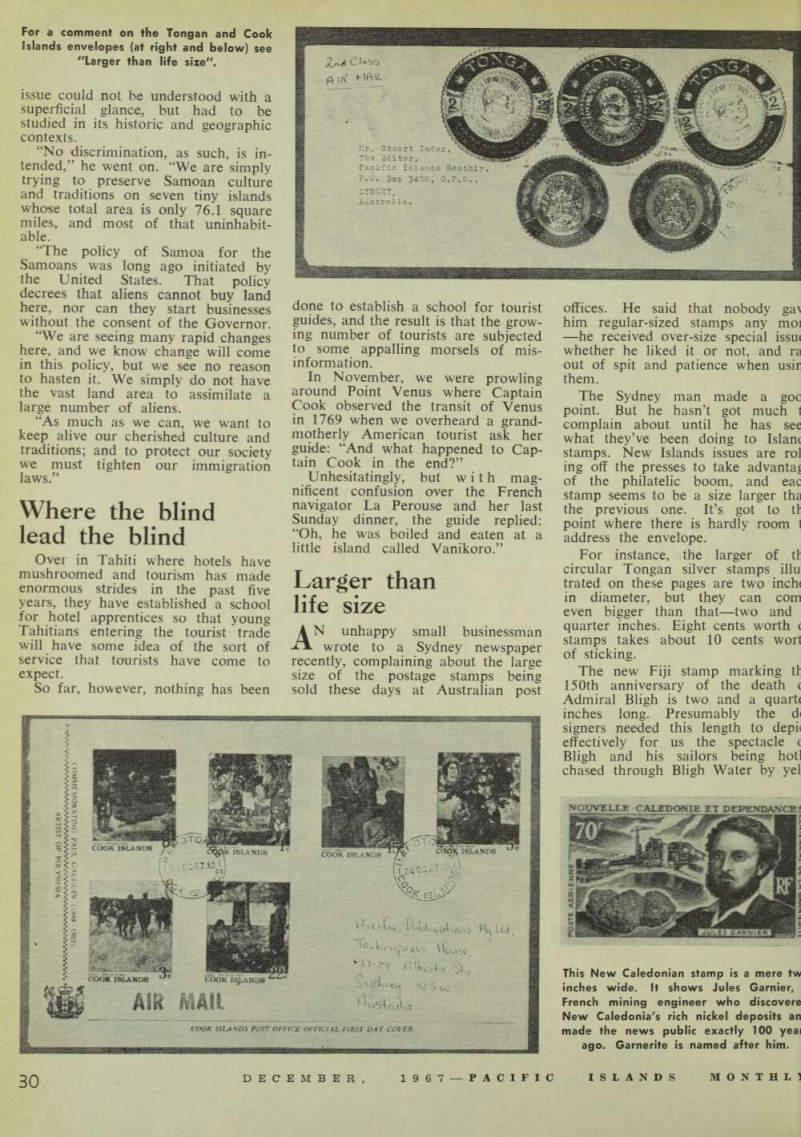
For instance, the larger of th circular Tongan silver stamps illu trated on these pages are two inch< in diameter, but they can com even bigger than that—two and quarter inches. Eight cents worth ( stamps takes about 10 cents wort of sticking.
The new Fiji stamp marking th 150th anniversary of the death c Admiral Bligh is two and a quarh inches long. Presumably the d< signers needed this length to depi< effectively for us the spectacle c Bligh and his sailors being hotl chased through Bligh Water by yel
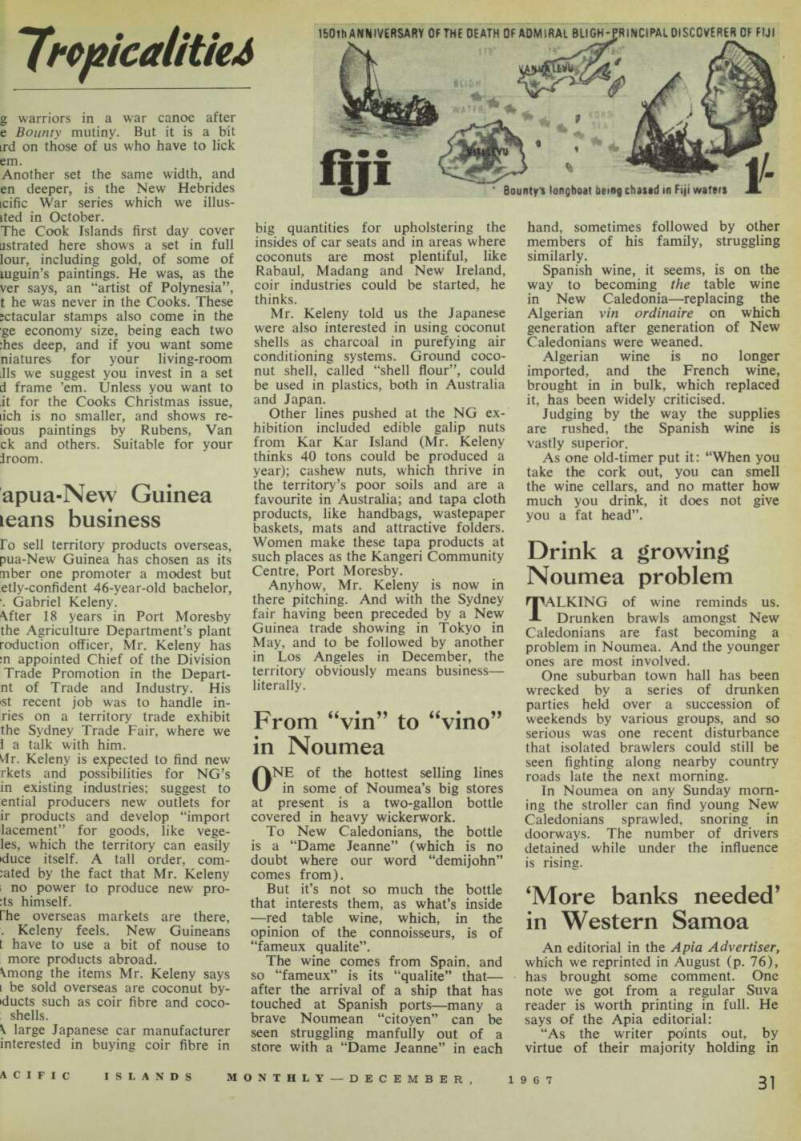
For a comment on the Tongan and Cook Islands envelopes (at right and below) see "Larger than life size".
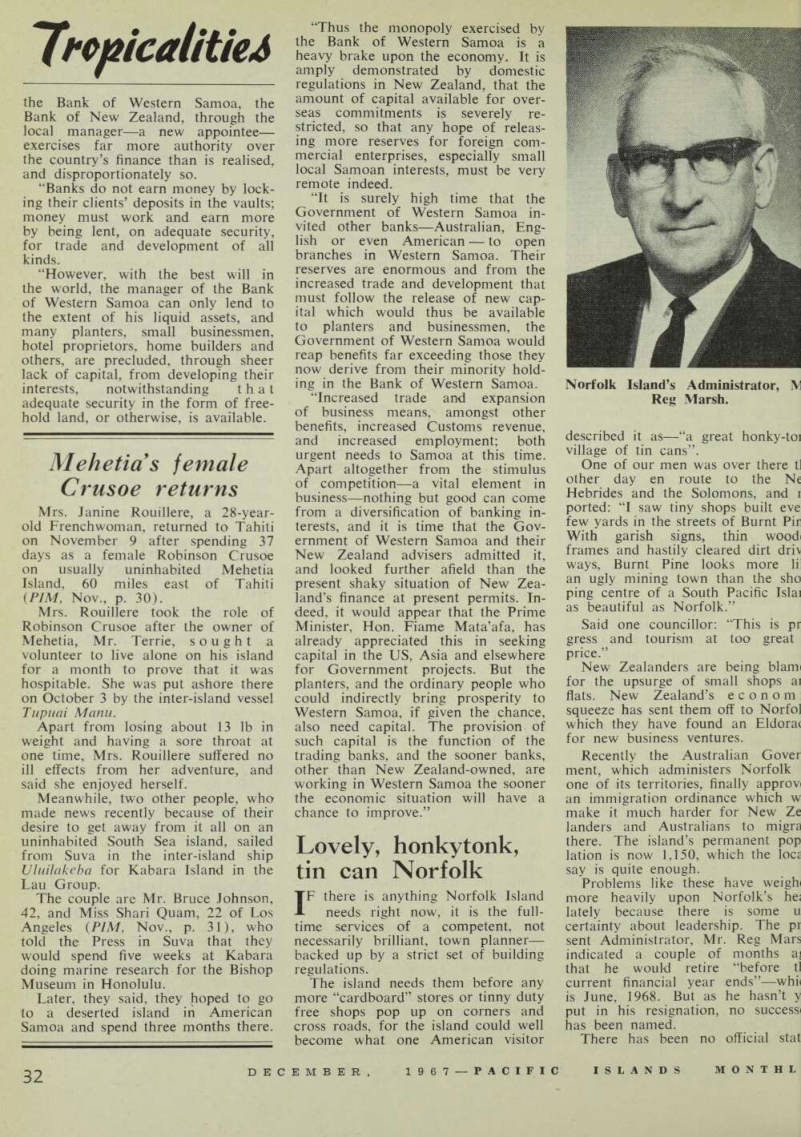
This New Caledonian stamp is a mere two inches wide. It shows Jules Gamier, French mining engineer who discovere New Caledonia's rich nickel deposits an made the news public exactly 100 yeai ago. Garnerite is named after him.
g warriors in a war canoe after e Bounty mutiny. But it is a bit ird on those of us who have to lick em.
Another set the same width, and en deeper, is the New Hebrides icific War series which we illus ited in October.
The Cook Islands first day cover astrated here shows a set in full lour, including gold, of some of mguin’s paintings. He was, as the ver says, an “artist of Polynesia”, t he was never in the Cooks. These jctacular stamps also come in the ge economy size, being each two :hes deep, and if you want some niatures for your living-room ills we suggest you invest in a set d frame ’em. Unless you want to it for the Cooks Christmas issue, lich is no smaller, and shows re ious paintings by Rubens, Van ck and others. Suitable for your iroom.
apua-New Guinea
leans business
Fo sell territory products overseas, pua-New Guinea has chosen as its mber one promoter a modest but etly-confident 46-year-old bachelor, '. Gabriel Keleny, \fter 18 years in Port Moresby the Agriculture Department’s plant reduction officer, Mr. Keleny has :n appointed Chief of the Division Trade Promotion in the Depart nt of Trade and Industry. His st recent job was to handle in ries on a territory trade exhibit the Sydney Trade Fair, where we i a talk with him.
Mr. Keleny is expected to find new rkets and possibilities for NG’s in existing industries; suggest to ential producers new outlets for ir products and develop “import lacement” for goods, like vege les, which the territory can easily ►duce itself. A tall order, com :ated by the fact that Mr. Keleny ; no power to produce new pro ds himself. fhe overseas markets are there, . Keleny feels. New Guineans t have to use a bit of nouse to more products abroad. \mong the items Mr. Keleny says i be sold overseas are coconut by >ducts such as coir fibre and coco ; shells.
V large Japanese car manufacturer interested in buying coir fibre in
big quantities for upholstering the insides of car seats and in areas where coconuts are most plentiful, like Rabaul, Madang and New Ireland, coir industries could be started, he thinks.
Mr. Keleny told us the Japanese were also interested in using coconut shells as charcoal in purefying air conditioning systems. Ground coco nut shell, called “shell flour”, could be used in plastics, both in Australia and Japan.
Other lines pushed at the NG ex hibition included edible galip nuts from Kar Kar Island (Mr. Keleny thinks 40 tons could be produced a year); cashew nuts, which thrive in the territory’s poor soils and are a favourite in Australia; and tapa cloth products, like handbags, wastepaper baskets, mats and attractive folders.
Women make these tapa products at such places as the Kangeri Community Centre, Port Moresby.
Anyhow, Mr. Keleny is now in there pitching. And with the Sydney fair having been preceded by a New Guinea trade showing in Tokyo in May, and to be followed by another in Los Angeles in December, the territory obviously means business— literally.
From “vin” to “vino”
in Noumea
ONE of the hottest selling lines in some of Noumea’s big stores at present is a two-gallon bottle covered in heavy wickerwork.
To New Caledonians, the bottle is a “Dame Jeanne” (which is no doubt where our word “demijohn” comes from).
But it’s not so much the bottle that interests them, as what’s inside —red table wine, which, in the opinion of the connoisseurs, is of “fameux qualite”.
The wine comes from Spain, and so “fameux” is its “qualite” that— after the arrival of a ship that has touched at Spanish ports—many a brave Noumean “citoyen” can be seen struggling manfully out of a store with a “Dame Jeanne” in each
hand, sometimes followed by other members of his family, struggling similarly.
Spanish wine, it seems, is on the way to becoming the table wine in New Caledonia —replacing the Algerian vin ordinaire on which generation after generation of New Caledonians were weaned.
Algerian wine is no longer imported, and the French wine, brought in in bulk, which replaced it, has been widely criticised.
Judging by the way the supplies are rushed, the Spanish wine is vastly superior.
As one old-timer put it: “When you take the cork out, you can smell the wine cellars, and no matter how much you drink, it does not give you a fat head”.
Drink a growing
Noumea problem
TALKING of wine reminds us.
Drunken brawls amongst New Caledonians are fast becoming a problem in Noumea. And the younger ones are most involved.
One suburban town hall has been wrecked by a series of drunken parties held over a succession of weekends by various groups, and so serious was one recent disturbance that isolated brawlers could still be seen fighting along nearby country roads late the next morning.
In Noumea on any Sunday morn ing the stroller can find young New Caledonians sprawled, snoring in doorways. The number of drivers detained while under the influence is rising.
‘More banks needed’
in Western Samoa
An editorial in the Apia Advertiser, which we reprinted in August (p. 76), has brought some comment. One note we got from a regular Suva reader is worth printing in full. He says of the Apia editorial: “As the writer points out, by virtue of their majority holding in
the Bank of Western Samoa, the Bank of New Zealand, through the local manager—a new appointee— exercises far more authority over the country’s finance than is realised, and disproportionately so.
“Banks do not earn money by lock ing their clients’ deposits in the vaults; money must work and earn more by being lent, on adequate security, for trade and development of all kinds.
“However, with the best will in the world, the manager of the Bank of Western Samoa can only lend to the extent of his liquid assets, and many planters, small businessmen, hotel proprietors, home builders and others, are precluded, through sheer lack of capital, from developing their interests, notwithstanding that adequate security in the form of free hold land, or otherwise, is available.