interest in Papuan oils
pp. 127-130 · Read in the full issue


Business send
Development
Shares rise following renewed interest in Papuan oils
search for oil in and around Papua has resumed in a big way. Three huge corporations—Esso, British Petro um and Phillips—will spend up to $lO million looking for oil i the Papuan mainland and $l4 million over a two-year >riod off-shore drilling in the Gulf of Papua.
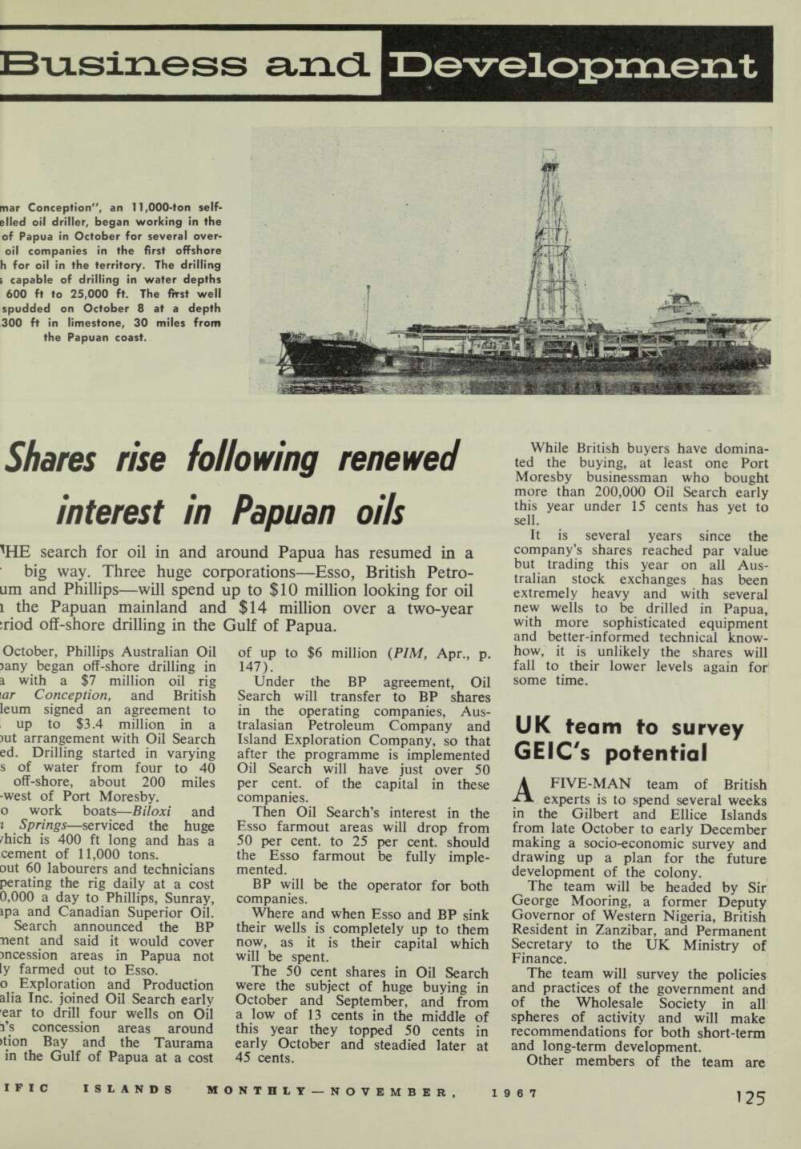
October, Phillips Australian Oil )any began off-shore drilling in a with a $7 million oil rig ar Conception, and British leum signed an agreement to up to $3.4 million in a )ut arrangement with Oil Search ed. Drilling started in varying s of water from four to 40 off-shore, about 200 miles -west of Port Moresby. 0 work boats —Biloxi and 1 Springs —serviced the huge diich is 400 ft long and has a cement of 11,000 tons. out 60 labourers and technicians perating the rig daily at a cost 0,000 a day to Phillips, Sunray, ipa and Canadian Superior Oil.
Search announced the BP nent and said it would cover mcession areas in Papua not ly farmed out to Esso, o Exploration and Production alia Inc. joined Oil Search early ear to drill four wells on Oil a’s concession areas around >tion Bay and the Taurama in the Gulf of Papua at a cost
of up to S 6 million ( PIM , Apr., p. 147).
Under the BP agreement, Oil Search will transfer to BP shares in the operating companies, Aus tralasian Petroleum Company and Island Exploration Company, so that after the programme is implemented Oil Search will have just over 50 per cent, of the capital in these companies.
Then Oil Search’s interest in the Esso farmout areas will drop from 50 per cent, to 25 per cent, should the Esso farmout be fully imple mented.
BP will be the operator for both companies.
Where and when Esso and BP sink their wells is completely up to them now, as it is their capital which will be spent.
The 50 cent shares in Oil Search were the subject of huge buying in October and September, and from a low of 13 cents in the middle of this year they topped 50 cents in early October and steadied later at 45 cents.
While British buyers have domina ted the buying, at least one Port Moresby businessman who bought more than 200,000 Oil Search early this year under 15 cents has yet to sell.
It is several years since the company’s shares reached par value but trading this year on all Aus tralian stock exchanges has been extremely heavy and with several new wells to be drilled in Papua, with more sophisticated equipment and better-informed technical know how, it is unlikely the shares will fall to their lower levels again for some time.
UK team to survey
GEIC's potential
A FIVE-MAN team of British experts is to spend several weeks in the Gilbert and Ellice Islands from late October to early December making a socio-economic survey and drawing up a plan for the future development of the colony.
The team will be headed by Sir George Mooring, a former Deputy Governor of Western Nigeria, British Resident in Zanzibar, and Permanent Secretary to the UK Ministry of Finance.
The team will survey the policies and practices of the government and of the Wholesale Society in all spheres of activity and will make recommendations for both short-term and long-term development.
Other members of the team are
[?]mar Conception", an 11,000-ton self [?]elled oil driller, began working in the of Papua in October for several over fill oil companies in the first offshore [?]h for oil in the territory. The drilling [?] capable of drilling in water depths [?] 600 ft to 25,000 ft. The first well spudded on October 8 at a depth 300 ft in limestone, 30 miles from the Papuan coast.
[essrs. Dennis Hollos, J. Inman, eorge Mcßobie and J. J. Keigwin.
Mr. Inman, who is now in the cono m i c Department of the ommonwealth Office, was previously conomic Adviser to the Secretary : State for the Colonies. His brief ill be economic and fiscal affairs i the GEIC.
Mr. Keigwin will examine the ElC’s education, health and social jvelopment.
id moan soap factory
iff to good start
VESTERN Samoa’s soap factory, which started production of undry soap early this year and put 5 first toilet soap on the market September, is doing good business.
General manager of Western imoa Trust Estates Corporation, ho built the factory, P. W. Kelly, ported that in the first two weeks ; September the sales of laundry iap had broken all records, and the les of toilet soap had “exceeded all :pectation.”
In that period the factory sold 400 cartons, each containing 28 irs, of laundry soap; and 26,760 ikes of toilet soap. Factory man ner G. Werner said he hoped that ;fore long the factory would be sup ying all Samoa’s soap requirements, nports of soap in 1966 amounted to rtr $lOO,OOO.
?opra market
ases slightly
CONTINUING good prices in late J September resulted in an 'erage monthly price of £Stg.7l/7/6 i.f. UK/Continent to be applied gainst October shipments, the ;puty chairman of the P-NG Copra [arketing Board, Mr. K. G. Oliver, id in Port Moresby on October 20.
Mr. Oliver said the upward trend mtinued strongly into the first half : October when prices, after reach g a high of £Stg.7B/8/8, eased imewhat.
He went on: “During the months : June and July the appreciable jcline in the supplies of laurics to ic two most important consuming eas in the world continued. Western uropean gross imports of the com ined copra and coconut oil during le two months were about un langed from the previous year but : the same time the imports of jmbined palm kernels and kernel il were down sharply.
“The total imports of the four
commodities declined about 20,00 G tons oil basis or 12.3 per cent, with practically all of the decline on account of palm kernels.
“The cumulative total for the first seven months of this year again shows the sharpest decline for palm kernels, though copra imports into West Europe and the US were also down appreciably.
“The reason for this development is twofold—the sharp decline in Philippine copra production with the corresponding reduction in exports from that source, and the civil war in Nigeria which has affected ship ments of palm kernels from the Eastern region and partly also from the mid-Western region.
“However, the overall supply position in laurics is currently expec ted to take a turn for the better with Philippine exports already showing signs of a sharp recovery.
“There remains the question of whether an improvement in the Nigerian situation is also imminent.
“Even though peace may be re stored soon it is believed by the Nigerian Federal authorities that a return to the normal export position could take up to a year, with for example, the necessity to reconstruct the docks at Port Harcourt.”
"Fair profit rise"
expected for BP's
DESPITE a drop in profits for w.
R. Carpenter and only a marginal profit increase for Steamships, Burns Philp and Co. Ltd., is expected to show a fair profit rise when its accounts are announced early in November. Indications of this were to be seen in the accounts of BP sub sidiaries which were to hand in October.
Nevertheless, many shareholders were apprehensive about BP’s results and in late October the BP $1 shares fell to the year’s low of $3.50 on Sydney and Melbourne Exchanges.
Carpenter’s comments on lower turnovers in Fiji, and BP’s loss of its shipping subsidy (see pp. 24 and 133) obviously influenced the share market, but it must be not forgotten that BP’s has a large and rich invest ment portfolio.
At balance date last year, the company held almost $39 million worth of shares in other companies, while net book assets were worth $4.83 a share—well above market estimation.
Last year’s profits—ss,o93,ooo— more than a full year. • More news of business and develop ment appears on p. 133.