Cruising Yachts
pp. 105-118 · Read in the full issue
Pacific Shipping And
Underwater blasting opens up new sea lanes in Fiji
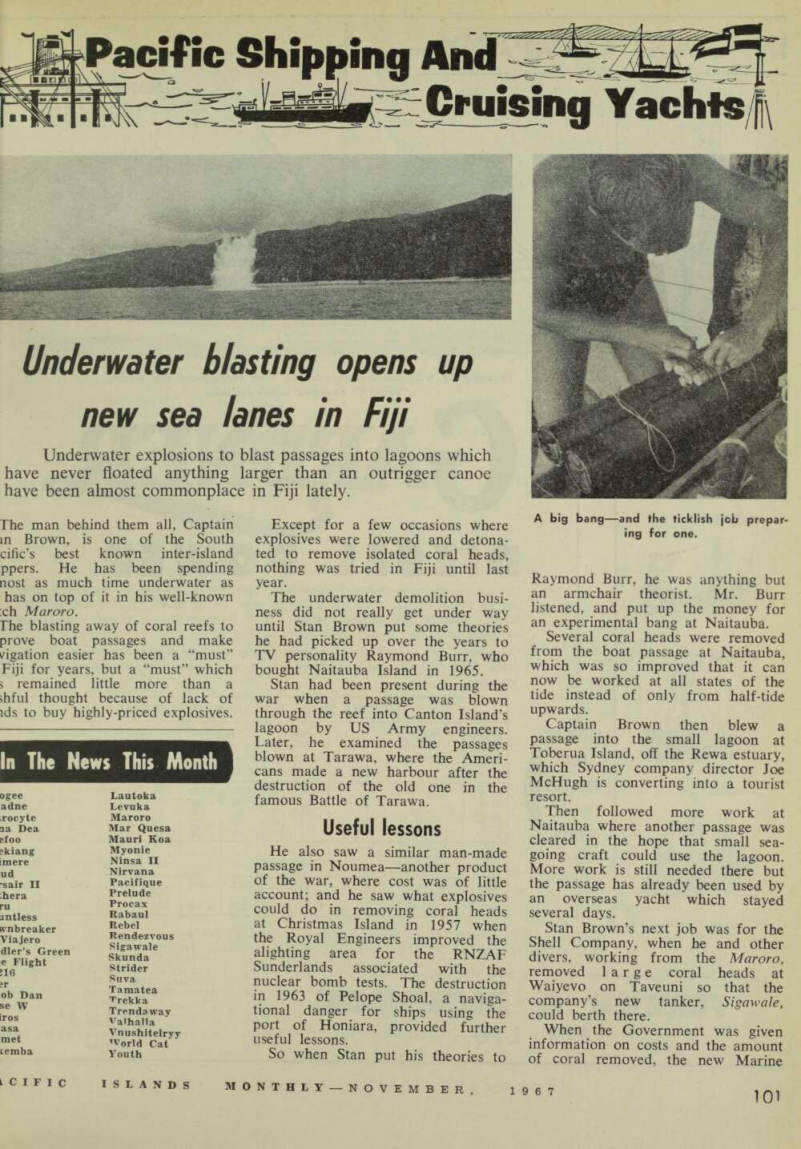
Underwater explosions to blast passages into lagoons which have never floated anything larger than an outrigger canoe have been almost commonplace in Fiji lately.
The man behind them all, Captain in Brown, is one of the South cific’s best known inter-island ppers. He has been spending nost as much time underwater as has on top of it in his well-known :ch Maroro.
The blasting away of coral reefs to prove boat passages and make ligation easier has been a “must”
Fiji for years, but a “must” which 5 remained little more than a >hful thought because of lack of ids to buy highly-priced explosives.
Except for a few occasions where explosives were lowered and detona ted to remove isolated coral heads, nothing was tried in Fiji until last year.
The underwater demolition busi ness did not really get under way until Stan Brown put some theories he had picked up over the years to TV personality Raymond Burr, who bought Naitauba Island in 1965.
Stan had been present during the war when a passage was blown through the reef into Canton Island’s lagoon by US Army engineers.
Later, he examined the passages blown at Tarawa, where the Ameri cans made a new harbour after the destruction of the old one in the famous Battle of Tarawa.
Useful lessons
He also saw a similar man-made passage in Noumea—another product of the war, where cost was of little account; and he saw what explosives could do in removing coral heads at Christmas Island in 1957 when the Royal Engineers improved the alighting area for the RNZAF Sunderlands associated with the nuclear bomb tests. The destruction in 1963 of Pelope Shoal, a naviga tional danger for ships using the port of Honiara, provided further useful lessons.
So when Stan put his theories to
Raymond Burr, he was anything but an armchair theorist. Mr. Burr listened, and put up the money for an experimental bang at Naitauba.
Several coral heads were removed from the boat passage at Naitauba, which was so improved that it can now be worked at all states of the tide instead of only from half-tide upwards.
Captain Brown then blew a passage into the small lagoon at Toberua Island, off the Rewa estuary, which Sydney company director Joe McHugh is converting into a tourist resort.
Then followed more work at Naitauba where another passage was cleared in the hope that small sea going craft could use the lagoon.
More work is still needed there but the passage has already been used by an overseas yacht which stayed several days.
Stan Brown’s next job was for the Shell Company, when he and other divers, working from the Maroro, removed large coral heads at Waiyevo on Taveuni so that the company’s new tanker, Sigawale, could berth there.
When the Government was given information on costs and the amount of coral removed, the new Marine
A big bang—and the ticklish job prepar ing for one.
partment employed the Maroro n to carry out underwater lolition elsewhere.
"he first job was to improve the ranee to the lagoon at Fulaga nd in the Lau Group. Several al heads were shattered, includ one which has accounted for jral local vessels, and now some the largest inter-island ships can into the lagoon, where previously f would have needed wings, leads have also been removed in ;ral boat passages at Kabara nd (Lau Group) and the anchor has been improved out of all ignition. n the islands where blasting has n place, the Fijians have been icing both for the better shipping ities and because each big bang s its toll of fish. Islanders have :r had so much fish with so little -t. larks have caught on too. They : learned that a big bang means eal, and no sooner has the spray sd down after an explosion than race in for the harvest, hey put on a polished performance Naitauba and Fulaga where olition work went on for days, before the last bang the sharks worked out the modus operandi remarkable degree.
At Waiyevo, a large black whaler shark made a practice of working the area early in the morning and taking any fish that were lying on the bottom.
Meanwhile, the Maroro divers have become aquatic explosion experts and they’ll go anywhere.
The only thing that stops them from doing even more work than they do is the price of explosives— £ 1,000-worth of commercial ex plosives is soon used up.
Last Of Carpenter
Ships Goes To Bottom
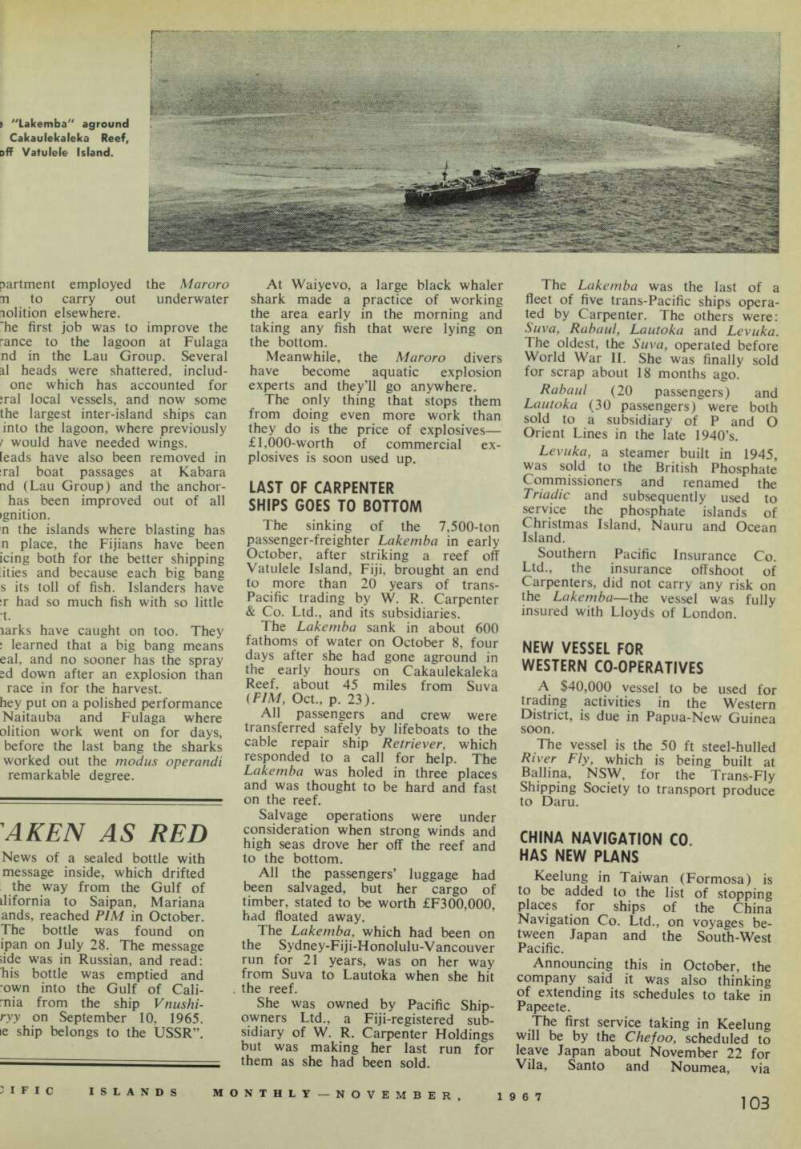
The sinking of the 7,500-ton passenger-freighter Lakemba in early October, after striking a reef off Vatulele Island, Fiji, brought an end to more than 20 years of trans pacific trading by W. R. Carpenter & Co. Ltd., and its subsidiaries.
The Lakemba sank in about 600 fathoms of water on October 8, four days after she had gone aground in the early hours on Cakaulekaleka Reef, about 45 miles from Suva (PIM, Oct., p. 23).
All passengers and crew were transferred safely by lifeboats to the cable repair ship Retriever, which responded to a call for help. The Lakemba was holed in three places and was thought to be hard and fast on the reef.
Salvage operations were under consideration when strong winds and high seas drove her off the reef and to the bottom.
All the passengers’ luggage had been salvaged, but her cargo of timber, stated to be worth £F300,000, had floated away.
The Lakemba, which had been on the Sydney-Fiji-Honolulu-Vancouver run for 21 years, was on her way from Suva to Lautoka when she hit the reef.
She was owned by Pacific Ship owners Ltd., a Fiji-registered sub sidiary of W. R. Carpenter Holdings but was making her last run for them as she had been sold.
The Lakemba was the last of a fleet of five trans-Pacific ships opera ted by Carpenter. The others were: Suva, Rabaul, Lautoka and Levuka.
The oldest, the Suva, operated before World War 11. She was finally sold for scrap about 18 months ago.
Rabaul (20 passengers) and Lautoka (30 passengers) were both sold to a subsidiary of P and O Orient Lines in the late 1940’5.
Levuka, a steamer built in 1945, was sold to the British Phosphate Commissioners and renamed the Triadic and subsequently used to service the phosphate islands of Christmas Island, Nauru and Ocean Island.
Southern Pacific Insurance Co.
Ltd., the insurance offshoot of Carpenters, did not carry any risk on the Lakemba —the vessel was fully insured with Lloyds of London.
New Vessel For
Western Co-Operatives
A $40,000 vessel to be used for trading activities in the Western District, is due in Papua-New Guinea soon.
The vessel is the 50 ft steel-hulled River Fly, which is being built at Ballina, NSW, for the Trans-Fly Shipping Society to transport produce to Daru.
China Navigation Co.
Has New Plans
Keelung in Taiwan (Formosa) is to be added to the list of stopping places for ships of the China Navigation Co. Ltd., on voyages be tween Japan and the South-West Pacific.
Announcing this in October, the company said it was also thinking of extending its schedules to take in Papeete.
The first service taking in Keelung will be by the Chefoo, scheduled to leave Japan about November 22 for Vila, Santo and Noumea, via
[?] "Lakemba" aground [?] Cakaulekaleka Reef, off Vatulele Island.
Keelung, Hong Kong and Papua-Ne Guinea ports.
A company spokesman said tl new service would reduce the freigl cost of commodities imported froi Taiwan, as cargo shipped at Keelur would be freighted at the direct rat i.e., the same rate as from Hor Kong.
“This represents a substantial sa ing over the amount of freight pa in the past when cargo was tra] shipped at Hong Kong,” the spoke man said.
“As most Taiwan products a] fairly competitively priced, it hoped that this new facility will h crease trade between the two areas Referring to the service which mi extend to Papeete, the spokesme said that the China Navigation C was keenly interested in the area.
It was proposed that the Chekian scheduled to leave Japan on Nover ber 5 and Hong Kong on Novemb 13, would call at Papeete, Pago Pag Apia and Suva after Papua-Ne Guinea ports.
The direct service to the area w eliminate transhipment of cargo Sydney.
The sailing of the Chekiang fro Japan will provide a pre-Christm delivery to Tahiti.
The spokesman said that if tl Chekiang’s voyage indicated a ne< for a regular service, the compai would give that question “vei serious consideration”.
Satellite Tracking
Team On Pitcairn
A six-man satellite tracking tea for the American Army Map servi has set up a base on Pitcairn Islai for six months.
The team arrived in the US Arr vessel FS 216 on July 15, and toi a week, with the Pitcairners’ he] to unload their gear and equipme and to set up camp at Palau Valle
French Liner On First
South Pacific Voyage
A Messageries Maritimes pi senger-cargo liner, which has be renamed Pacifique, left Marseil] on September 29 on her first voya to the South Pacific.
Formerly called Vietnam, t Pacifique was previously on the co pany’s Far East run. She is of 15,1 tons, is air-conditioned, carries 4 passengers, and has a speed of knots.
The Pacifique is due in Sydney < November 6, via Panama, Papet and Noumea. She will return Marseilles via Cape Town.
A Messageries Maritimes spok< man in Sydney said in October tt
decision had yet been made to the ship on a regular South ific run. he Pacifique is the second Messa es ship of that name—the first g part of the company’s fleet i 1899 to 1925.
Rehouse Will Ease
I 0 Pago Congestion
is underway on a new ),000 main dock transit ware >e at Pago Pago, designed to end e shortages in storage facilities *ago Pago’s docks.
Department of Public Works esman said in late September the new warehouse should be tied in eight months, ic warehouse will have about 00 square feet of floor space. : of this will be for general ly offices and cargo storage ities, and the other half for es, bonded storage, refrigeration ts and general storage, argoes handled will be those just 3aded from ships or cargoes ing to be loaded.
Ualofa's New
Ir? Opened
a colourful ceremony attended nore than 3,000 Tongans, King a’ahau Tupou IV opened the million Queen Salote Memorial rf at Ma’ufanga, Nukualofa, on ber 11. The day was the 49th /ersary of the coronation of the Queen Salote. ic new wharf extends more than yards from the shore along a
bitumen dual carriageway. It is of steel and reinforced concrete—the front stage being 300 ft across, with a depth of 40 ft at low water.
The main contractors, George Drew, of Oldham, England, removed large sections of the surrounding reef to enable liners of up to 50,000 tons to be accommodated.
By attracting larger ships and more frequent visits, the wharf is expected to give a big fillip to the export of copra and bananas, and also to the development of tourism.
It was designed by Messrs. Sand ford Fawcett, Wilton and Bell, of London, who have also undertaken major contracts in Fiji, the new Hebrides, the Solomons, the Gilbert and Elice Isands, and Pitcairn Island.
Work began in June, 1962.
The builders were Dew and Company.
Opening the wharf, the king said it was the largest single project ever completed in Tonga. It would place Tonga squarely on the main shipping routes from Europe and America to New Zealand and Australia. This
would most certainly attract more shipping to Tonga.
The king said that Tonga’s main roads were on the ocean, not high ways throughout the land as in the major Pacific Islands, “On this day Tonga is coming off the dirt road and travelling on the main highway,” he added.
The king unveiled a memorial plaque to Queen Salote, which was mounted on a 10-ton boulder, re covered from the sea floor recently by divers working on the project.
Motor Vessel For
New Ireland
The New Ireland Transport Society Ltd., took delivery of its new Si 40,000 70 ft motor vessel Ninsa 11 in Port Moresby in late September.
Built at Ballina, New South Wales, the Ninsa II will service New Ireland, Manus, New Britain and Bougain ville co-operatives, carrying general cargo and produce. Its owners are based at Kavieng, New Ireland, and represent 50 co-operative societies in the New Ireland District.
The "Pacifique" is a replica of her sister ship "Cambodge" pictured here.
cs under the name of the Amaz- Diabolo. ighlight is owned by John and id Glennie, of Blenheim, NZ, have been cruising the Pacific ; May, 1965. le Amazing Diabolo is a young ’ Zealand magician and hypnotist, lard Reid, who has worked pro onally in 17 countries.
TAMATEA, 48 ft sloop, left i on October 17 for Auckland, pered by her owner, Mr. Ross irane. imatea was formerly owned by Heath Hemphill, secretary of Defence Club, Suva, tie sloop was forced back to Suva lay by bad weather while on her attempted delivery voyage to kland ( PIM, June, p. 115).
KAIROS, 32 ft steel-hulled p with Mr. and Mrs. E. Koch, 'ed back in Hamburg, Germany, ntly after a circumnavigation— [ght to be the first ever by a nan couple. airos was in the Pacific in )-66. Her calls included Suva and avu. Fiji, New Zealand, Noumea Port Moresby.
MAR QUESA, 40 ft ketch i California with owner-skipper Harold Whilldin. his wife Pat crewman, Jamie Lopez, reached s on August 28, but was not wed to berth because she had e from Vavau, Tonga, an area sted with the rhinoceros beetle. • Quesa had to remain more than ile offshore and left after a day’s in the direction of Tonga.
• PROCAX, 34 ft Norwegian cutter, with Guy Cappeoiez and his wife on board, arrived at Rarotonga on September 19 from the Marquesas.
The young couple sailed from Belgium to Falmouth, England, last November. They arrived at Madeira after encountering a gale, and reached the Canary Islands in December.
Their next ports of call were Barbados and other West Indian islands, after they had been becalmed and then hit by a gale 500 miles west of the Cape Verde Islands.
They reached the Galapagos Islands nine days out from Panama, and took only 25 days from the Gala-
pagos to the Marquesas where they were made welcome at Hivaoa.
From Rarotonga they plan to visit Tonga, Fiji, and to spend the hurri cane season in New Zealand.
Their firs P« rt ' » f o in New Zealand will be Russell and Auck land. y£ss£ w 35 ft Hedley Nicol trimaran, owned by an 80-year-old Australian clergymen, the Rev.
Frederick Watts, arrived in Suva f rom Sydney on’ August 9.
He reported bad weather on an 18-day crossing. There were numerous deck leaks, particularly around the hatches, and the dinghy
; first smashed by waves crashing deck, then demolished when it put over the side as a sea hor. ir. Watts was hoping to use his t to carry Communion to the •e isolated islands in Fiji. > ASTROCYTE, 50 ft sloop led by Dr. and Mrs. Charles ild, left Suva for the New irides, New Caledonia and Aus ia on August 23. [strocyte arrived in Suva from :ualofa and Vavau in July and ained there a month making or repairs and re-provisioning. i REBEL, 35 ft trimaran, sailed Marvin and Ann Glenn, was in imea, New Caledonia, early in aber after a passage from Suva Kadavu. The Glenns planned to in Brisbane about the beginning November. ebel first arrived in Suva from :ua!ofa on July 26, and remained e a month, participating in several s sponsored by the Royal Suva ht Club. n August 26, the Glenns left a cruise of the Lau Islands, ;ing stops at Matuku, Totoya, eba, Veikai, Vanua Balavu, ;oba, and Koro. ntranced by the idea of playing inson Crusoe on an uninhabited id, they planned a stop at tiny cai. But, they found it nothing forbidding rock with “the barest scrub on sharp, guano-covered lades of limestone, and hundreds irds”. In addition, the anchorage most uncomfortable, and they j happy to leave it to the birds irst light the following morning, he yacht returned to Suva on ember 19 to spend a week pro ving and preparing for the pas te Kadavu and New Caledonia.
LORI, 34 ft sloop with Jim ard, will start on a cruise of the h Pacific from Marina del Rey, fornia, soon. Ballard spent a year le South Pacific a couple of years in the Los Angeles yacht Strider.
ARIADNE, 70 ft NZ motor r, owned by Tom Newland, is g refitted in Auckland, n leaving Tonga after the coro 3n, the yacht suffered a fire in engine room and was sailed :tly to Auckland. She made good age under sail. wner Newland reports that she be “better than ever” when the t is completed. is plans include a return to
Nukualofa, where he is contemplating going into business, and possible passenger work among the Vavau and Ha’apai groups of Tonga. • CYTHERA, 50 ft Australian ketch with Mr. Peter Fenton, his wife Pat and their daughter Penny, 13, reached Durban on September 25.
Cythera was in Port Moresby in May {PIM, June, p. 113). She made stops at Christmas Island, Cocos Islands, Mauritius and Reunion be fore reaching Durban.
The Fentons will stay in Durban a few months before setting off for
South America, the West Indies, California and back to the South Pacific.
The ketch made headlines in 1963 when she was stolen from Lord Howe Island and eight days later was rammed by a freighter at Norfolk Island in the act of recaptur ing her. • PRELUDE, 36 ft ketch with Bob and Jan Polston, is to leave Florida before the end of the year for the South Pacific, via the Virgin Islands. • MY ON lE, 36 ft ketch, with
Gehrman and his wife “Mike”, ited Suwarrow Atoll, in the Cooks, September. \iyonie (home port: Miami, irida) is on a second circum igation. She completed her first June, 1964.
Mter Suwarrow Myonie, was to ke a stop at Rose Atoll, American noa. • TREND AW AY, 35 ft ketch, h skipper Norman Baylay and wman Martin Gillard, was in Apia ently en route to Honolulu, ’.ndaway arrived in Apia on gust 25 after a 25-day passage m Suva. i STR 1D ER , American-built ap, was to leave Noumea in early tober for Brisbane, via the Isle Pines and “several stops on the y”. In Australia, skipper-owner . Robert Heacock and his wife n to travel extensively, leaving ider in Brisbane for a few months, n a note to PIM from Noumea, and Mrs. Heacock said; antrary to what we had been told, zes in Noumea are not any higher, general, than they are elsewhere the South Pacific.
They are on a par with Papeete )oth Noumea and Papeete have ribly high-priced fresh produce, h other food items cost the same in Tonga, Fiji, and Rarotonga. ‘Liquor and cigarettes are reason y priced and there is fortunately grand variety of wines ranging m really cheap to expensive. The :ht club has a good marina and >m for several visiting yachts to up. ‘The highlight of our stay in New ledonia has been our hiking and nping trip around the island. We ;nt one week with a New Zealand iple (here on their yacht Mauri •a) and saw and learned about
many things that the tourist who stays in Noumea misses.
“We packed the minimum of sleeping and cooking gear on our backs, took the bus to the ‘end of the line’ at Hienghene on the east coast, and started walking (hoping, of course, to get frequent rides)!
“Wearing shoes for the first time in over two years was a bit of a shock to the feet for us.
“Naturally we cannot go into the details of the trip here—but we found it great fun and extremely interesting, and the scenery on New Caledonia’s east coast magnificient.”
• FREE FLIGHT . American yacht, with Willie and Shirley Barnes, has been exploring the Galapagos Islands recently. Free Flight left Los Angeles in February; stayed in Acapulco for a month; and arrived at Wreck Bay, Chatham Island, Galapagos, on June 15. • CORSAIR 11, 53 ft South African ketch, arrived at Durban on October 3 with one more leg to go —the passage to Cape Town before completing a circumnavigation begun in April, 1964.
On board were the owners Mr.
(Continued on p. 116)
The Gehrmans of "Myonie".
and Mrs. Stanley Jeffrey, Californian Tom Thurston and South African Stewart MacLaren.
Corsair II made stops in the South Pacific in the Galapagos, Marquesas, Society and Cook Islands, Tonga, Fiji, New Caledonia and Thursday Island.
• Dawnbreaker, 41 Ft
moulded fibreglass trimaran, owned by Mr. and Mrs. Russell Garcia, of California, will remain in Pago Pago until March next year when the Garcias intend to resume a cruise of the South Pacific.
The Garcias, with Dr. and Mrs.
Ronald Schneider and their son Stephen, 14, of Hollywood, reached Pago Pago in Dawnbreaker recently, and then flew to Sydney for the Baha’i Intercontinental Conference from October 5 to 9.
Mr. Garcia, a composer and con ductor at Universal Film Studios, Hollywood, will work for the Aus tralian Broadcasting Commission in Sydney until March. He and his wife will live in Paddington, Sydney.
Dr. Schneider, a lawyer, will tour most Australian cities before flying on to East Africa with his family.
Dawnbreaker, which began her cruise from Florida, reached Pago
Pago via the Galapagos (Chathan Santa Cruz and Santa Maria Islands the Marquesas (Nukuhiva and O; Pu) Manihi in the Tuamotus, tb Society Group (Tahiti, Moore; Huahine, Raiatea, Tahaa and Boi Bora) and the Cooks (Rarotong; Aitutaki and Suwarrow).
She arrived at Suwarrow in earl September and found Tom Neal enjoying his return stay on the islan< • SKUNDA, 32 ft Tahiti ketcl with Susan and Bruce Lamb, of Lc Angeles, was wrecked on Tetiarc Island, 26 miles north of Tahiti, i June. • KELASA, 36 ft cutter froi Vancouver, British Columbia, reache Sydney on October 17 after a tram Pacific crossing which include several stops in the Marquesas an a short stay in Tahiti (PIM, July, i 113).
The cutter is skippered by M Harry Gilbert.