Chatty Volume
pp. 100-101 · Read in the full issue
On Lord
Howe Island
In 1878, Captain Richard
Armstrong, a retired British naval officer, was sent to Lord Howe Island by the New South Wales Government to investigate persistent rumours of discord and discontent among the 100
people living there.
THE Lord Howe Islanders were a motley collection of shipwrecked and runaway sailors, get-away-from it-all types, and settlers with an eye for business, who had arrived on the island in dribs and drabs during the previous 44 years.
They had got along fairly well during the heyday of Pacific whaling, when numerous whalers put into their island for supplies. But with the decline of the whaling industry, life became more difficult.
In trouble
After Captain Armstrong made a report on their situation to the New South Wales Government, he was ap pointed resident Government repre sentative on the island—his job in cluding the posts of magistrate, post master, forest ranger, coroner, register of births, deaths and mar riages, clerk of petty sessions and officer-in-charge of Government boats.
Captain Armstrong’s appointment marked the beginning of a new and more orderly era for Lord Howe. He brought new plants and trees to the island, improved the scant harbour facilities, started new industries, built the first road, imported four New Caledonians to clear scrub, and even enticed a schoolteacher from a pass
ing ship to settle on the island and teach the local children.
When he found that the islanders had been brewing their own liquor from fig and banana leaves, he pro vided them with wine and spirits from his own resources.
But as Alan and Valrie Finch reveal in their new book, Lord Howe Island, even obliging, helpful fellows like Armstrong can get into trouble sometimes.
In 1881, an absconding debtor called Ponder arrived on the island from Noumea, with the idea of shipping guano from both Lord Howe and the nearby Admiralty Islets.
Ponder apparently took a great dislike to the captain, and by whis pering stories in certain ears he re kindled some silly grievances from the past. When some of the islanders complained to the New South Wales
Government early in 1882, a com missioner was appointed to inquir into their complaints. The result wa that Armstrong was removed fron his port.
Armstrong protested to the gov eminent that he had been unfair!; treated; a group of Lord Howi Islanders backed his protest with petition to the NSW Parliament; am newspapers fulminated in editorials In the end, a parliamentary com mittee looked into the whole affair found the captain had been unfairl treated, and voted him £3,000 a recompense for his damaged honou and dignity.
Kentia palm seeds
Captain Armstrong used the mone for farming in NSW and Tasmani and sponge fishing in Western Aus tralia, where he died in 1910.
Meanwhile, the development o Lord Howe Island’s unique Kent! palm seed industry was under way an industry that was the economi mainstay of the island until th current days of tourism.
The Finchs devote a good deal o space in their book to the palm seei business, and along the way they alsi go into most of the other prominer aspects of the island’s past.
They tell of the island’s discover in 1788 by Lieutenant Ball in th Supply; they discuss the treasure o 5,000 sovereigns which is suppose! to have been buried in 1830 afte the whaling brig George was wrecked
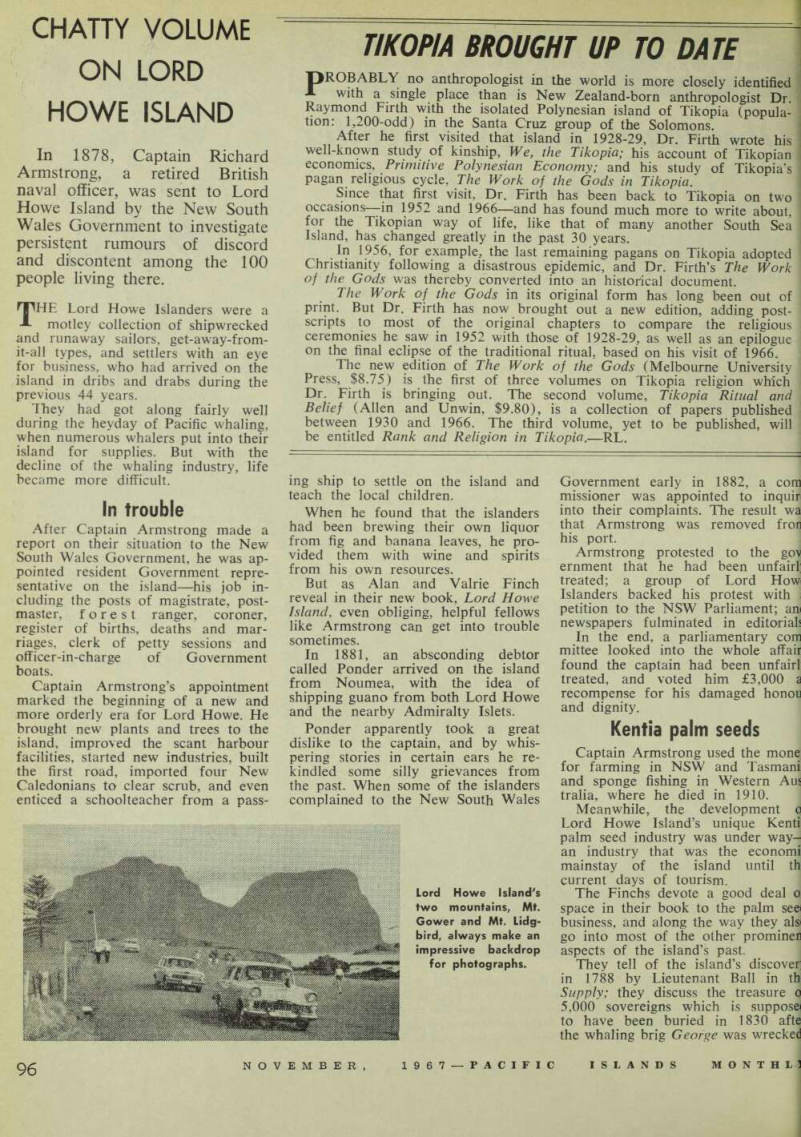
Lord Howe Island's two mountains, Mt.
Gower and Mt. Lidg bird, always make an impressive backdrop for photographs.
id they describe the island’s first ttlement in 1834.
Then there is the comedy about a dney taxi driver who made repeated ortive attempts to sail to Lord awe with his family; the tragedy Gower Wilson, who was lost at a after trying to reach Lord Howe am Sydney in a ketch; the story of * Francis Chichester’s ill-starred sit in a seaplane in 1931 while ing from New Zealand to Aus ilia; the tragic Catalina flying boat ash of 1948; and numerous ship ecks over the years.
But the Finchs’ book is not a story, nor are the historical aspects it always in chronological order, ic authors’ main aim seems to ve been to put together a chatty ok about the island to appeal to i hundreds of people from Austra who spend holidays there each ar.
The book has an attractive dust :ket and several excellent photo aphic illustrations, and being the ly book on Lord Howe on the arket, it is bound to sell well.
I would have liked it better if jre had been less about the island’s rly history and more about the anges of the past 20 years and the al “characters” whom one still
;ets on the island today.-
Kmcg.
LORD HOWE ISLAND. Rigby Limited, elaide. $3.75).
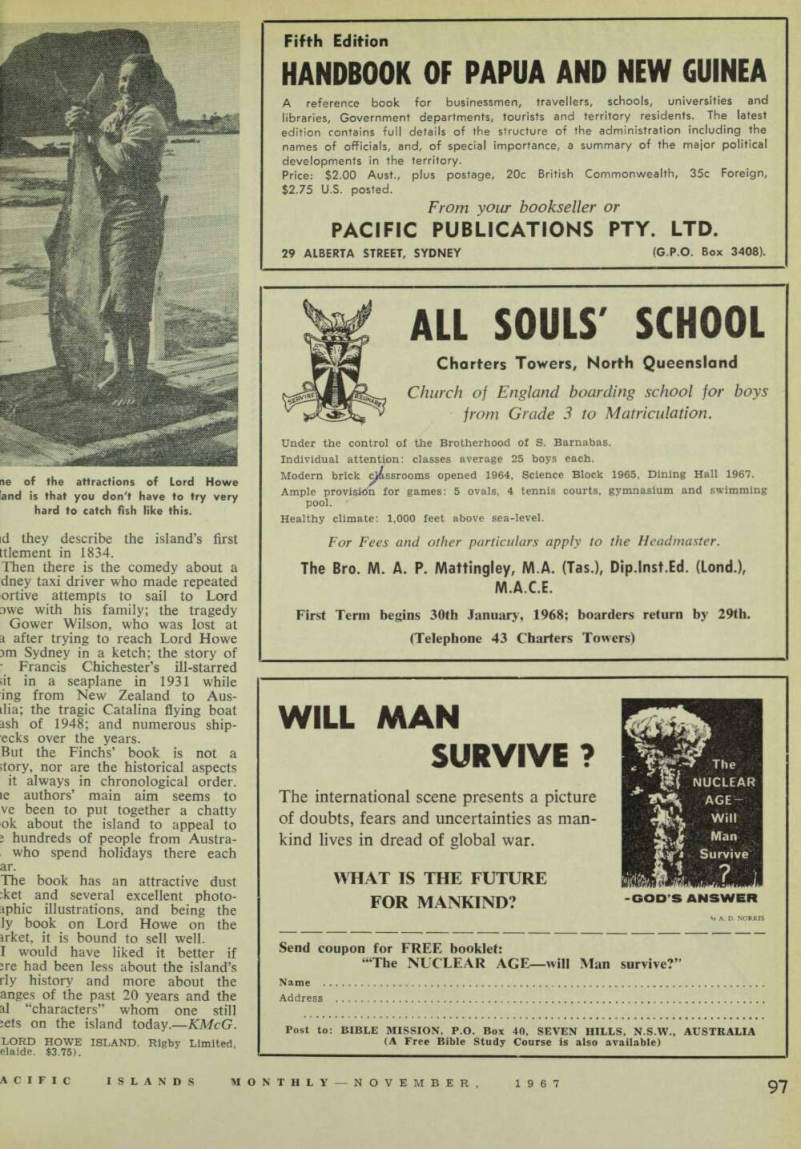
The of the attractions of Lord Howe and is that you don't have to try very hard to catch fish like this.