development to independence
pp. 69-73 · Read in the full issue
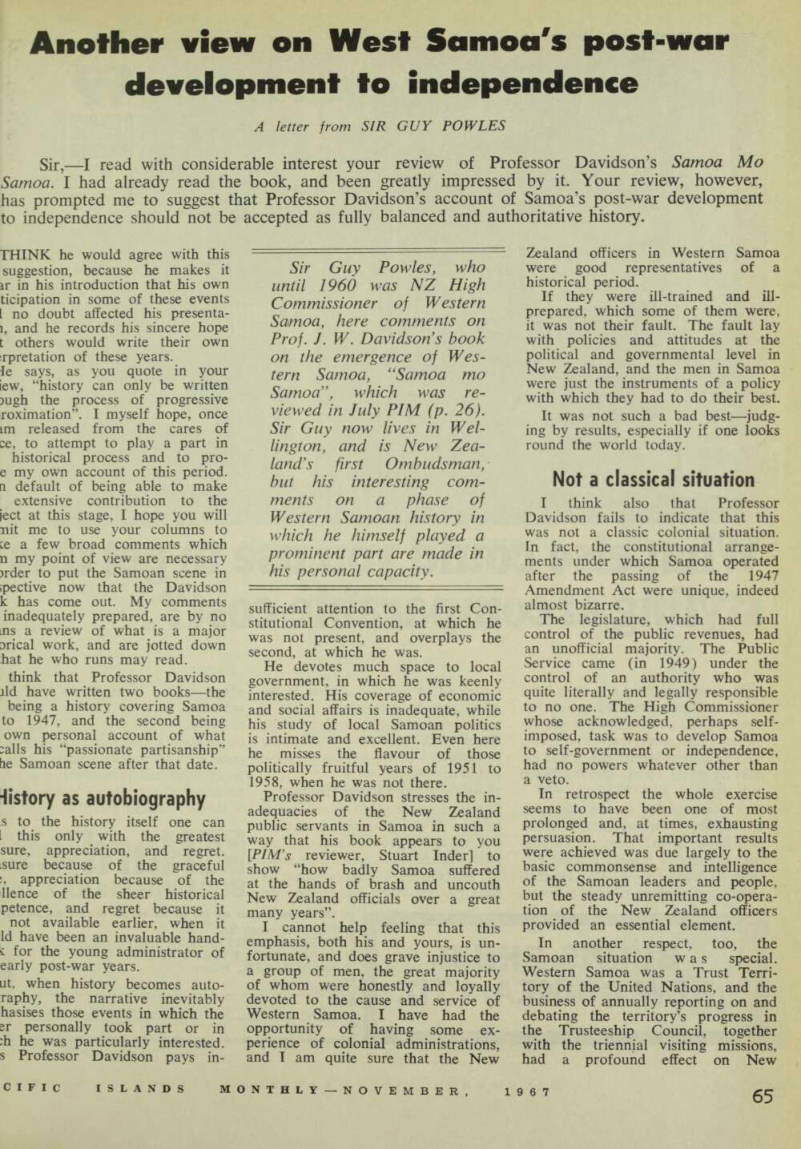

Another view on West Samoa's post-war development to independence
A letter from SIR GUY POWLES Sir, —I read with considerable interest your review of Professor Davidson’s Samoa Mo Samoa. I had already read the book, and been greatly impressed by it. Your review, however, has prompted me to suggest that Professor Davidson’s account of Samoa’s post-war development to independence should not be accepted as fully balanced and authoritative history.
THINK he would agree with this suggestion, because he makes it ir in his introduction that his own ticipation in some of these events I no doubt affected his presenta i, and he records his sincere hope t others would write their own :rpretation of these years, le says, as you quote in your iew, “history can only be written )ugh the process of progressive roximation”. I myself hope, once im released from the cares of ce, to attempt to play a part in historical process and to pro e my own account of this period, a default of being able to make extensive contribution to the ject at this stage, I hope you will nit me to use your columns to :e a few broad comments which n my point of view are necessary )rder to put the Samoan scene in ipective now that the Davidson k has come out. My comments inadequately prepared, are by no ms a review of what is a major arical work, and are jotted down hat he who runs may read, think that Professor Davidson ild have written two books—the being a history covering Samoa to 1947, and the second being own personal account of what calls his “passionate partisanship” be Samoan scene after that date.
history as autobiography
s to the history itself one can i this only with the greatest sure, appreciation, and regret, isure because of the graceful :, appreciation because of the Hence of the sheer historical petence, and regret because it not available earlier, when it Id have been an invaluable band it for the young administrator of early post-war years, ut, when history becomes auto raphy, the narrative inevitably hasises those events in which the sr personally took part or in ;h he was particularly interested, s Professor Davidson pays in-
Sir Guy Powles, who until 1960 was NZ High Commissioner of Western Samoa, here comments on Prof. J. W. Davidson’s book on the emergence of Wes tern Samoa, “Samoa mo Samoa”, which was re viewed in July PIM (p. 26).
Sir Guy now lives in Wel lington, and is New Zea land’s first Ombudsman, but his interesting com ments on a phase of Western Samoan history in which he himself played a prominent part are made in his personal capacity.
sufficient attention to the first Con stitutional Convention, at which he was not present, and overplays the second, at which he was.
He devotes much space to local government, in which he was keenly interested. His coverage of economic and social affairs is inadequate, while his study of local Samoan politics is intimate and excellent. Even here he misses the flavour of those politically fruitful years of 1951 to 1958, when he was not there.
Professor Davidson stresses the in adequacies of the New Zealand public servants in Samoa in such a way that his book appears to you [PIM’s reviewer, Stuart Inder] to show “how badly Samoa suffered at the hands of brash and uncouth New Zealand officials over a great many years”.
I cannot help feeling that this emphasis, both his and yours, is un fortunate, and does grave injustice to a group of men, the great majority of whom were honestly and loyally devoted to the cause and service of Western Samoa. I have had the opportunity of having some ex perience of colonial administrations, and I am quite sure that the New
Zealand officers in Western Samoa were good representatives of a historical period.
If they were ill-trained and ill prepared, which some of them were, it was not their fault. The fault lay with policies and attitudes at the political and governmental level in New Zealand, and the men in Samoa were just the instruments of a policy with which they had to do their best.
It was not such a bad best—judg ing by results, especially if one looks round the world today.
Not a classical situation
I think also that Professor Davidson fails to indicate that this was not a classic colonial situation.
In fact, the constitutional arrange ments under which Samoa operated after the passing of the 1947 Amendment Act were unique, indeed almost bizarre.
The legislature, which had full control of the public revenues, had an unofficial majority. The Public Service came (in 1949) under the control of an authority who was quite literally and legally responsible to no one. The High Commissioner whose acknowledged, perhaps self imposed, task was to develop Samoa to self-government or independence, had no powers whatever other than a veto.
In retrospect the whole exercise seems to have been one of most prolonged and, at times, exhausting persuasion. That important results were achieved was due largely to the basic commonsense and intelligence of the Samoan leaders and people, but the steady unremitting co-opera tion of the New Zealand officers provided an essential element.
In another respect, too, the Samoan situation was special.
Western Samoa was a Trust Terri tory of the United Nations, and the business of annually reporting on and debating the territory’s progress in the Trusteeship Council, together with the triennial visiting missions, had a profound effect on New
Devoted Public Service
ealand policy. This needs more :udy than Professor Davidson has iven it.
It would be interesting to argue le thesis that if Samoa had not een a trust territory she would not ave achieved independence when ad how she did. Samoa’s post-war istory was developed from dis assions and arguments in New brk, Wellington and Vailima, as ell as in Apia and the rest of amoa, whereas Professor Davidson ancentrates very much on the last vo.
I agree with PIM that the Samoan ;sires and attitude were not always > clear as Professor Davidson’s xount implies—nor does he make lequate allowance for the strong id understandable strain of con rvatism in Samoan thinking.
His much loved scheme for district id village government, upon which ; spent much time, was really pre :nted from coming to fruition by e opposition of the Samoan leaders the centre. Economic development the pace which Professor Davidson >pears to think warranted was pre mted by Samoan opposition to any hemes involving loan finance.
Public servants defended
Professor Davidson is justly critical the Public Service structure, but is should not lead to criticism of e individuals working under it. lere were many cases of selfless id devoted service on the part of ;w Zealand officers without which is difficult to see how much of e progress could have been made.
His criticism of the inadequate lining schemes in the Public Service wholly valid, but this was due the extraordinary fact that no one, it even the New Zealand Cabinet, d authority to direct the Public rvice Commissioner in Samoa to 1 anything about it.
Professor Davidson also rightly iticises the tensions that arose in s early days of the Samoan »islature over the position and tions of the official members, but overlooks the difficulties of hav g to attempt to govern without a ajority in the legislature, when 2 legislature had absolute control the purse strings.
The reference in your review to lediocre expatriates brought in on od salaries with fringe benefits such inexpensive Government housing”, I think, rather unfair. The salaries ;re, by New Zealand standards,
)t good, and it was necessary to duce officers to go to Samoa by e offering of these fringe benefits, tiich were openly advertised in iblic Service circulars and in the ess and were by no means oncealed”, as Professor Davidson iplies.
Of course, no one, not the least yself, would wish in any way to idervalue Professor Davidson’s eat services to Samoa. Indeed I ways regard his assistance and my sociation with him as most pleasant id rewarding experiences.
I write therefore just to point out at honest and devoted men can ffer about important matters. I too id my moments of “passionate irtisanship”, as Wellington well tew.
I hope that some day others will 1 in the gaps in the Davidson count, which will, however, always main a definitive work of great lue to all students of the passing colonialism, and of particularly >stalgic pleasure to the many old iamoan hands” who still cherish eir memories of Samoa and the imoans.
Guy Powles
'ellington, NZ