round , Tonga's king says
p. 39 · Read in the full issue
Population explosion creates job problems
There's not enough land to go round , Tonga's king says
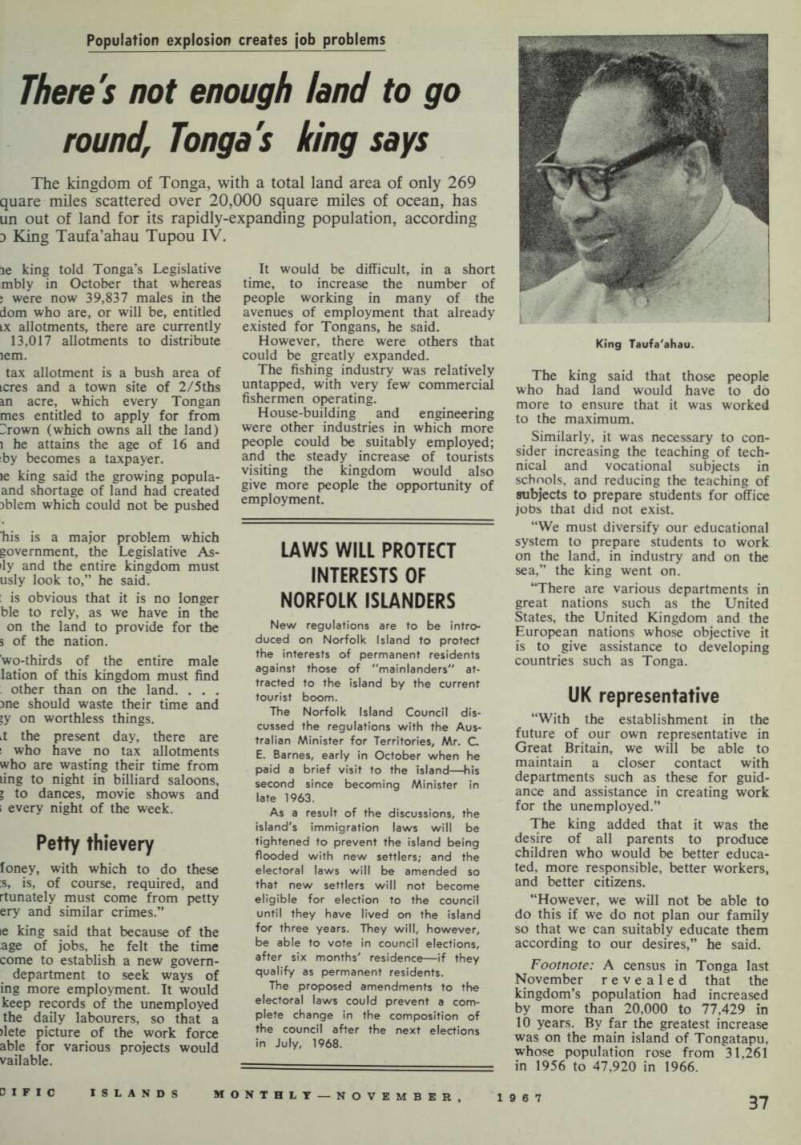
The kingdom of Tonga, with a total land area of only 269 quare miles scattered over 20,000 square miles of ocean, has un out of land for its rapidly-expanding population, according 3 King Taufa’ahau Tupou IV.
ie king told Tonga’s Legislative mbly in October that whereas ; were now 39,837 males in the dom who are, or will be, entitled ix allotments, there are currently 13,017 allotments to distribute lem. tax allotment is a bush area of icres and a town site of 2/sths an acre, which every Tongan mes entitled to apply for from 2rown (which owns all the land) i he attains the age of 16 and by becomes a taxpayer, ie king said the growing popula and shortage of land had created ablem which could not be pushed his is a major problem which government, the Legislative As ily and the entire kingdom must usly look to,” he said. : is obvious that it is no longer ble to rely, as we have in the on the land to provide for the s of the nation. wo-thirds of the entire male lation of this kingdom must find other than on the land. . . . me should waste their time and \y on worthless things.
X the present day, there are ! who have no tax allotments who are wasting their time from ling to night in billiard saloons, I to dances, movie shows and ; every night of the week.
Petty thievery
loney, with which to do these :s, is, of course, required, and rtunately must come from petty ery and similar crimes.” ie king said that because of the age of jobs, he felt the time come to establish a new govern department to seek ways of ing more employment. It would keep records of the unemployed the daily labourers, so that a )lete picture of the work force able for various projects would vailable.
It would be difficult, in a short time, to increase the number of people working in many of the avenues of employment that already existed for Tongans, he said.
However, there were others that could be greatly expanded.
The fishing industry was relatively untapped, with very few commercial fishermen operating.
House-building and engineering were other industries in which more people could be suitably employed; and the steady increase of tourists visiting the kingdom would also give more people the opportunity of employment.
The king said that those people who had land would have to do more to ensure that it was worked to the maximum.
Similarly, it was necessary to con sider increasing the teaching of tech nical and vocational subjects in schools, and reducing the teaching of subjects to prepare students for office jobs that did not exist.
“We must diversify our educational system to prepare students to work on the land, in industry and on the sea,” the king went on. ‘There are various departments in great nations such as the United States, the United Kingdom and the European nations whose objective it is to give assistance to developing countries such as Tonga.
UK representative
“With the establishment in the future of our own representative in Great Britain, we will be able to maintain a closer contact with departments such as these for guid ance and assistance in creating work for the unemployed.”
The king added that it was the desire of all parents to produce children who would be better educa ted, more responsible, better workers, and better citizens.
“However, we will not be able to do this if we do not plan our family so that we can suitably educate them according to our desires,” he said.
Footnote: A census in Tonga last November revealed that the kingdom’s population had increased by more than 20,000 to 77,429 in 10 years. By far the greatest increase was on the main island of Tongatapu, whose population rose from 31,261 in 1956 to 47,920 in 1966.
King Taufa'ahau.