- and the Islanders like it
pp. 27-139 · Read in the full issue
SOUTH PACIFIC COMMISSION HAS A NEW LOOK
It's not an exclusive club now - and the Islanders like it
From a special correspondent in Noumea The decision by the participating governments to give Islands delegates a bigger voice in determining the work of the South Pacific Commission ( PIM, Oct., p. 22) resulted in the Seventh South Pacific Conference in Noumea in October be ing rather less lively than had been expected.
The decision was announced soon fter the conference began by the enior Commissioner for Great ritain, Mr. A. J. Fairclough. Dele ates from 17 Pacific territories ttended.
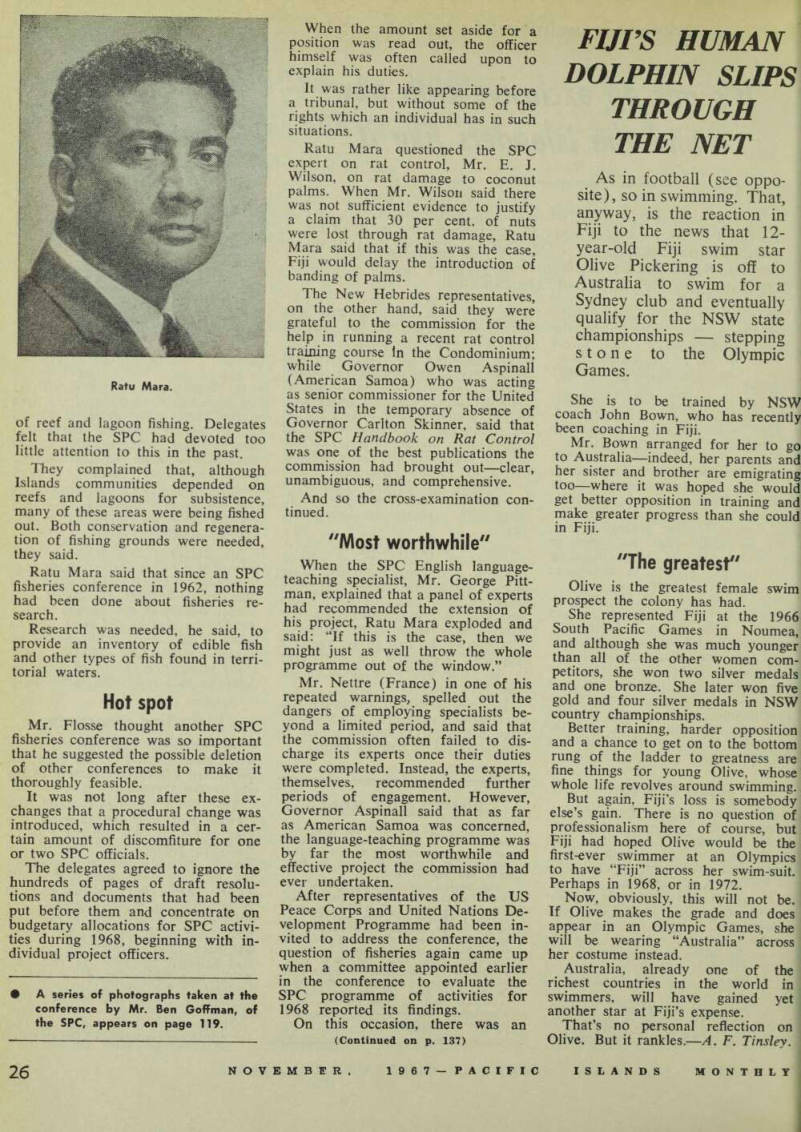
They were told that the participat ig governments —Great Britain, Aus alia, New Zealand, France, the fnited States and Western Samoa— ad agreed that the South Pacific Conferences should be held annually, nd that Islands delegates should ansider, debate and make proposals n both the SPC’s work programme nd budget for the following year, heir proposals would be subject to le final decision of the participating overnments, meeting in session at le end of the conference, Mr. Fairclough said the new ar angements were due to Fiji’s Chief linister, Ratu K. K. T. Mara, who ad pressed hard for the territories to xert influence on the commission.
However, Ratu Mara, who had reviously claimed that the SPC was an exclusive club of the metropolitan overnments”, said in reply that the lea was not entirely his, but the onsensus of opinion of delegates at ic conference in Lae in 1965.
Now a forum
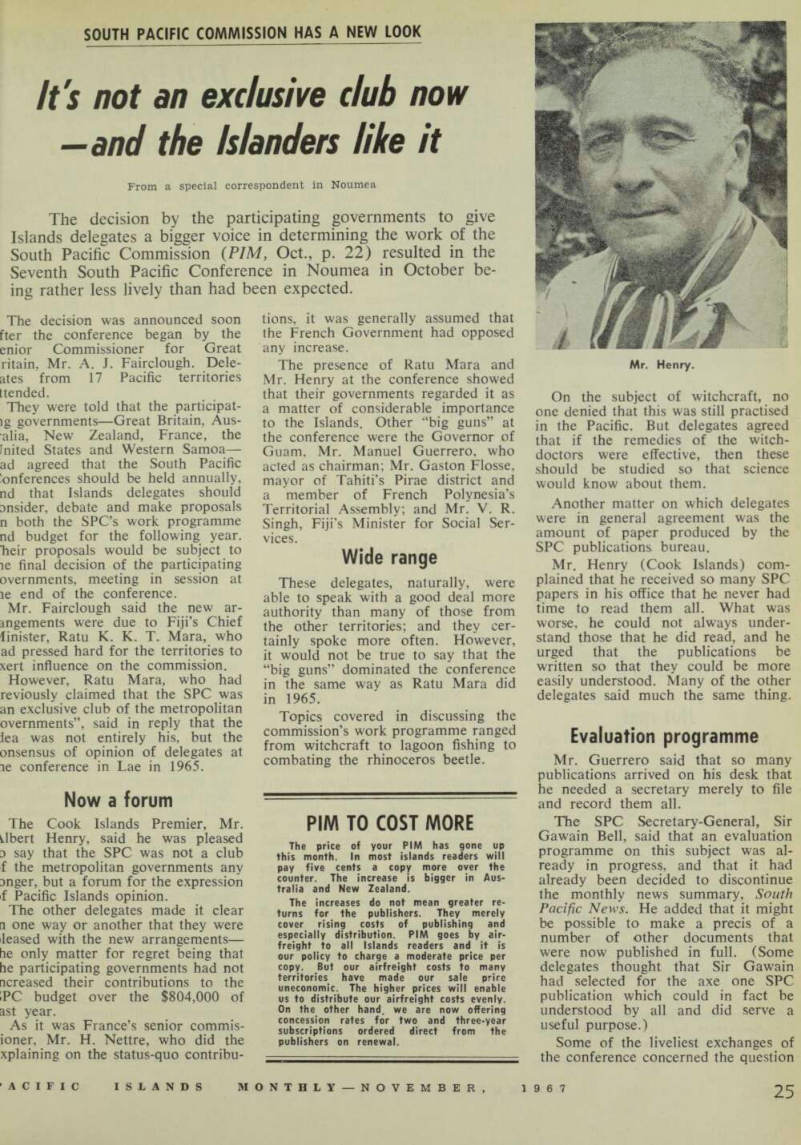
The Cook Islands Premier, Mr. dbert Henry, said he was pleased a say that the SPC was not a club f the metropolitan governments any anger, but a forum for the expression f Pacific Islands opinion.
The other delegates made it clear ti one way or another that they were leased with the new arrangements— he only matter for regret being that he participating governments had not ncreased their contributions to the CPC budget over the $804,000 of ast year.
As it was France’s senior commis ioner. Mr. H. Nettre, who did the xplaining on the status-quo contribu
tions, it was generally assumed that the French Government had opposed any increase.
The presence of Ratu Mara and Mr. Henry at the conference showed that their governments regarded it as a matter of considerable importance to the Islands. Other “big guns” at the conference were the Governor of Guam, Mr. Manuel Guerrero, who acted as chairman; Mr. Gaston Flosse, mayor of Tahiti’s Pirae district and a member of French Polynesia’s Territorial Assembly; and Mr. V. R.
Singh, Fiji’s Minister for Social Ser vices.
Wide range
These delegates, naturally, were able to speak with a good deal more authority than many of those from the other territories; and they cer tainly spoke more often. However, it would not be true to say that the “big guns” dominated the conference in the same way as Ratu Mara did in 1965.
Topics covered in discussing the commission’s work programme ranged from witchcraft to lagoon fishing to combating the rhinoceros beetle.
On the subject of witchcraft, no one denied that this was still practised in the Pacific. But delegates agreed that if the remedies of the witch doctors were effective, then these should be studied so that science would know about them.
Another matter on which delegates were in general agreement was the amount of paper produced by the SPC publications bureau.
Mr. Henry (Cook Islands) com plained that he received so many SPC papers in his office that he never had time to read them all. What was worse, he could not always under stand those that he did read, and he urged that the publications be written so that they could be more easily understood. Many of the other delegates said much the same thing.
Evaluation programme
Mr. Guerrero said that so many publications arrived on his desk that he needed a secretary merely to file and record them all.
The SPC Secretary-General, Sir Gawain Bell, said that an evaluation programme on this subject was al ready in progress, and that it had already been decided to discontinue the monthly news summary, South Pacific News. He added that it might be possible to make a precis of a number of other documents that were now published in full. (Some delegates thought that Sir Gawain had selected for the axe one SPC publication which could in fact be understood by all and did serve a useful purpose.) Some of the liveliest exchanges of the conference concerned the question
Mr. Henry.
of reef and lagoon fishing. Delegates felt that the SPC had devoted too little attention to this in the past.
They complained that, although Islands communities depended on reefs and lagoons for subsistence, many of these areas were being fished out. Both conservation and regenera tion of fishing grounds were needed, they said.
Ratu Mara said that since an SPC fisheries conference in 1962, nothing had been done about fisheries re search.
Research was needed, he said, to provide an inventory of edible fish and other types of fish found in terri torial waters.
Hot spot
Mr. Flosse thought another SPC fisheries conference was so important that he suggested the possible deletion of other conferences to make it thoroughly feasible.
It was not long after these ex changes that a procedural change was introduced, which resulted in a cer tain amount of discomfiture for one or two SPC officials.
The delegates agreed to ignore the hundreds of pages of draft resolu tions and documents that had been put before them and concentrate on budgetary allocations for SPC activi ties during 1968, beginning with in dividual project officers.
• A series of photographs taken at the conference by Mr. Ben Goffman, of the SPC, appears on page 119.
When the amount set aside for a position was read out, the officer himself was often called upon to explain his duties.
It was rather like appearing before a tribunal, but without some of the rights which an individual has in such situations.
Ratu Mara questioned the SPC expert on rat control, Mr. E. J.
Wilson, on rat damage to coconut palms. When Mr. Wilson said there was not sufficient evidence to justify a claim that 30 per cent, of nuts were lost through rat damage, Ratu Mara said that if this was the case, Fiji would delay the introduction of banding of palms.
The New Hebrides representatives, on the other hand, said they were grateful to the commission for the help in running a recent rat control training course In the Condominium; while Governor Owen Aspinall (American Samoa) who was acting as senior commissioner for the United States in the temporary absence of Governor Carlton Skinner, said that the SPC Handbook on Rat Control was one of the best publications the commission had brought out—clear, unambiguous, and comprehensive.
And so the cross-examination con tinued.
"Most worthwhile"
When the SPC English language teaching specialist, Mr. George Pitt man, explained that a panel of experts had recommended the extension of his project, Ratu Mara exploded and said: “If this is the case, then we might just as well throw the whole programme out of the window.”
Mr. Nettre (France) in one of his repeated warnings, spelled out the dangers of employing specialists be yond a limited period, and said that the commission often failed to dis charge its experts once their duties were completed. Instead, the experts, themselves, recommended further periods of engagement. However, Governor Aspinall said that as far as American Samoa was concerned, the language-teaching programme was by far the most worthwhile and effective project the commission had ever undertaken.
After representatives of the US Peace Corps and United Nations De velopment Programme had been in vited to address the conference, the question of fisheries again came up when a committee appointed earlier in the conference to evaluate the SPC programme of activities for 1968 reported its findings.
On this occasion, there was an
(Continued on p. 137)
Ratu Mara.
se and even hostile debate on ler a proposed technical meeting sheries and a fisheries training e should be held in French r a of or t h a : :^oriaT t imeres™ ainly Pr ° mPted mch Polynesia argued strongly French Polynesia was the more ical place; while Mr. B. T. ;lona (US Trust Territory) >ed for Koror, ror finally won the vote as the appropriate location on the ids that it was handy to the West Center in Honolulu; it ly had a training institute; and insport for delegates was already ed. other major point of debate
was an SPC recommendation to ap point a specialist in mental health late in 1968. Nearly every delegate spoke on this topic.
Mr. W. Betu (Solomon Islands) doubted whether there was a mental health problem in his territory. But Western Samoa’s young lulai Toma had no such doubts about his; and this was the view of most other dele gates, who said that with rapid urbanisation, mental health was a growing problem.
After a suggestion had been made that one of the three psychiastrists already working in Fiji, Papua-New Guinea and New Caledonia should be employed as an SPC consultant, Western Samoa’s senior commissioner, Afoafouvale Misimoa, called on dele gates to “dig deep into their pockets” to appoint an SPC specialist. If they left it for even one more year, he said, it might be too late.
The conference voted in favour of the appointment.
This left delegates with only a few minor matters to discuss.
These included the question of whether future conferences should be “large” or “small” and whether or not they should be held in the same year.
No conclusion was reached on this —the matter being left in abeyance in the hope that the metropolitan governments would uncover a solu tion in time for the 1968 conference.
It semed to be assumed that the 1968 conference would take place in Noumea, although no one actually confirmed this.
The site of the 1969 conference is a somewhat ticklish matter. The Guamanian delegates at the Lae con ference in 1965 tentatively offered their territory as the venue for it, but there have been so many changes in SPC business since then that no decision has yet been made on their offer.