control in coconut plantations
pp. 145-151 · Read in the full issue



The Practical Planter
How to achieve effective weed control in coconut plantations
The importance of effective methods of weed control in South Pacific coconut plantations was subject that merited a good deal of attention from delegates to a technical meeting on coconut reduction at Rangiroa, French Polynesia, in August.
E meeting was organised by the South Pacific Commission and attended by agricultural experts all over the Pacific, e delegates agreed that effective ing Was important because s: Compete with coconuts for ;ure and nutrients in the soil, ially in the first few years of sdling’s growth.
Impede movement within ations.
Conceal fallen nuts. paper presented on behalf of T. L. Mune, senior field officer iji’s Department of Agriculture, that hundreds of thousands of hours had been wasted in Fiji’s mt plantations over the years gh ineffective methods of weed 01.
Progressive reduction
t he said that once a well ied weeding programme had been iuced on a plantation, weeds be “progressively reduced to ce of no importance in the man ent programme.” hough Mr. Mune’s paper was ailarly concerned with Fiji, of what he said applies gener hroughout the Pacific, lie history of the coconut in- V in Fiji,” Mr. Mune said, “is itory of ineffective methods of control throughout its develop ffore the land was settled, it was :avy bush or tall reeds. When »ush was cut, difficulty was ex iced in obtaining a clean bum
because of the high rainfall. This added to the trials of the planter, as poor burns meant great masses of logs and stumps giving protection to secondary growth.
“This situation prevailed for the first five to 10 years of a young plantation’s development.
Greatest problem
“Until the last decade there was no improvement in plantation weed ing. The cane knife was the chief weeding tool, and, over the years, hundreds of thousands of man-hours have been wasted in once or twice-a year slashing.”
Mr. Mune said that plantation owners came to consider that money spent on weeding was money lost and eventually reduced their weed control operations to slashing every two or three years.
This attitude to weeding had come to be the accepted one, and was now the greatest problem to be overcome.
“Owners must be persuaded that they cannot afford not to weed,” Mr, Mune said.
He went on: “No method of weed control can be successful without the support of a regular weeding pro gramme, involving the general man agement of the plantation. (Over)
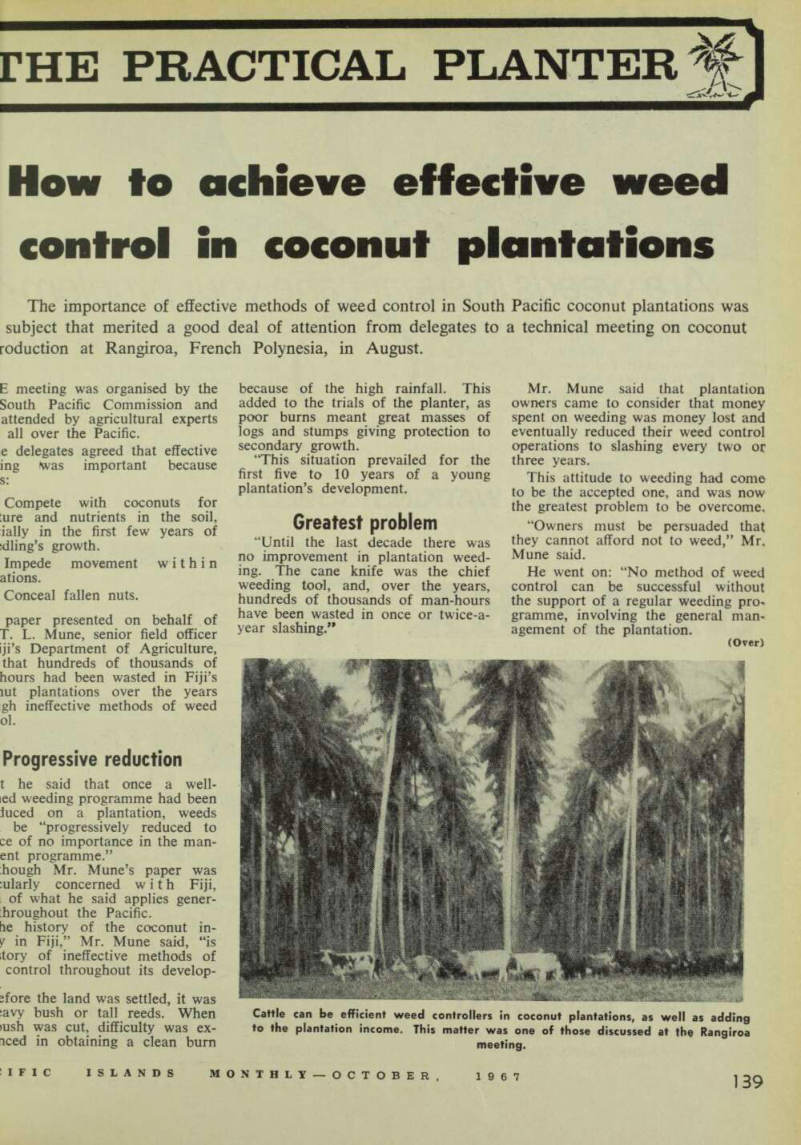
Cattle can be efficient weed controllers in coconut plantations, as well as adding to the plantation income. This matter was one of those discussed at the Rangiroa meeting.
yeed control . . . must be planned care, making full use of the effective methods, directed at lestruction of the growing weeds the weed seeds in the soil, his can be achieved by regular ling, timed to prevent the weeds setting seed.
Regular weeding
ls most of the weeds of Fiji have ig protracted seeding period, and not governed by well-defined ►ns, it has been found that this be most successfully achieved seeding each grove of nuts once r eight weeks. •nee control has been established, icriod between weedings can be ided to 12 weeks, although it be necessary to return to eight s during the growing season. •nee a weeding programme has put into operation, nothing must ermitted to interfere with it, for the success or failure of a ation will depend on regular ing.” r. Mune said that in once-a-year ing, it took up to 96 man-hours proot an acre of lantana. t by weeding at eight-weekly in is, weeds were kept under con and in 96 man-hours, it would ossible to weed up to 20 acres.
Noxious weeds
ferring to the control of weeds ;w plantations, Mr. Mune said manual control was often the means, as soft young palms readily susceptible to a wide : of selective herbicides and 1 be seriously damaged or killed small amounts of spray, or the first few years,” Mr. Mune on, “the young palms should be arly ring-weeded. This will give ffective weed control for eight s. he area between the rows of g palms should be cut back to
Once you start your programme, don't stop!
a height of two feet which will check the secondary growth and control it until the palms are old enough to permit the use of herbicides and the sowing of desirable pastures or ground covers. Declared noxious weeds should be removed by uproot ing.
“Grasses are a major weed in many young plantations and extremely dif ficult to control, so new lands should not be sown with pastures until the palms have reached a height which will permit the use of livestock to control the grasses.”
Mr. Mune gave this advice for con trolling common weeds: • Chinese burr (Triumfetta rhomboidea jacq.). This should be slashed or rolled, followed by the spraying of stems and regrowth, as soon as it appears, with an ester formulation of 2,4,5-trichlorophenoxy acetic acid at the rate of 3.5 lb acid equivalent per acre in 80 gallons of fresh water. • Fern ( Nephrolespsis exaltata — Linn — Schott). This should be slashed with chain slashers or crushed with heavy rollers, after which desirable ground covers should be sown. This has proved an effective control if regularly applied over one or two years. • Guava ( Psidium guajava Linn).
When cut back year after year, this becomes very difficult to kill even with herbicides. However, young seedling plants up to two or three feet in height can be effectively con trolled by cutting off three or four inches below the ground surface and pressing the sod back to cover the cut root in the soil. With a sharp spade in stone-free soil, one man can remove up to 200 plants in an eight hour day. This method is suitable for small plantations, but on large ones, where labour costs are high, the removal of guava by heavy machinery, followed by ploughing and the sowing of a useful ground cover, is suggested.
Chemical control
Mr. Mune also recommended the use of chemicals in the control of guava. However, he said that as guava grew it developed a high degree of resistance to water-based foliage sprays, and changes had to be made in the method of application.
Cutting the trees off at ground level and applying a mixture of 3.5 lb a.e. of 2,4,5-T ester diluted in 30
gallons of diesel fuel oil to the freshly cut stumps and all exposed roots was an effective control.
Alternatively, the same mixture could be applied as a fine spray or with a paint brush to the stems of trees from ground level to a height of three feet without cutting.
“As long as all of the bark in the treated area is covered with the mixture, the tree will die,” Mr. Mune said. “The 2,4,5-T ester kills slowly and it may take up to six months for the guava to die.”
Other weeds, for which Mr. Mune recommended chemical controls are: • Hibiscus burr (Urena lobata Linn). This is readily susceptible to the following herbicides applied at the rate of 2 lb a.e. per acre diluted in water and applied as a fine spray to the leaves and stems: 2-methyl-4chlorophoxyacetic acid, 2,4-dichloro phenoxyacetic acid as an amine salt. • Mint weed ( Hyptis pectinata Linn). This is easily controlled by spraying with the same herbicides as for hibiscus burr. • Lant a n a ( Lantana camara Linn). Uprooting is an effective con trol so long as the complete root system is removed from the soil, as broken roots are capable of sending up new top growth. In sites where farm machinery can be operated, the growing plants can be grubbed out mechanically and the regrowth sprayed. (Over)
Treating lantana
•. Mune said: “Lantana is readily ptible to the amine formulations !,4-dichlorophenoxyacetic acid sd at the rate of 4 to 5 lb acid alent per acre diluted in water, tie spray mixture should wet the leaves and canes. This is aportant part of the control as is a weed which has growing s spread the full length of the tie herbicides can be applied ut pre-treatment, but the degree ntrol is greatly improved if the is first crushed or slashed and spray applied when there is / of fresh new leaf.” the newer herbicides which ively control lantana, Mr. Mune oned: 4, amino 3,6,5-trichloropico acid 0.5 lb a.e. 2,4-dichloro ixyacetic acid as an amine. 2 lb er acre.
4, amino—3,6.s-trichloropi
c acid 0.75 lb a.e. 2,4,5-Tri- Dphenoxyacetic acid as an amine, a.e. per acre.
Diluted
;se herbicides are diluted in and applied with and without eatment at the rate of 80 is of spray mixture per acre, treatments have been found to mtana completely when spraying rried out with Rega knapsack ers at a pressure of about 25 : square inch.
One other weed which Mr. Mune described—Tobacco weed (Elephanto pus Mollis H. B. K.) —is a newcomer to Fiji’s coconut plantations. This can be controlled by spraying with 2 lb acid equivalent of 2,4-dichloro phenoxyacetic acid as an ester or amine formulation.
Concluding his paper, Mr. Mune said: “We now have a selection of effective methods of control involving a number of safe chemical weed killers that will kill weeds, which, in the past, were only checked by regular slashing. But these chemicals are not a substitute for good manage ment practices.
Cattle "mowers"
“After control by treatment, it is essential to consider the source of the infestation and the reason for it.
Most plantation weeds are present due to lack of production pressure.
“This is brought about by in effective weeding, insufficient capital, labour, fertiliser, and, in some cases, lack of incentive.”
Another paper, which touched on the control of weeds in coconut plant ations, was presented on behalf of Mr. J, L. Baker, chief veterinary officer in Fiji’s Department of Agri culture.
Mr. Baker’s paper concerned the grazing of cattle in coconut plant ations where arable or tree crops could not be grown along with the coconuts.
He said that cattle could be a
source of considerable income to plantation owners, besides helping to control weeds and making the collec tion of nuts easier.
In some areas of Fiji, good pasture species could be grown in such abundance in coconut plantations that up to one beast per acre could be grazed in them. But Mr. Baker sounded a warning on this score.
“While pasture species can do an effective job of controlling weeds in mature plantations,” he said, “it must be remembered that those same pasture species can be weeds them selves in young plantations where palms are not yet high enough for fronds to be out of the reach of cattle or goats.
Rotational grazing
“In this respect, sheep have shown themselves in Fiji to be far less likely to damage young palms than cattle or goats.
“In Fiji, the basic aim is to estab lish pasture to control weeds, and then use cattle to control the grass.
“It must not be thought that cattle or goats will control weeds per se.
If anything, the reverse will be the case, and if stock are run in a badly weed-infested area, the infestation will tend to increase.
“There will be a tendency to over graze the pasture areas and to leave the weeds until all available pasture is consumed. (Over)
The plantations have used aerial spraying to control plantation pests, but the method is not widely used in the Pacific.
f the stock are then withdrawn i the area, the denuded pasture be encroached on further by the Is, and so the situation will be ier aggravated.” r. Baker said the main require t of pasture management was to the grass high enough and thick igh to control weeds, and short igh to find ripe nuts easily. lis involved adequate fencing, a ;ional grazing system, and the in dent use of livestock. r. Baker suggested that any nut area should be divided into less than four equal paddocks. nder this system, the herd would otated around the paddocks at :ly intervals, allowing a three : recovery period for each lock. le herd size would then have to set at a number that would uately graze each paddock in a : so that nuts could be easily cted. But they should not over 5, causing grass recovery to be Dpra cutters would go into each lock immediately after the cattle s out. Any necessary weed con would be done at the same time nuts were collected.