The Editors' Mailbag
pp. 65-71 · Read in the full issue


"Blue" Allan
Sir, —On the off-chance that you ive not already heard from Mr. Don irrett, or others associated with abaul immediately after World War , I would like to mention that your cellent article in July PIM (p. 87), nceming the late Colonel H. T. [lan, contained one slight error.
Colonel Allan did return to New ninea after World War 11. He rmed a transport company in rtnership with two of his junior deers, and traded most successfully the late 40’s and early 50’s as dlan, Barrett and Read.” At the me time the partnership leased ndenhafen Plantation from Bums dip and Co. Ltd. The three partners ed “on top at Tililigap”, enjoying surpassed views of Rabaul and St. ;orge’s Channel, and I think “Blue” lan returned to Sydney in either 51 of 1952, and from then I lost ich with him.
J. C. Binder.
ilson & Robertson Pty. Ltd., mley Street, uth Brisbane.
Sir, —I feel I must write and thank a for including in July PIM the ituary of “Bluey” Allen. 1 have just returned from a six mths’ tour of New Guinea, Fiji, nga, Samoa and finally Australia 1 New Zealand. I retire from thell Gwyn and Co. Ltd., at the 1 of this month, and whilst I was Australia I did my best to obtain y information I could about lonel Allan.
There is one story which I feel might be new, which he told me last time I saw him, and that was that his boy in New Guinea, who had been in Japanese hands since he left, was able to produce a suitcase full of his per sonal effects when he returned with the Americans towards the end of the war.
Once again thank you for your article on Bluey Allan.
C. F. Davis.
Bethell, Gwyn and Co. Ltd., Gravel Lane, London.
The Road To Naiserelagi
Sir, —On going through your July issue I enjoyed reading an article by Jane Gregor in Suva, entitled, “Little known murals of Fiji Church capture essence of countryside”. However, the correct distance from Suva to Naiserelagi is some 85 miles (and not 50 as stated). I feel it would be most frustrating information for travellers who set out with only limited time, and who might have to return to Suva to catch a ship.
P. Erbsleben,
Executive Secretary.
Fiji Visitors Bureau, Suva.
Yachting In N.G.
Sir, —We have just completed one of the most interesting and reward ing parts of our trip around the world.
The areas along the east and north coasts of New Guinea are beautiful cruising grounds. The natives in out of the way coastal villages are still primitive, friendly, and fascinating.
Why are more yachts not coming this way? They are missing an amazing adventure.
Our main ports were: Samarai, Esa ala, Amphlett Islands, Trobriand Islands (a beautiful spot, where the people still dress, or rather don’t dress, in their primitive style), Lae, Madang Manam Island (an active volcano), the Sepik River, Wewak and Vanimo.
We powered 197 miles up the muddy, log-filled Sepik as far as Pagwi. “Morris”, a Sepik native, came from Madang up the Sepik with us as a pilot for this uncharted area. He added much to our enjoy ment and gave us a better under standing of the interesting customs,
art, and music of his people. The colourful tambaran houses of Maprik are as beautiful as colourplates in New Guinea books indicate.
We are now in Vanimo harbour, the last port in the Mandated Terri tory of New Guinea, which is 20 miles from the West Irian border. We leave tomorrow (September 4) for Ceram, Bali, Java, Singapore, Penang, and Ceylon.
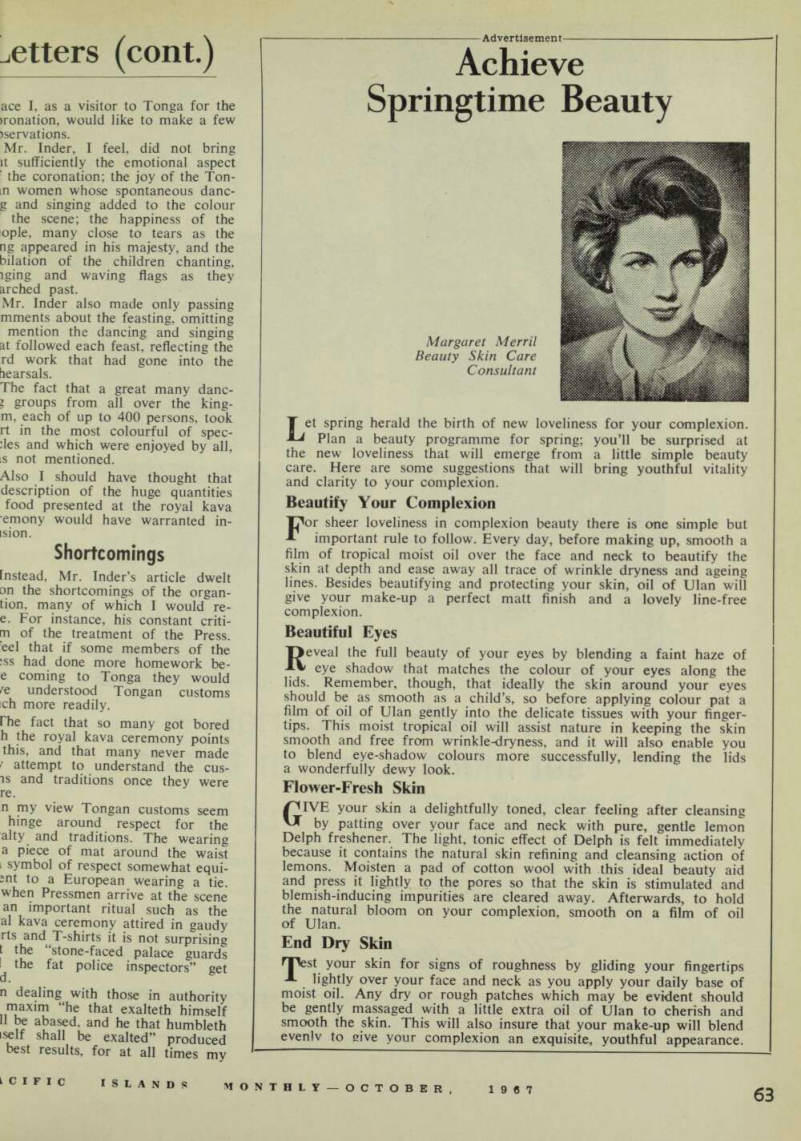
La Belle Sole is a bit lower in the water these days. She is loaded with carvings from the Trobriand Islands and from the Sepik District. We were most impressed with the arts of these people.
Please encourage your cruising friends to consider seeing more of New Guinea. It is an unforgettable experience.
There has been no problem in get ting the necessary papers and sailing permits for Indonesia. We have no reason to expect trouble.
Our crew is still the same: Roger Franson, Anne Franson, Keith Franson, 10, Karen Franson, 9, Allan Hare, and Teppy Angermeyer.
Anne Franson
La Belle Sole (American yacht), Vanimo, New Guinea.
Tonga's Coronation
Sir, —I was very disappointed with Mr. Inder’s report of the Tongan coronation (P/M, Aug., p. 45) and feel that his report did not reflect the spirit prevailing in Tonga at that time.
Lest too many people get the wrong impression of what actually took
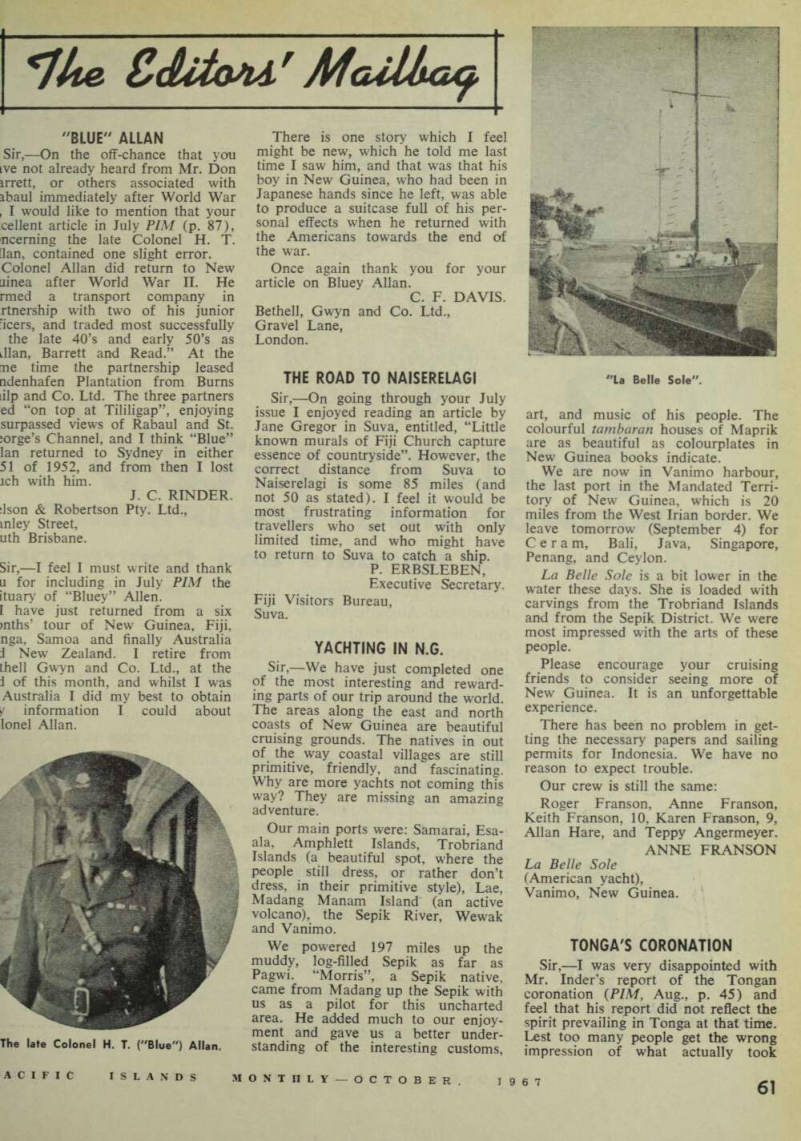
The late Colonel H. T. ("Blue") Allan.
"La Belle Sole".
ace I, as a visitor to Tonga for the donation, would like to make a few iservations.
Mr. Inder, I feel, did not bring it sufficiently the emotional aspect : the coronation; the joy of the Ton in women whose spontaneous danc g and singing added to the colour the scene; the happiness of the ople, many close to tears as the ng appeared in his majesty, and the bilation of the children chanting, iging and waving flags as they arched past.
Mr. Inder also made only passing mments about the feasting, omitting mention the dancing and singing at followed each feast, reflecting the rd work that had gone into the hearsals.
The fact that a great many danc l groups from all over the king m, each of up to 400 persons, took rt in the most colourful of spec :les and which were enjoyed by all, is not mentioned.
Also I should have thought that description of the huge quantities food presented at the royal kava emony would have warranted in ision.
Shortcomings
Instead, Mr. Inder’s article dwelt on the shortcomings of the organ tion, many of which I would re e. For instance, his constant criti m of the treatment of the Press, eel that if some members of the ;ss had done more homework be e coming to Tonga they would ft understood Tongan customs ich more readily. fhe fact that so many got bored h the royal kava ceremony points this, and that many never made ' attempt to understand the cus is and traditions once they were re. n my view Tongan customs seem hinge around respect for the ally and traditions. The wearing a piece of mat around the waist l symbol of respect somewhat equi ;nt to a European wearing a tie. when Pressmen arrive at the scene an important ritual such as the al kava ceremony attired in gaudy rts and T-shirts it is not surprising t the “stone-faced palace guards I the fat police inspectors” get n dealing with those in authority maxim “he that exalteth himself II be abased, and he that humbleth iself shall be exalted” produced best results, for at all times my
nit and I were treated courteously nd with the utmost friendliness and onsideration, and often I was disap ointed to find that we were being rivileged at the expense of the Ton ans.
Mr. Inder’s inability to understand lie Tongan language could easily ave been overcome as we did by laking personal friends of some of le many English-speaking Tongans diom we found only too glad to elp.
Also I objected to the sly criticism f visitors with “Instamatics and rownies”, as though one has to be “professional” to be able to handle lore elaborate equipment. At one of le instances complained of, that of le royal group posing at the door of le palace after the chapel ceremony, should like to point out that we isitors were invited at that juncture y happy, smiling palace guards to 3 forward and take photographs if e wished.
So in reply to Mr. Inder’s opening jestion, the coronation was most jfinitely a success, both for Tongans id visitors alike. I feel proud and deed privileged to have been pre nt for such a memorable ex :rience.
John H. Booth
'- ANZ Bank /dney.
Problems Of The Bsip
Copra Industry
Sir, —PIM in August (p. 126) fers to comments by the High ommissioner for the Western icific. Sir Robert Foster, at the >ening of the eighth session of BSIP ;gislative Council in July.
In reference to copra, Sir Robert reported as saying, “The experts il me that the specific reasons for e decline elude them, but being a nple soul, I would imagine that d all the nuts which were on the ound been collected we should ve done rather better than we did”.
Sir Robert is to be commiserated th on the inexpertness of his perts in this matter. Any planta in man could tell him in a very v words what is wrong with the pra industry.
The trouble is the 15 per cent, port duty on copra levied on the 3ss income after allowing overseas sight only as a deduction, plus a rther percentage deduction to the >pra Board’s agents for performing lat is nothing else but an un mplicated stevedoring operation, s taken the profit out of the in stry.
With rice now selling at £95 per i in Honiara (or 1/3 per lb retail)
it is a better proposition for a native producer to eat his coconuts or feed them as a supplementary ration to his pigs rather than produce copra. He gets only approximately 2Jd per lb for “green” copra, or about 4id per lb for dry copra.
Did Sir Robert’s experts tell him that ripe nuts were not being picked up, or was this just an inspired guess on his part? Could not over-age palms slowly slipping out of pro duction have something to do with it? How many places are becoming sub-marginal because of rising costs and shrinking production?
The manager of the largest BSIP plantation company, at a meeting of the Planters and Farmers’ Associa tion last December, stated in answer to direct questions that, in his opinion, in these Solomon Islands it would neither pay to plant up new areas nor to re-plant over-age plantations. Some day Government may get the message.
Vicious export duties on primary products are the surest way to frighten off investment capital. Such export taxes are also a method of imposing income taxation on people who would otherwise be exempt by reason of standard taxation exemp tions on low incomes. Furthermore, export taxes introduce the vicious principle of discriminatory taxation, and, in most cases have the effect of a stab in the back to industries which really merit a shot in the arm.
I can assure Sir Robert and his team of experts that, if all the coconuts had been planted in the years gone by which would have been planted had there been no export tax on copra to milk the
profits away, the industry—and the country generally—would have done a hell of a lot better than it has done. Fine buildings are a very poor substitute for full bellies.
J. Bryan
Rere Plantation, via Honiara,
Bsip
Book Reviews
Sir, —If no one else ever read any of my books it would still be worth the effort of writing them just to get one of Judy Tudor’s reviews.
I must admit that I had a sneaky feeling she might rather like Serpents in Paradise {PIM, July), knowing she has a sense of humour and a healthy attitude towards Experts, not to mention her knowledge of the area. All the same, I was surprised and delighted at the space spared for the review.
Nancy Phelan.
Mosman, Sydney.
Sir, —I might have cavilled at the words “lugubrious” and “beef-steak pudding” in the review of my book.
Time Expired {PIM, July), if I had not accepted “lugubrious” in its sad and not in its lumbering meaning; and if I had not accepted “beef-steak pudding” as a solid and nourishing meal, rather than an indigestible one.
As the reviewer [Judy Tudor] so succintly illustrated, Time Expired is a story of losers, of men caught and not yet able to escape their tragic circumstances; but nevertheless Time Expired is also a satisfying bite at the real New Guinea, a fact the reviewer records in her comment on the Administrative aspects of the book.
I conclude therefore with my thanks for the review.
Gus O’Donnell.
Woollahra, Sydney.
Pacific Tourism
Sir, —The articles on Pacific tourism {PIM, July, p. 45) were a valuable review of the problems and aspirations of the various island groups in their joint and separate quests for overseas funds in exchange for recreational services, rather than minerals and produce.
It is encouraging to learn that nearly all Islands leaders are coming to the view that the dictates of the future require them to embrace
Sir Robert Foster.
tourism as one support of Islands economy. Questions of how to proceed effectively are vital, and a number were well discussed in the issue. It seems to me that two important problems were overlooked.
One is the question of high trans pacific fares. I once spoke to a travel agent about a ticket to Tahiti. He replied that he would sell me a ticket if I insisted, but that he could put me over the Pole to Europe for the same price, and into almost any arbitrary number of airports on the other side as part of the package.
Even with the reduction in rates, the round-trip fare for a family to travel from California to Auckland or Sydney is frightening, and simply prohibitive for many an American who fairly aches to go down-under.
Would it make economic sense for airlines based in the South Pacific to fight for fare reduction, even at the cost of government subsidy?
Once an American gets to the South Pacific, would he spend more than enough time and money to offset the loss on fares?
High tariffs
A second severe problem is the question of the type of accommoda tions provided. At the moment, several South Pacific areas seem determined to price themselves out of all but the luxury American trade.
To me, this makes no sense, except perhaps in the case of a small place like Pago Pago, which may very well assume that only a limited number of visitors can be handled, and these few might as well be as affluent as possible. Certainly the rates in the new hotel are simply over the heads of most American families. On a regional basis, this kind of thinking loses force in my mind.
Why not seek the kind of tourists whose more modest resources would lead them to be content with less prestigious settings? Why not build modes* structures, tasteful but less costlyS Why not rely more heavily on local foods?
There are twice as many people in the west coast states alone than in Australia and New Zealand com bined. A large proportion take their vacation-planning seriously, but only a small proportion think in the grandiose terms that many people in the South Pacific appear to take as the norm for Americans.
I think it is fair to say they have seen precious few normal American tourists, because that breed can’t afford to travel there under present conditions!
William R. Dickinson
Menlo Park, California Sir, —It was very interesting to read your July articles concerning the promotion of tourism in both Samoas and Tonga. One finds that the conference has ignored, whether purposely I don’t know, a very important factor in tourism. This is the impossibility of pleasing the tourists and maintaining the dignity of the Islands people at the same time.
The seven points emphasised by Governor Lee are all in favour of the tourists. “Don’t exploit the tourists. Protect them and their interests, etc.” The question is, what about the Islanders? The seventh point put forward by the promoters was the only one that deals with the welfare of the Islanders, and for this I say thank you very much.
However, to be able to please the tourist and maintain the dignity of the Islander, is to me a paradox —the paradox of tourism. One is not thinking of the respectable and dignified tourists, for these people are welcome at all times. They are the cream of the world. They make the world a worthy and interesting place in which to live.
Unfortunately tourism in the Islands has come to mean exploita tion. One often reads news and advertisements with these words, “unspoiled Polynesian life”. Certain articles refer to Islands life as being spoiled by the coming of European civilisation.
What do they mean? Do they mean the coming of the motor car, tractor or aeroplane? Or is it the penetrating influence of modern thoughts in regard to atheism, agnosticism and many other isms?
There may be a point here, but one hardly thinks that this is all. Half of the story lies within the evils of modern civilisation.
Have the tourist promoters ignored the fact that only a handful of pure Hawaiians are now living in a small island by themselves? Take a look at the main island of Tahiti. Isn’t there evidence to support the fact that pure Tahitians are decreasing in number?
I am not advocating superiority of
races, even though they do exist.
I’m simply talking of the evil that is often associated with tourism— the ruthless, lawless elements in it, I mean. There is evil within the Islanders themselves. This is bad enough, but, ignition from outside will drive the Islanders to the extreme.
History testifies to the fact that the evils of Western civilisation are often taken one step further by Islanders with little education and limited experience. They drink excessively, not only beer but methylated spirit. They learn to smoke, but furthermore chew bitter, dirty tobacco.
Tourism may solve the economic problems but it will increase the moral problem. It brings wealth but
also brings breweries, illegitimate rths (legitimate soon?), night clubs id low morality. One day it will ing LSD.
To please this ruthless, lawless sment in tourism certain laws must ; relaxed. If not, a compromise ust be arrived at, or tourists will nply cross over to Tahiti and awaii. The Samoan Legislative As mbly has moved towards this in gard to immigration laws. Watch s next step!
My country is by no means an jal one and I hope tourism will Ip eradicate some of the customs at are holding back her progress, jvertheless I do want the tourist omoters to bear in mind some of ; risks that tourism can bring and 11 bring.
Ualesi Tuni Jerome
(A Samoan student) rondale College, loranbong, >W, Australia
Bligh Relics
The relics of Captain Bligh re red to in July PIM (p. 89) are present held by Mr. G. R. B. itting, of “Ngawaha”, Longbush, asterton, New Zealand. They are actly as described in the article Robert Langdon.
Mr. Nutting is the grandson of Dr.
S. Nutting, of Inglewood. 1 have discussed the lending of jse relics to the Mitchell Library :h Mr. Nutting, as I feel that they : unique, and it would be a great y to have them destroyed in a fire some other disaster.
D. H. S. Irwin.
es Chermettes”, artherston, NZ. • The relics are the bowl, cup, Uet weight and compass which ptain Bligh used during his open it voyage from Tonga to Timor 1789. Mr. Nutting’s relationship Dr. Nutting makes him Bligh’s at-great-great-grandson.