Fiji Woos
pp. 49-51 · Read in the full issue
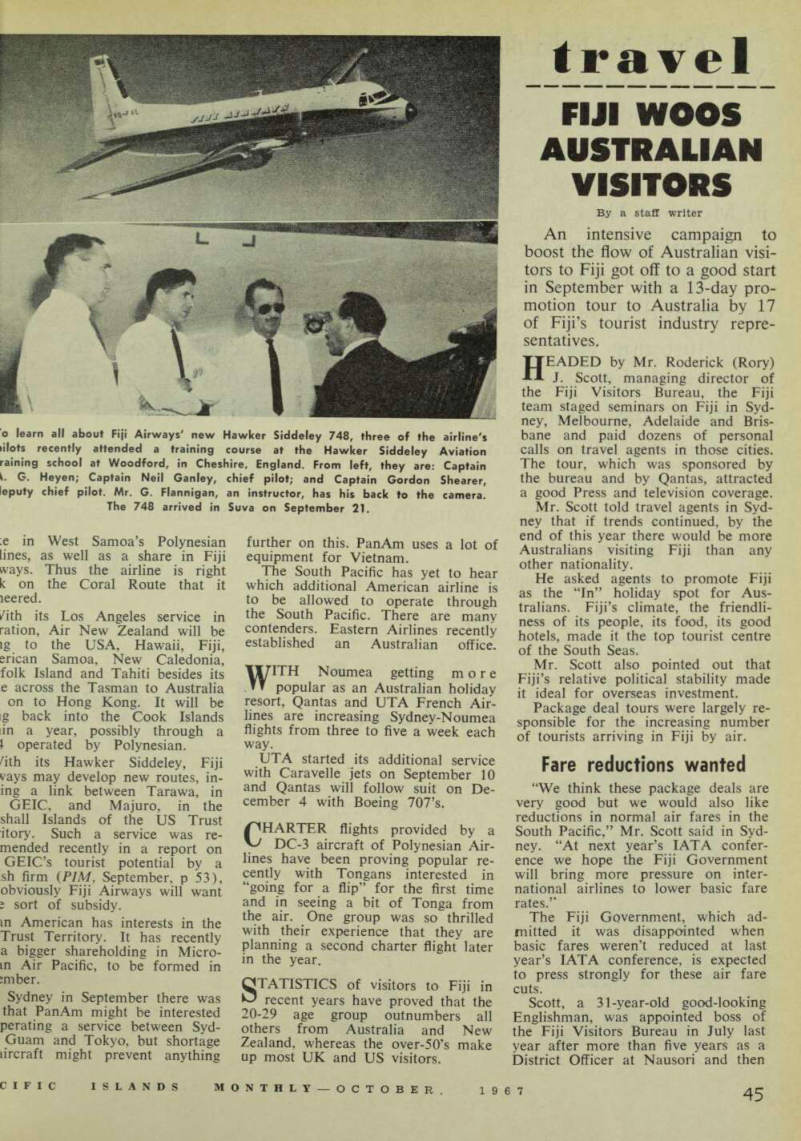
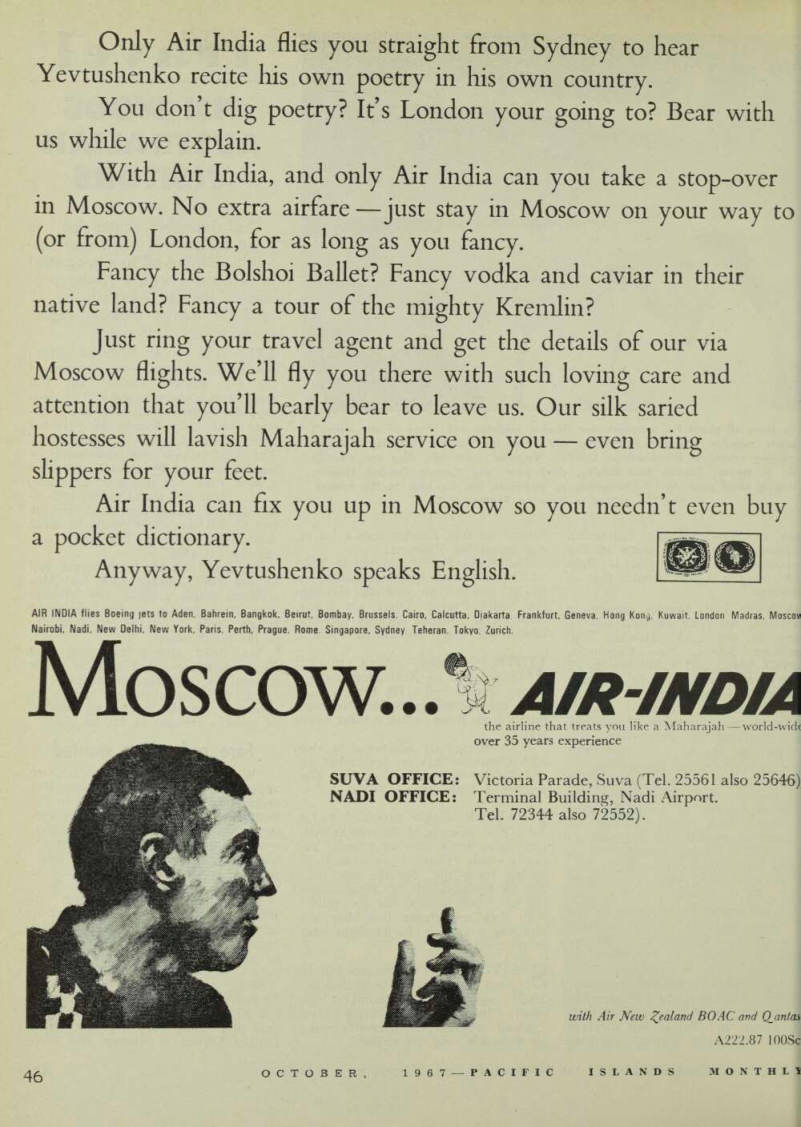
Australian
Visitors
By a staff writer
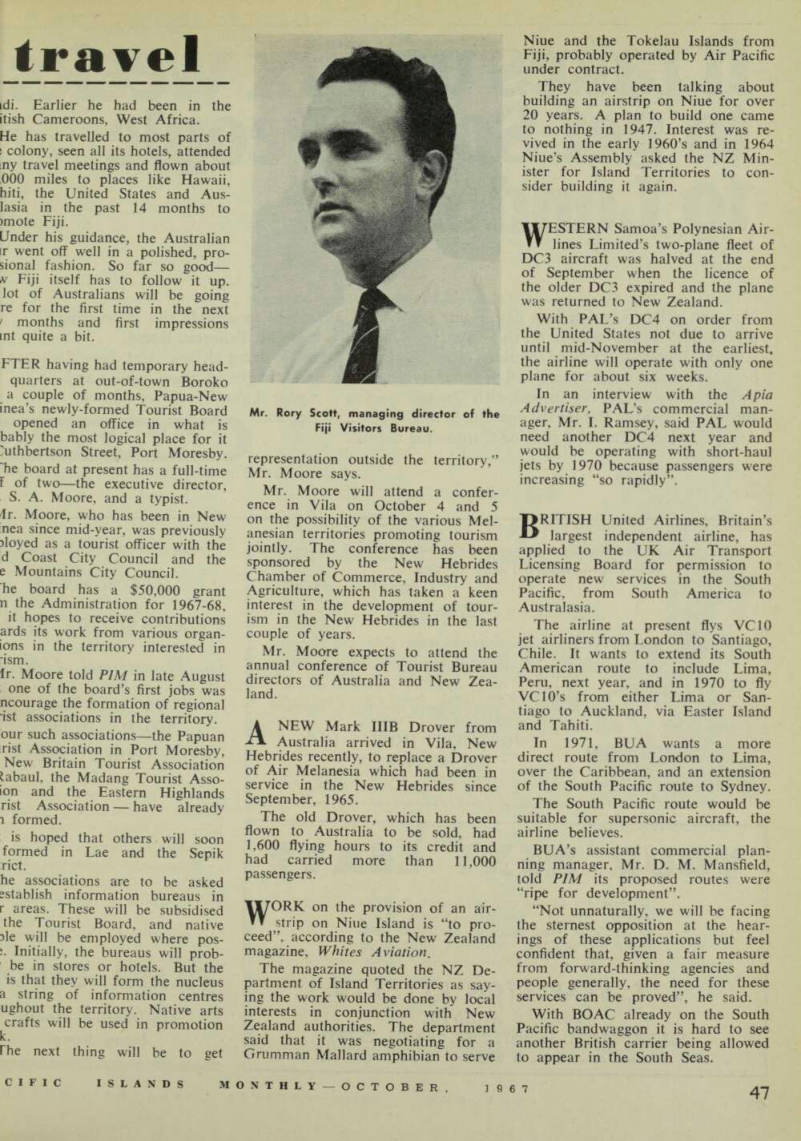
An intensive campaign to boost the flow of Australian visi tors to Fiji got off to a good start in September with a 13-day pro motion tour to Australia by 17 of Fiji’s tourist industry repre sentatives, HEADED by Mr, Roderick (Rory) J. Scott, managing director of the Fiji Visitors Bureau, the Fiji team staged seminars on Fiji in Syd ney, Melbourne, Adelaide and Bris bane and paid dozens of personal calls on travel agents in those cities.
The tour, which was sponsored by the bureau and by Qantas, attracted a good Press and television coverage, Mr. Scott told travel agents in Syd ney that if trends continued, by the end of this year there would be more Australians visiting Fiji than any other nationality.
He asked agents to promote Fiji as the “In” holiday spot for Aus tralians. Fiji’s climate, the friendli ness of its people, its food, its good hotels, made it the top tourist centre of the South Seas.
Mr. Scott also pointed out that Fiji’s relative political stability made it ideal for overseas investment.
Package deal tours were largely re sponsible for the increasing number of tourists arriving in Fiji by air.
Fare reductions wanted
“We think these package deals are very good but we would also like reductions in normal air fares in the South Pacific,” Mr. Scott said in Syd ney. “At next year’s lATA confer ence we hope the Fiji Government will bring more pressure on inter national airlines to lower basic fare rates.”
The Fiji Government, which ad mitted it was disappointed when basic fares weren’t reduced at last year’s lATA conference, is expected to press strongly for these air fare cuts.
Scott, a 31-year-old good-looking Englishman, was appointed boss of the Fiji Visitors Bureau in July last year after more than five years as a District Officer at Nausori and then
idi. Earlier he had been in the itish Cameroons, West Africa.
He has travelled to most parts of : colony, seen all its hotels, attended my travel meetings and flown about 000 miles to places like Hawaii, hiti, the United States and Aus lasia in the past 14 months to imote Fiji.
Under his guidance, the Australian ir went off well in a polished, pro sional fashion. So far so good— v Fiji itself has to follow it up. lot of Australians will be going re for the first time in the next ' months and first impressions int quite a bit.
FTER having had temporary head quarters at out-of-town Boroko a couple of months, Papua-New inea’s newly-formed Tourist Board opened an office in what is bably the most logical place for it 'uthbertson Street, Port Moresby, 'he board at present has a full-time F of two—the executive director, S. A. Moore, and a typist. ir. Moore, who has been in New nea since mid-year, was previously iloyed as a tourist officer with the d Coast City Council and the e Mountains City Council, he board has a $50,000 grant n the Administration for 1967-68, it hopes to receive contributions ards its work from various organ ions in the territory interested in ■ism.
Ir. Moore told PIM in late August one of the board’s first jobs was ncourage the formation of regional ist associations in the territory, our such associations—the Papuan rist Association in Port Moresby, New Britain Tourist Association labaul, the Madang Tourist Asso ion and the Eastern Highlands rist Association have already 1 formed. is hoped that others will soon formed in Lae and the Sepik rict. he associations are to be asked establish information bureaus in r areas. These will be subsidised the Tourist Board, and native ?le will be employed where pos ;. Initially, the bureaus will prob be in stores or hotels. But the is that they will form the nucleus a string of information centres ughout the territory. Native arts crafts will be used in promotion Phe next thing will be to get
representation outside the territory,”
Mr. Moore says.
Mr. Moore will attend a confer ence in Vila on October 4 and 5 on the possibility of the various Mel anesian territories promoting tourism jointly. The conference has been sponsored by the New Hebrides Chamber of Commerce, Industry and Agriculture, which has taken a keen interest in the development of tour ism in the New Hebrides in the last couple of years.
Mr. Moore expects to attend the annual conference of Tourist Bureau directors of Australia and New Zea land.
ANEW Mark 1118 Drover from Australia arrived in Vila, New Hebrides recently, to replace a Drover of Air Melanesia which had been in service in the New Hebrides since September, 1965.
The old Drover, which has been flown to Australia to be sold, had 1,600 flying hours to its credit and had carried more than 11,000 passengers.
WORK on the provision of an air strip on Niue Island is “to pro ceed”, according to the New Zealand magazine, Whites Aviation.
The magazine quoted the NZ De partment of Island Territories as say ing the work would be done by local interests in conjunction with New Zealand authorities. The department said that it was negotiating for a Grumman Mallard amphibian to serve
Niue and the Tokelau Islands from Fiji, probably operated by Air Pacific under contract.
They have been talking about building an airstrip on Niue for over 20 years. A plan to build one came to nothing in 1947. Interest was re vived in the early 1960’s and in 1964 Niue’s Assembly asked the NZ Min ister for Island Territories to con sider building it again.
WESTERN Samoa’s Polynesian Air lines Limited’s two-plane fleet of DC3 aircraft was halved at the end of September when the licence of the older DC3 expired and the plane was returned to New Zealand.
With PAL’s DC4 on order from the United States not due to arrive until mid-November at the earliest, the airline will operate with only one plane for about six weeks.
In an interview with the Apia Advertiser, PAL’s commercial man ager, Mr. I. Ramsey, said PAL would need another DC4 next year and would be operating with short-haul jets by 1970 because passengers were increasing “so rapidly”.
BRITISH United Airlines, Britain’s largest independent airline, has applied to the UK Air Transport Licensing Board for permission to operate new services in the South Pacific, from South America to Australasia.
The airline at present flys VC 10 jet airliners from London to Santiago, Chile. It wants to extend its South American route to include Lima, Peru, next year, and in 1970 to fly VClO’s from either Lima or San tiago to Auckland, via Easter Island and Tahiti.
In 1971, BUA wants a more direct route from London to Lima, over the Caribbean, and an extension of the South Pacific route to Sydney.
The South Pacific route would be suitable for supersonic aircraft, the airline believes.
BUA’s assistant commercial plan ning manager, Mr. D. M. Mansfield, told PIM its proposed routes were “ripe for development”.
“Not unnaturally, we will be facing the sternest opposition at the hear ings of these applications but feel confident that, given a fair measure from forward-thinking agencies and people generally, the need for these services can be proved”, he said.
With BOAC already on the South Pacific bandwaggon it is hard to see another British carrier being allowed to appear in the South Seas.
Mr. Rory Scott, managing director of the Fiji Visitors Bureau.