travel
pp. 39-49 · Read in the full issue
A Regular Rim Department
Reporting News Of South
Seas Tourism And Travel
From The Inside
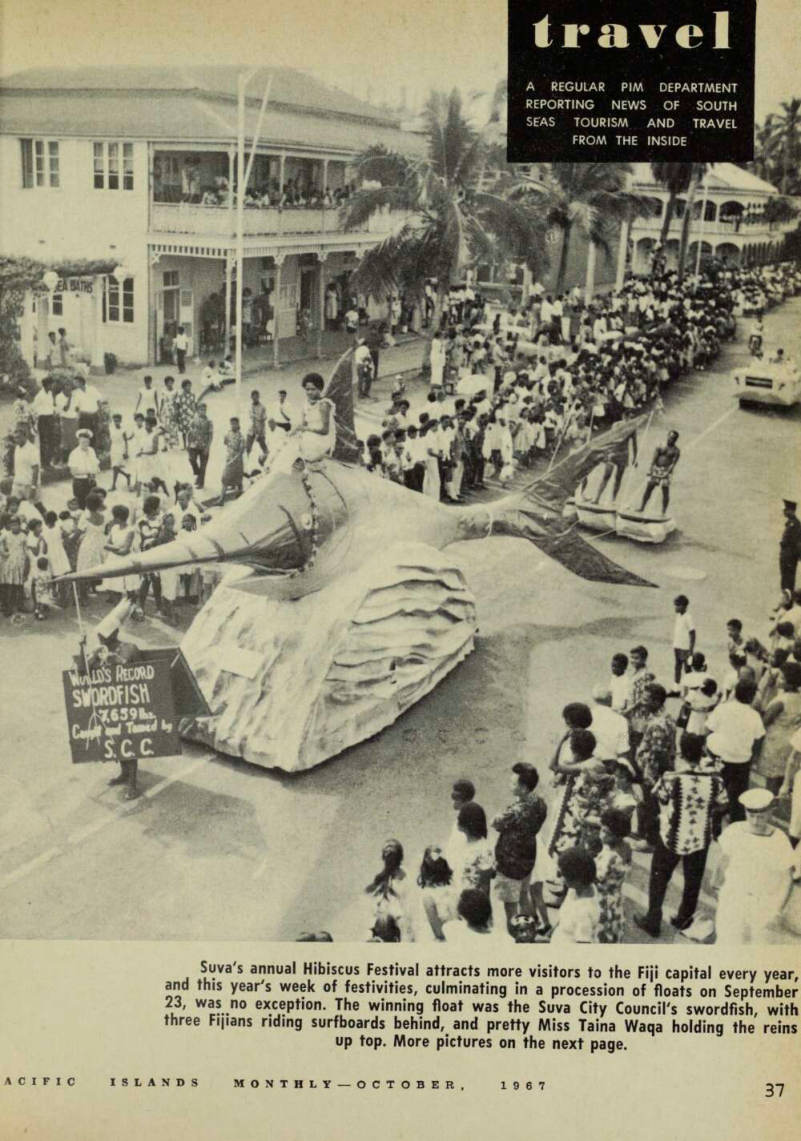
Suva's annual Hibiscus Festival attracts more visitors to the Fiji capital every year, and this year's week of festivities, culminating in a procession of floats on September 23, was no exception. The winning float was the Suva City Council's swordfish, with three Fijians riding surfboards behind, and pretty Miss Taina Waqa holding the reins up top. More pictures on the next page.
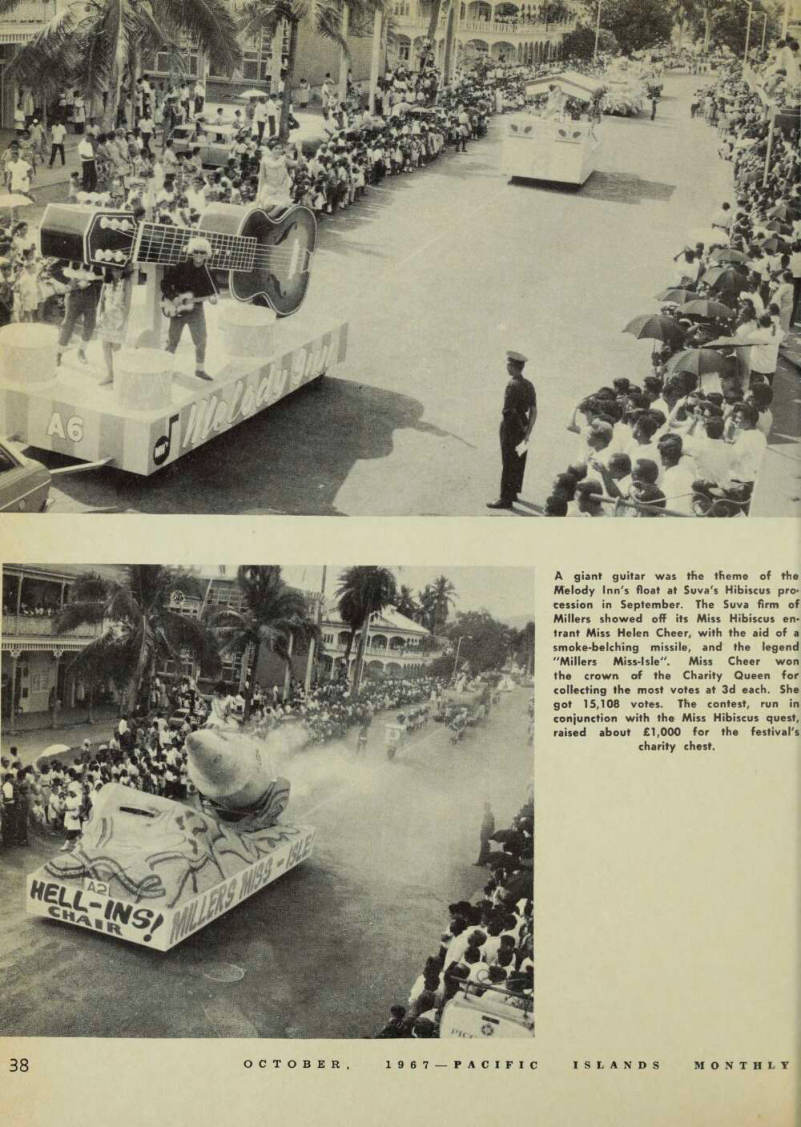
A giant guitar was the theme of the Melody Inn's float at Suva's Hibiscus pro cession in September. The Suva firm of Millers showed off its Miss Hibiscus en trant Miss Helen Cheer, with the aid of a smoke-belching missile, and the legend "Millers Miss-Isle". Miss Cheer won the crown of the Charity Queen for collecting the most votes at 3d each. She got 15,108 votes. The contest, run in conjunction with the Miss Hibiscus quest, raised about £1,000 for the festival's
charity chest.
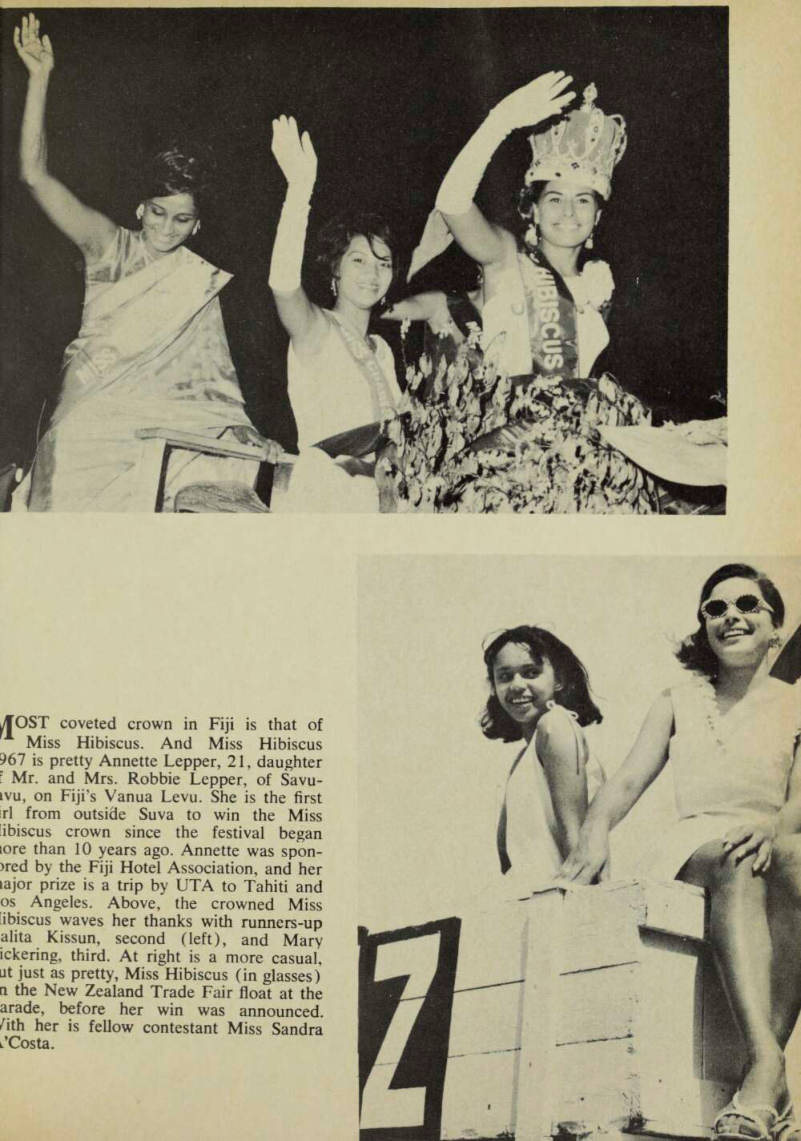
Most coveted crown in Fiji is that of Miss Hibiscus. And Miss Hibiscus 1967 is pretty Annette Lepper, 21, daughter of Mr. and Mrs. Robbie Lepper, of Savu [?]vu, on Fiji’s Vanua Levu. She is the first [?] rl from outside Suva to win the Miss [?] ibiscus crown since the festival began more than 10 years ago. Annette was spon [?]red by the Fiji Hotel Association, and her major prize is a trip by UTA to Tahiti and [?] os Angeles. Above, the crowned Miss [?] ibiscus waves her thanks with runners-up [?] alita Kissun, second (left), and Mary [?] ickering, third. At right is a more casual, [?] ut just as pretty, Miss Hibiscus (in glasses) in the New Zealand Trade Fair float at the [?] arade, before her win was announced, With her is fellow contestant Miss Sandra [?] ’Costa.
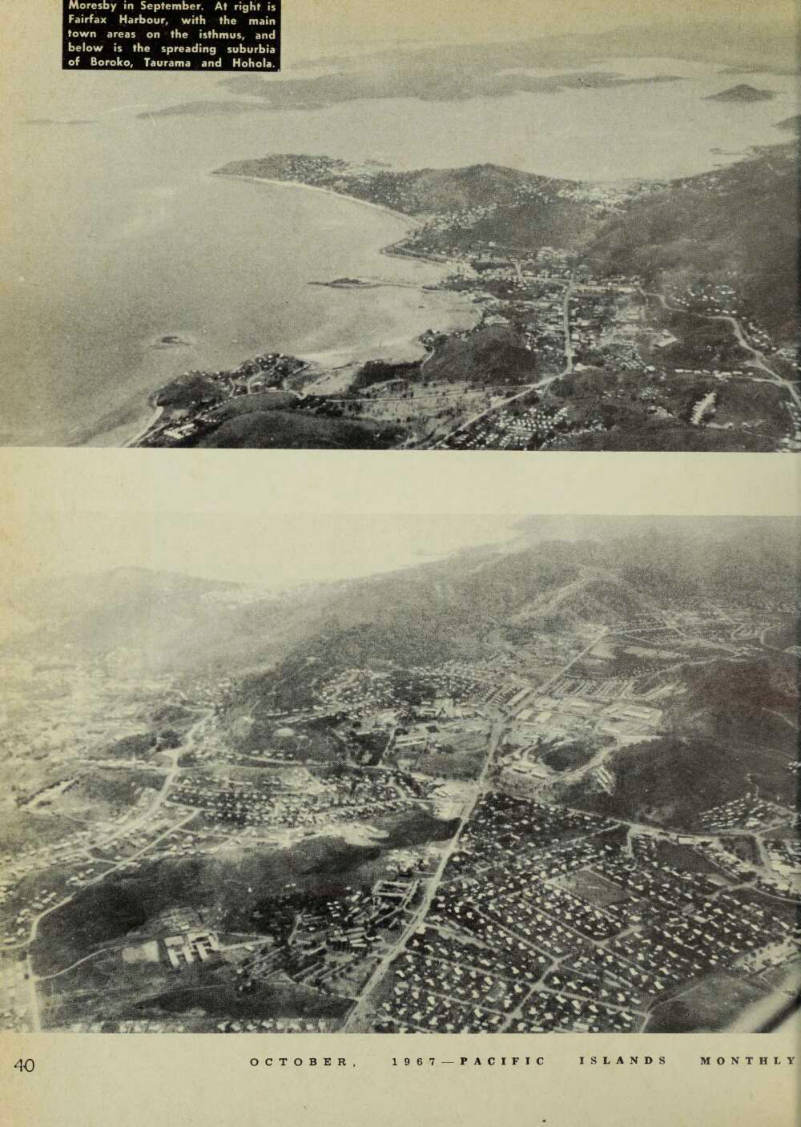
Moresby in September. At right is Fairfax Harbour, with the main town areas on the isthmus, and below is the spreading suburbia of Boroko, Taurama and Hohola.
New Guinea—Asia Air Link
Creates New Air Patterns
By a Staff Writer
When Qantas linked Papua-New Guinea with South-East Asia on September 14 after a five-year absence from the territory, the welcome at Port Moresby’s Jacksons Airport was reminis cent of Tahiti or Rarotonga rather than of Papua.
LANDS beauties with flashing smiles greeted aircraft passengers placing leis about their shoulders, 1 farewelled them with gifts of w Guinea wood carvings. A pical downpour at the key moments r e the occasion local colour rather n a dampening down, fhe Papuan girls, selected for their glish as well as their looks, were m Port Moresby. The girls invited h through-passenger, “to come k again”. The reception was anged by the recently established JG Tourist Board, which made no ret of the fact it is delighted that v Guinea is now on the world rist route to stay.
Qantas last operated through New inea in July, 1962, using old Super istellations on a weekly service :ing Sydney, Port Moresby, Manila Hong Kong. Qantas was not per ted to pick up or set down sengers between Port Moresby and dralia, and the service was ndoned because it wasn’t popular ugh with through passengers, who Id get faster service on other itas aircraft. Port Moresby at : time could not take large jets.
Deplored the loss
lew Guinea people deplored the of their outlet to and from the t, especially traders who were inning to make good use of air ght, but there was nothing tney Id do about it. Qantas has fought way back into the New Guinea [ice against the apathy of Aus ian Government planners, who e moved slowly in upgrading Port resby airport and who once en ained a bid by Ansett-ANA for ompetitive service to Manila, he reinstated service is still not :tly what Qantas wants, but the ine’s view seems to be better r a loaf than no bread at all. ag the larger Boeing 707 338c’s, service operates Sydney-Port resby-Manila-Hong Kong on irsdays and returns on Saturdays, aila is of little traffic interest
and Qantas will probably delete it when Port Moresby is brought up to full operational use.
Jacksons Airport is now 6,800 ft with over-runs of 200 ft at each end.
Although, oddly, the small Qantas 707 1388 Boeings cannot operate on this length, the larger Boeings can, if they restrict themselves north bound to 260,000 lb take-off weight, compared with their maximum of 316.000 lb.
They can carry a 31,000 lb pay load between Port Moresby-Manila, compared with the maximum of 46.000 lb. This enables them to carry full passenger loadings, plus baggage and mail, but restricts cargo. There are no problems southbound be cause of the decreasing fuel load.
Jacksons Airport will be lengthened to about 8,500 ft including over-runs, and be strengthened, thus allowing full direct services between Port
I -™-
Moresby and Hong Kong, with Manila omitted. Tokyo may then be added to the route and the services in creased to two a week, In the meantime work has started on improving the terminal building at Port Moresby, making it easier to handle the extra passengers the big jet services will carry. Until this has been completed P-NG Customs has agreed to process passengers at the Gateway Hotel, just opened right at the airport. The Gateway is the first luxury hotel built in the terri tory and a big improvement on the general hotel standard there (see p. 43), Others will follow, The Gateway was planned with in creased air travel in mind, for the
This was the scene at Jacksons Airport, Port Moresby, on September 14, when the new Qantas 707 service to Hong Kong set down. Rain did not detract from the welcome given to passengers by pretty Papuan girls.
v Qantas service will in fact turn t Moresby into an aerial gateway, t has coincided with the arrival Fiji of Fiji Airways’ new turbo p Hawker Siddeley 748. This air ft carries 40 passengers and will lace the eight-passenger Herons on inter-island services linking Fiji i the New Hebrides and the amons in the west, the Gilbert Ellice Islands in the north, and iga in the east. n Honiara, capital of the Solomons, HS74B service will connect with TAA Fokker Friendship service 3 ort Moresby, thus making it pos e for travellers to travel from ig Kong to Fiji on fast comfort -5 aircraft, without touching Aus ia. From Fiji they can also travel Hong Kong the same way, stop \ en route at Vila, Honiara. >aul, Lae and Port Moresby.
Qantas plans
|antas plans to get some of this eased traffic, as well as some of traffic originating within the terri . On the northbound run from t Moresby it has full rights, but hbound it cannot carry territory engers to the Australian mainland iss they have started their journey ide the territory or are complet it outside Australia, can, for instance, take passengers Australia who have originated r trip in the Solomons, and it can New Guinea passengers who t to go through Australia to, say, t Zealand or Africa; just as long hey buy a Qantas through ticket, ut the big market is obviously /een New Guinea, Hong Kong Japan, and already the projected enger loadings look healthy. The gural service carried more than economy class passengers north i Port Moresby. he flight is a daylight one, clear ss the entire island of New Guinea, sing the West Irian northern t near Biak. Mostly there are d build-ups on the high mountain cbone over which the aircraft but passengers lucky enough have a clear day should get nificent panoramas of parts of 1 Guinea not hitherto traversed commercial flights. There are libals down in some of those jys. antas is going all out to build our parties to New Guinea from north, particularly from Japan, ly New Guinea people already
include Hong Kong in their leave itineraries, travelling by ship.
It is unfortunate that the new service has coincided with recent bomb incidents in Hong Kong, which has had an effect on the tourist influx into that colony.
The Hong Kong scene
3 3 A PIM staff writer who spent several days in Hong Kong on the first flight through Port Moresby in September found accommodation was easy to get in Hong Kong although the colony is now in what is usually its peak tourist period. Many tour parties had cancelled tours there, and the Hong Kong travel industry was launching a campaign aimed at restoring confidence in Hong Kong as a tourist centre.
Certainly visitors should have no apprehensions. It is business as usual in the thriving colony, and there is no tension. The PIM man found the atmosphere the same as it was on his last trip three years ago, but there has been much more building, particularly of hotels, in the intervening period.
Nobody in the colony believes China is seriously attempting to take over Hong Kong. It is still in China’s interest to use Hong Kong as a valuable trading link with the West.
Large quantities of foodstuffs daily cross the Chinese border into Hong
Kong for sale, and trading of all sorts continues.
Experienced newspaper observers in Hong Kong believe that the re cent bomb scares may have been locally engineered by the Kwantung Province, the Chinese province closest to Hong Kong, as an em barrassment to the Peking Govern ment. Traditionally this province has always needled central authority, There is a strong opinion that Peking wants to avoid any clashes with the West in Hong Kong, One bomb which killed two small Chinese children in Hong Kong re cently caused a strong revulsion against the would-be terrorists among all sections of the Hong Kong popu lation. There is little support for the dissentients, and many big Red China owned businesses in the colony have been quietly boycotted by shoppers, M au/ p ar :f ir nlanc rdcmc P ,ans Meanwhile, the new Port Moresby gateway services will generally help intensify the whole South Pacific travel picture. There are several new developments, with more on the way.
Air New Zealand goes back to Tahiti in November, leaving Auck land on November 12, and inaugurat ing at the same time the Papeete- Los Angeles service. DCB’s are be ing used. Air New Zealand has a
;e in West Samoa’s Polynesian lines, as well as a share in Fiji ways. Thus the airline is right k on the Coral Route that it leered. /ith its Los Angeles service in ration, Air New Zealand will be ig to the USA, Hawaii, Fiji, erican Samoa, New Caledonia, folk Island and Tahiti besides its e across the Tasman to Australia on to Hong Kong. It will be g back into the Cook Islands in a year, possibly through a 1 operated by Polynesian. /ith its Hawker Siddeley, Fiji vays may develop new routes, ining a link between Tarawa, in GEIC, and Majuro, in the shall Islands of the US Trust itory. Such a service was remended recently in a report on GEIC’s tourist potential by a sh firm (PIM, September, p 53), obviously Fiji Airways will want ; sort of subsidy. m American has interests in the Trust Territory. It has recently a bigger shareholding in Microin Air Pacific, to be formed in !mber - Sydney m September there was that PanAm might be interested perating a service between Syd- Guam and Tokyo, but shortage urcraft might prevent anything
further on this. PanAm uses a lot of equipment for Vietnam, The South Pacific has yet to hear which additional American airline is to be allowed to operate through th e South Pacific. There are many contenders. Eastern Airlines recently established an Australian office, Tl/ITH Noumea getting more popular as an Australian holiday resort, Qantas and UTA French Air lines are increasing Sydney-Noumea flights from three to five a week each way, . UTA started its additional service Wldl Caravelle jets on September 10 and Q a ntas will follow suit on De member 4 with Boeing 707’s. , , (Ta^ TER fllghtS provlded b V . a , DC-3 aircraft of Polynesian Air lmes have been proving popular re- £ end y Wltb Tongans interested in B om B for a flip” for the first time an( l i* l seeing a bit of Tonga from eroup was «> thrilled .‘ h „ e,r ex P er ‘ enc ® ha * . th «y, are P binning a second charter flight later ,n ,he year - STATISTICS of visitors to Fiji in O recent years have proved that the 20-29 age group outnumbers all others from Australia and New Zealand, whereas the over-50’s make up most UK and US visitors.
[?] o learn all about Fiji Airways' new Hawker Siddeley 748, three of the airline's [?] ilots recently attended a training course at the Hawker Siddeley Aviation raining school at Woodford, in Cheshire, England. From left, they are: Captain A. G. Heyen; Captain Neil Ganley, chief pilot; and Captain Gordon Shearer, [?] eputy chief pilot. Mr. G. Flannigan, an instructor, has his back to the camera.
The 748 arrived in Suva on September 21.