Tropicalities
pp. 36-38 · Read in the full issue
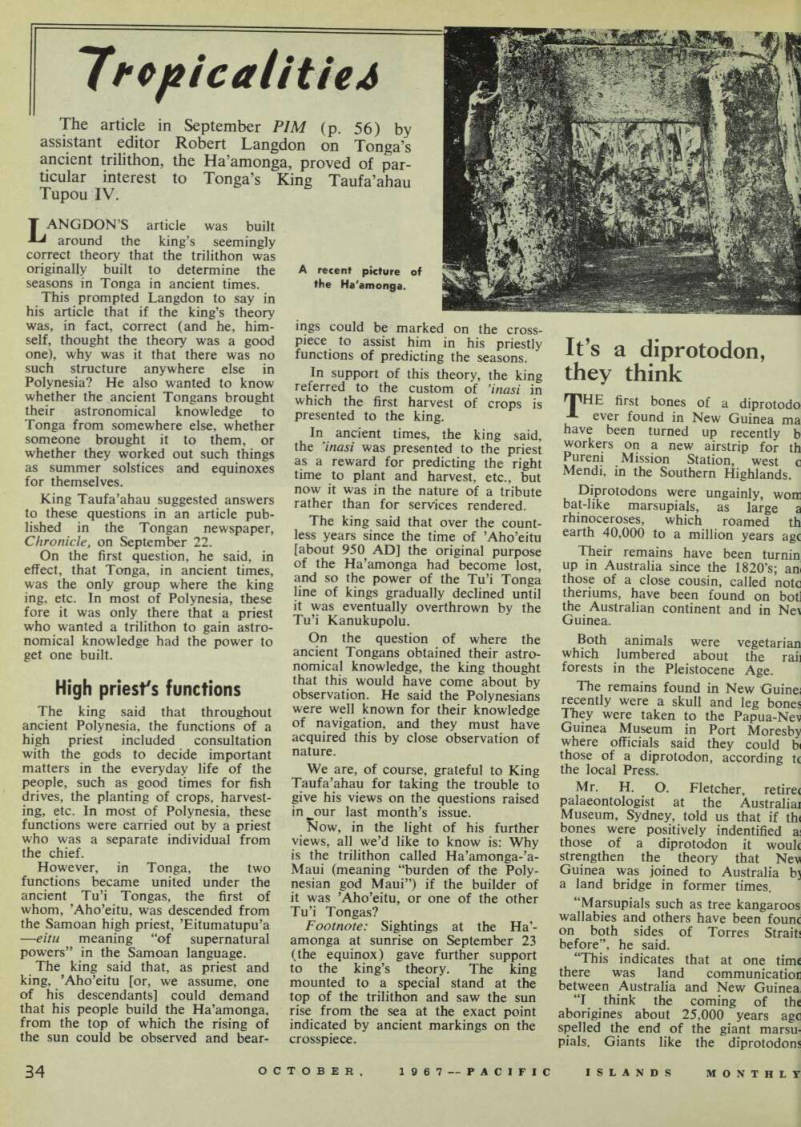
The article in September PIM (p. 56) by assistant editor Robert Langdon on Tonga’s ancient trilithon, the Ha’amonga, proved of par ticular interest to Tonga’s King Taufa’ahau Tupou IV.
LANGDON’S article was built around the king’s seemingly correct theory that the trilithon was originally built to determine the seasons in Tonga in ancient times.
This prompted Langdon to say in his article that if the king’s theory was, in fact, correct (and he, him self, thought the theory was a good one), why was it that there was no such structure anywhere else in Polynesia? He also wanted to know whether the ancient Tongans brought their astronomical knowledge to Tonga from somewhere else, whether someone brought it to them, or whether they worked out such things as summer solstices and equinoxes for themselves.
King Taufa’ahau suggested answers to these questions in an article pub lished in the Tongan newspaper, Chronicle, on September 22.
On the first question, he said, in effect, that Tonga, in ancient times, was the only group where the king ing, etc. In most of Polynesia, these fore it was only there that a priest who wanted a trilithon to gain astro nomical knowledge had the power to get one built.
High priest's functions
The king said that throughout ancient Polynesia, the functions of a high priest included consultation with the gods to decide important matters in the everyday life of the people, such as good times for fish drives, the planting of crops, harvest ing, etc. In most of Polynesia, these functions were carried out by a priest who was a separate individual from the chief.
However, in Tonga, the two functions became united under the ancient Tu’i Tongas, the first of whom, ’Aho’eitu, was descended from the Samoan high priest, ’Eitumatupu’a —eitu meaning “of supernatural powers” in the Samoan language.
The king said that, as priest and king, ’Aho’eitu [or, we assume, one of his descendants] could demand that his people build the Ha’amonga, from the top of which the rising of the sun could be observed and bear-
ings could be marked on the cross piece to assist him in his priestly functions of predicting the seasons.
In support of this theory, the king referred to the custom of ’inasi in which the first harvest of crops is presented to the king.
In ancient times, the king said, the "inasi was presented to the priest as a reward for predicting the right time to plant and harvest, etc., but now it was in the nature of a tribute rather than for services rendered.
The king said that over the count less years since the time of ’Aho’eitu [about 950 AD] the original purpose of the Ha’amonga had become lost, and so the power of the Tu’i Tonga line of kings gradually declined until it was eventually overthrown by the Tu’i Kanukupolu.
On the question of where the ancient Tongans obtained their astro nomical knowledge, the king thought that this would have come about by observation. He said the Polynesians were well known for their knowledge of navigation, and they must have acquired this by close observation of nature.
We are, of course, grateful to King Taufa’ahau for taking the trouble to give his views on the questions raised injDur last month’s issue.
Now, in the light of his further views, all we’d like to know is: Why is the trilithon called Ha’amonga-’a- Maui (meaning “burden of the Poly nesian god Maui”) if the builder of it was ’Aho’eitu, or one of the other Tu’i Tongas?
Footnote: Sightings at the Ha’amonga at sunrise on September 23 (the equinox) gave further support to the king’s theory. The king mounted to a special stand at the top of the trilithon and saw the sun rise from the sea at the exact point indicated by ancient markings on the crosspiece.
It’s a diprotodon,
they think
T*HE first bones of a diprotodo ever found in New Guinea ma have been turned up recently b workers on a new airstrip for th Pureni Mission Station, west o Mendi, in the Southern Highlands.
Diprotodons were ungainly, wore bat-like marsupials, as large a rhinoceroses, which roamed th earth 40,000 to a million years age Their remains have been turnin up in Australia since the 1820’s; am those of a close cousin, called note theriums, have been found on bot] the Australian continent and in Ne\ Guinea.
Both animals were vegetarian which lumbered about the rah forests in the Pleistocene Age.
The remains found in New Guinei recently were a skull and leg bones They were taken to the Papua-Nev Guinea Museum in Port Moresby where officials said they could b< those of a diprotodon, according tc the local Press.
Mr. H. O. Fletcher, retiree palaeontologist at the Australia!
Museum, Sydney, told us that if the bones were positively indentified a! those of a diprotodon it woulc strengthen the theory that Nev Guinea was joined to Australia bj a land bridge in former times, “Marsupials such as tree kangaroos wallabies and others have been founc on both sides of Torres Straits before”, he said.
“This indicates that at one time there was land communicatior between Australia and New Guinea, “I think the coming of the aborigines about 25,000 years ago spelled the end of the giant marsu pials. Giants like the diprotodons
A recent picture of the Ha'amonga.
id nototheriums went from Aus alia to New Guinea, not vice versa.
“The Australian gold rushes in the iddle of last century and wide read mining activities ever since ought many traces of diprotodons light and new finds are very com onplace.
“This is certainly the first one und in New Guinea. But it really ily confirms what scientists thought I along—that New Guinea, Aus ilia and Tasmania were all joined some stage.”
Lecognition for
Breadfruit” Bligh
[7TLLIAM BLIGH, of Bounty ▼ fame, who has received scant cognition for his discovery and curate charting of many of the ji islands, is to be the subject of set of postage stamps that the Fiji >st Office will issue on December to commemorate the 150th anof his death.
A 4d stamp will show Bligh in tline behind his ship HMS Pro ience, in which he visited Fiji in 92.
On a 1/- stamp Bligh and his loyal mnty crewmen will be shown sail l through Fiji waters in the tunty’s longboat after the famous itiny off the Tongan island of Tofua 1789. The stamp will show the igboat being pursued by Fijian ir canoes, as recorded in Bligh’s y of his journey from Tonga to mor. The scene will be superim sed on a contemporary chart of ; area.
A 2/6 stamp will show Bligh’s rib in London with his admiral’s t and glass.
It is not generally known that igh was the major discoverer of i Fiji Islands, and that for some ars Fiji was known as Bligh’s ands.
The only explorers who preceded n in the Fiji Group were Abel sman in 1642, and Captain Cook, to saw only the small island of itoa in the southern Lau Islands, 1774.
Bligh was in Fiji on two occasions, ic first was in the Bounty’s long at. The second was in the Pro ience after he had been to Tahiti second time to collect breadfruit - the West Indies.
On his two visits, he saw and jghly charted no less than 39 ands —l 9 in the Lau Group, eight central Fiji, and 12. including the tin island of Viti Levu, in the st.
Ironically, there are only two butes to Bligh’s achievements on >dern maps.
One is Bligh Water—the sea north of Viti Levu —over which Bligh was, as far as is known, the first European to sail. The other is Bounty Boat Passage, a recent (mid-1962) ad dition.
Bounty Boat Passage, through which Bligh entered Fiji waters, is in the Lau Group between the islands of Moce and Komo in the north, and Namuka and the Yaqasa cluster in the south.
Footnote : A series of stamps depicting the world-famous fire walkers at Beqa Island will be issued by the Fiji Post Office on October 19 to coincide with the Pacific Area Tourist Conference at the Korolevu Beach Hotel.
That’s what happened
to Johnson
SOME people will remember Ronald Johnson—street photo grapher, disposals merchant and, most of all, sailor extraordinary of extraordinary craft.
He used to occur in PIM a great deal between that time, in 1947, when he drifted and sailed in SC67I (later the Tovata ) from Honolulu to Fiji, and when, in March. 1956, with much publicity he sailed out of Sydney Harbour in a junk.
The junk was wrecked in a wild storm that same night, north of Broken Bay. Johnson lost everything but his life, clawed his way ashore, climbed the steep cliffs and, to an extent, out of our lives. The Pacific has not been quite the same since, We were surprised therefore to lift up the phone one night recently and hear a voice at the other end say: “My name’s Johnson. I picked up a book in the library today and saw my picture in it!”
The book he was referring to was Many a Green Isle by Judy Tudor who, among other things, tells the story of Johnson and Tovata, ex- Purple Sea, e\-SC67I.
Johnson was telephoning from Gosford, which isn’t far from where his junk was wrecked, and he was, in a way, he said, still in the disposals business—although, he explained, “disposals stuff wouldn’t buy morning tea. It’s all new although the dis posals sign brings them in—some people even think the Japanese toys are ex-Army!”
Johnson-like, he was in the middle of selling out, “with enough stock left over to fill three shops”. But he hadn’t forsaken boats altogether and was also in the middle of organising the Hawkesbury River Cruising Club around his 41-ft motor-cruiser nostalgically named Island Trader.
In it he hopes to take parties of up
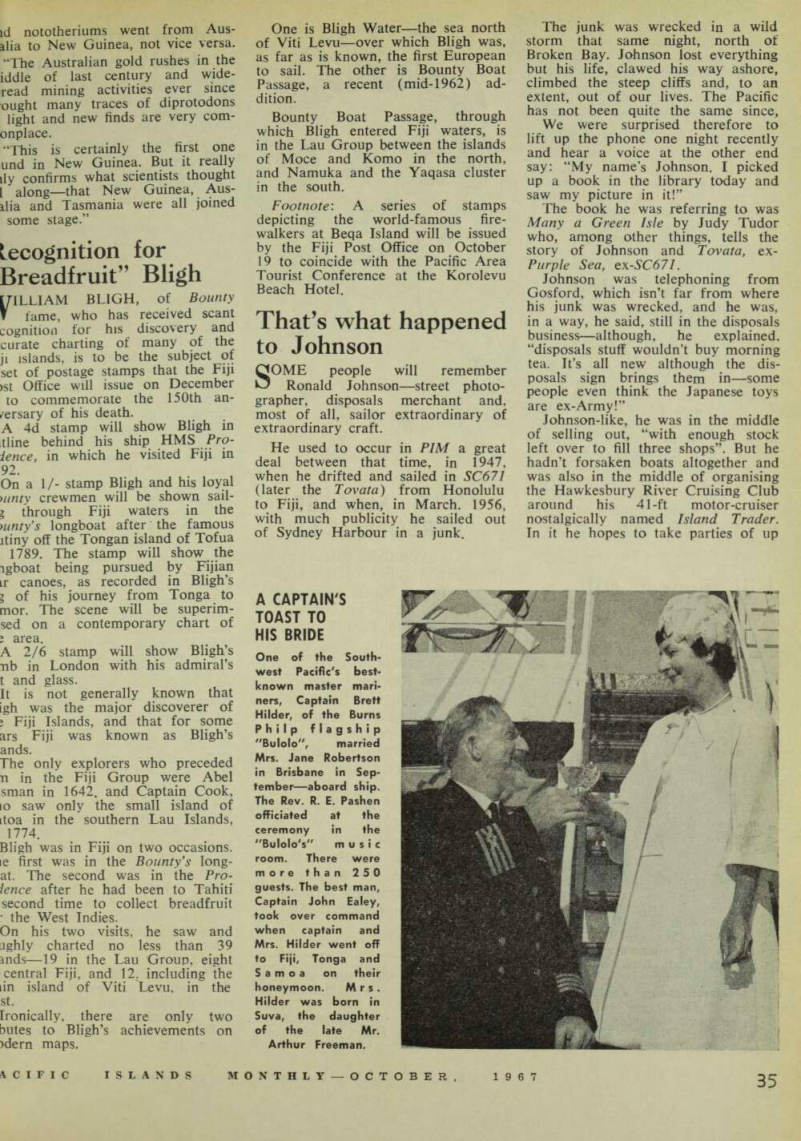
A Captain's
Toast To
His Bride
One of the South west Pacific's best known master mari ners, Captain Brett Milder, of the Burns
Philp flagship
"Bulolo", married Mrs. Jane Robertson in Brisbane in Sep tember—aboard ship.
The Rev. R. E. Pashen officiated at the ceremony in the "Bulolo's" music room. There were more than 250 guests. The best man, Captain John Ealey, took over command when captain and Mrs. Milder went off to Fiji, Tonga and Samoa on their honeymoon. Mrs.
Milder was born in Suva, the daughter of the late Mr.
Arthur Freeman.
to 20 cruising anywhere they like around the Hawkesbury waters, at $4 a day each. Or they can hire it by the week, with skipper supplied.
It seems a far cry from adventure on the high seas but even for the Ronald Johnsons of the world 20 years bring changes.
“I might sell everything up and take off in the boat,” he says, playing with the old dream, and then con tinues: “I’ve become the owner of five waterfront blocks and several others including 10 acres up the Hawkesbury, so if I get wrecked again at least I’ll have some place to go.”
She’s well-equipped
for delivery!
FIJI’S latest ship, the Alta, expected to go into service in a few months, was apparently used as a hospital ship of sorts by her previous owners, a Norwegian company.
According to The Fiji Times there is room for 30 first class passengers in 13 “two-birth” cabins, two single cabins and a “two-birth” suite.
In second class there will be ac commodation for a further 27 in nine “three-birth” cabins.
With so many multiple births one can image the Colony’s population exploding at an almost disastrous rate,
Fiji pioneer still
going strong at 96
MR. P. A. SNOW, formerly a District Commissioner in Fiji and magistrate in many districts, has written to us from his home in Rugby, Warwickshire, about a visit he made recently to Mrs. A. B.
Brewster, whose memories of Fiji go back some 70 years.
Mrs, Brewster, who is 96, is the widow of the author of The Hill Tribes of Fiji and other books. Mr.
Brewster (his name was originally Joske) was Commissioner of the Colo districts of Fiji at the beginning of the century.
Mr. Snow tells us that Mrs.
Brewster is still mentally alert and has vivid recollections of life in Fiji before the turn of the century.
On his visit to her, he took with him a photograph of her husband and herself (Mr. and Mrs. Adolph Joske as they then were) with Sir Henry and Lady Berkeley, amid the boulders and bush of Nadarivatu.
Sir Henry Berkeley was then Chief Justice of Fiji.
Sir Henry’s daughter, Alice, died recently at North Kilworth in Warwickshire at the age of 86, and
Mr. Snow, who was a near neighbour, was among those who attended her funeral.
Mr. Snow says that another daughter of Sir Henry is still going strong at 84.
Cultures merge
at GEIC wedding
TpHE recent marriage of Mi; A Tabei Uriam, of the Ellic Islands, and Mr. Euta Toma, of th Gilbert Islands, at the Protestai Church, Betio, was not an event c great social importance, but th manner in which it was carried oi was significant. It was a merging c Gilbertese, Ellice and Europea tradition.
The marriage, according t Gilbertese custom, was not a lov match, something still frowned upo by the old Gilbertese. Mr. Tom wrote to the cook of his old schot at Rongorongo, requesting that sh should find him a wife among th pupils there. Miss Uriam was ap proached, and, as her famil approved of the match, she agreec During the engagement, the bride to-be spent a week with her futur husband’s family, to give them chance to know her. She followe Gilbertese tradition closely by wash ing her feet before entering thei home. Mr. Toma performed tha same small ritual before enterin his future parents-in-laws’ home fo a week’s stay.
The marriage service was j)ei formed in European style, althoug the bridegroom’s relatives made an* paid for the bride and her attendant dresses, while the bride’s famil provided the groom and his best ma with their lounge suits. A few rela lives were invited to the church fo the service, although the parents o both the bride and the groom wer not present, because of Gilbertes custom, which stipulates that whil the couple are being married th. parents must be preparing th celebration feast.
After the wedding, the newb married couple proceeded to thi bride’s home, where they change* into traditional Ellice costume for th. feast, in their honour, prepared b 1 both families, held in the main Beli<
Maneaba (meeting-house).
The feast itself was both Gilbertese and Ellice, and com prised the customary roast pigs chickens, babai, fish and other islanc dishes. Yet, even there Europeai civilisation made its mark. A wedding cake, to be cut by the bride anc groom, lay next to a roast pig, anc after the feast, coffee and cake wen served.
Some weeks later, at a traditiona three-day farewell party, guests were doused with water if they showee any inclination to sleep!
For a picture of the bridal party see p. 118,