New Caledonia
p. 35 · Read in the full issue
22 Years After The War
Apanese "Spy” Radio
Found In Cave On
New Caledonia
From FRED DUNN in Noumea Two German ex-members of the French Foreign gion, who have taken over a grazing property at ite, on the south-east coast of New Caledonia, ve reported finding a powerful radio transmitter a limestone cave there. Though in an advanced ige of deterioration, the set was easily identifiable being of Japanese manufacture.
HE transmitter obviously has been in the cave for many years and vould seem that it was used for ionage purposes. tefore the Japanese attack on irl Harbour in December, 1941, at it two Japanese lived at Yate age, one of them conducting a ie store a few hundred yards from jre the transmitter is reported to e been found. couple of Japanese also lived ther up the coast, and for some rs the natives had a legend that radio transmitter was hidden icwhere in the vicinity.
Invasion plan
'he coast around the district of ;e right down to the port of Goro of upraised coral and is honey ibed with caves. Many of them e never been explored.
'he natives are more or less ified to enter some of them be se they are ancient burial sites . sites (according to legend) of t cannibal orgies.
'he Japanese plan of invasion of v Caledonia in 1942 was based the idea that action would be centrated in the south around amea.
V landing on the south-eastern st could not have been opposed, fhe Japanese had built the port
at Goro, where they held iron ore concessions. The iron ore was shipped in considerable quantities over about two years, apparently for the nickel it contained.
If troops had landed at Goro, which is situated right on Havannah Passage, Noumea’s back entrance, they could have reached Noumea within hours. How long they might have taken to occupy the town is another matter.
There were at that period no roads in the area—the Plain of Lakes— but the Japanese never seemed to worry about the lack of roads in their campaigns.
The existence of the two big lakes
which give the extreme southern end of New Caledonia its name could have been used by the Jap anese for sea planes, The biggest lake, Grand Lake, is of considerable depth. The second lake is of considerable area, but is be lieved to be no more than six feet in depth.
Most New Caledonians have never seen these lakes, although they are on >y a few miles . from Noumea.
Dl The s ‘ rate g lc importance of the Plai " of L. akes 15 u now . reco B nis ed by the military authorities. Annual army manoeuvres are invariably held in that region, the most recent being last month.
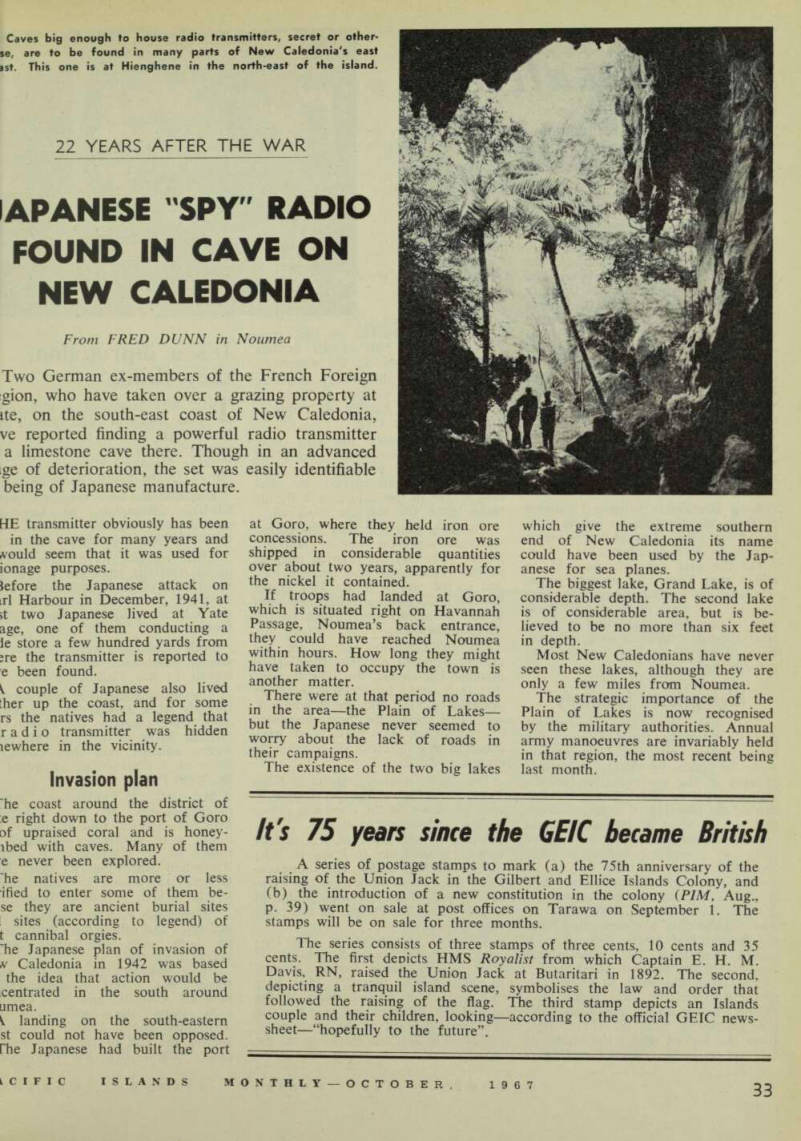
Caves big enough to house radio transmitters, secret or other [?]se, are to be found in many parts of New Caledonia's east [?] ast. This one is at Hienghene in the north-east of the island.