Warning, reassurance
pp. 33-162 · Read in the full issue
for Cook Islands
Prom a Rarotonga correspondent The visit to the Cook Islands late August by New Zealand’s jputy Prime Minister, Mr. J.
Marshall, has brought the
f-goveming Cook Islands up date with the latest New aland attitudes. The Cooks ve received both reassurance
d a warning.
IR. MARSHALL, who was ac l companied by a parliamentary egation, made the following points an address to the Cook Islands »islative Assembly: » New Zealand had promised to p the Cooks to the maximum, but , finance would have to be used maximum advantage, and NZ uld want to know how the money s being spent. The amount of NZ mcial help for the Cooks over the :t three years was now being imined. • NZ would not be happy to iq government money applied omatically to wage increases for Cook Islands Public Service in same way as Public Service in ases in NZ. The conditions of the \ increases were not connected with ok Islands conditions. A cost of ng index for the Cooks was being
(continued on p. 156)
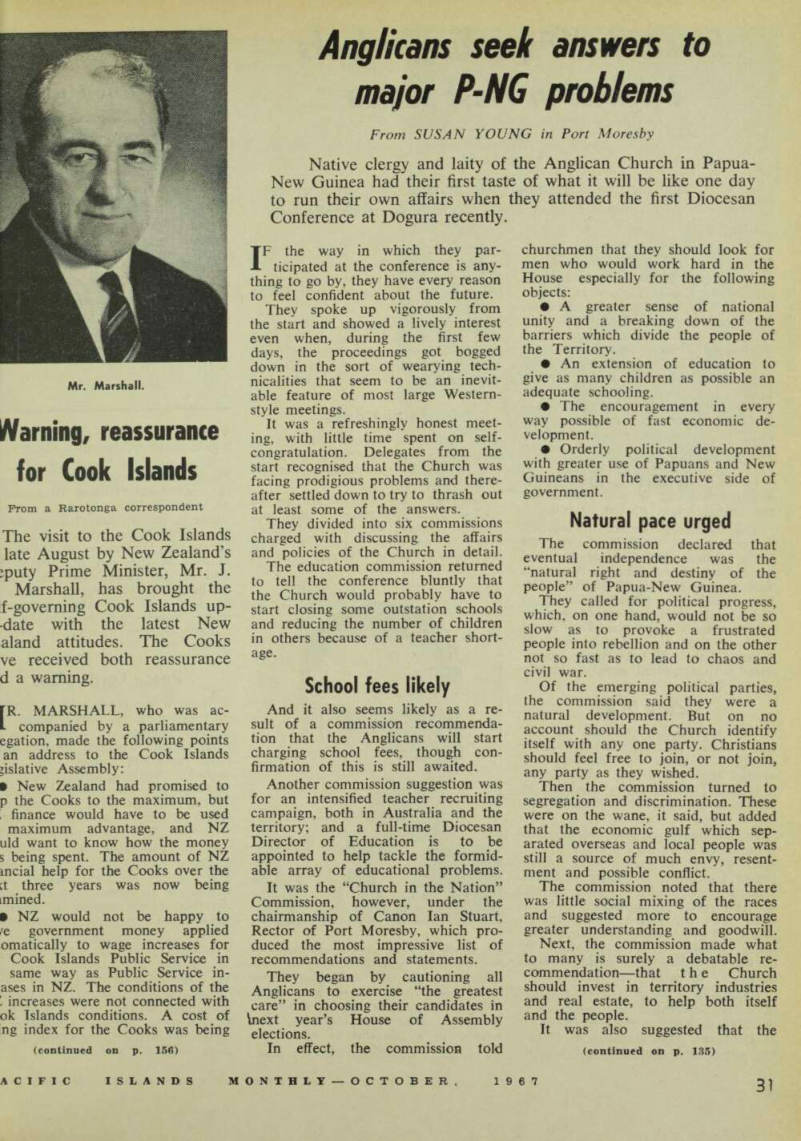
Mr. Marshall.
worked out so that wage increases given locally would be more realistic. • NZ and Cook Islands economies had similarities. Both countries were isolated, far from their main markets and dependent on expensive transport, and both had to import a high percentage of their goods. • Both countries had to spend in creasing amounts on such things as education and health just to maintain standards for their current popula tions. NZ had had to take some un popular measures, such as raising taxes and curtailing import and gov ernment expenditure, and the Cooks Government had been asked to assist NZ in this.
One hopeful comment by Mr.
Marshall was that there were “obvious signs” of progress being made under self-government. He also said that he had noticed “a continued affection for New Zealand”.
During its visit Mr. Marshall’s party also flew to Aitutaki.