in South Seas trade problems
pp. 23-24 · Read in the full issue
How Australia can lend a hand in South Seas trade problems
By R. B. Gall
I think the time has come for a South Pacific Business Co-operation Committee, of the kind which is working very well between Australia and Japan. And I think Australia should take the lead in establishing it.
'■ we are to have prosperity for the people of the South West :ific, then there must be co nation between the “haves” and ive nots”. Australia and New dand are “have” countries, and y have to recognise the needs of “have nots” in this part of the rid. I think this can be done ough such a committee, t is in everybody’s interests, but ticularly in the interests of the inds, that something be got moving ►n, and I am putting forward a r suggestions here in the hope t they might be helpful in getting h a committee started. me explain first how the Aus !ia-Japan Business Co-operation mmittee was established and how works. fhe committee was set up following /isit to Australia in 1961 of the n Prime Minister of Japan, Mr. da, in connection with a proposed Je agreement.
Need for co-operation
t became obvious to both sides ing the discussions that Mr. Ikeda lin Australia that there were ny opportunities for increased le between the two countries, and t problems could be ironed out ter on the business level than the ernmental level. fhere was need simply for closer operation between the leading inessmen of Australia and Japan, i businessmen themselves could ng to the attention of the govern its. those matters which needed cial help for solution. 7 urther, government representa ;s could, if they wanted, be on id to put an official point of view bout their governments being barrassed by the decisions, fhe idea was that the committee aid become a catalyst for generat action, when action was con ned either desirable or possible, i committee meetings would be ums for the exchange of ideas and iciples; for an appreciation of
each other’s problems, and thus, through closer understanding, pro mote trade with a minimum of dis agreement.
The Australia-Japan Business Co operation Committee was formed with headquarters in Canberra. The
Japan-Australia Business Co-operation Committee was formed with head quarters in Tokyo. The first meeting was held in Japan in 1963 and meetings have been held each year since, alternating between Japan and Australia. The fifth meeting was last April, in Tokyo.
Great success
As a member of the Australian committee I can say that the scheme has been a great success. It now seems that this type of approach was rather unique, and other countries have followed our example.
What the committee has shown is that although machinery exists to protect trading interests, fraternisa tion—rather than legislation—can produce more acceptable results. The committee has no legal powers, and needs none.
Of special interest to me has been the fact that although trading pro blems initially were considered to be the most important matters for dis cussion, it quickly became apparent that other matters, too, could and were being discussed—such as student and technician exchange schemes, joint ventures in underdeveloped, countries, and cultural matters.
What are some of the successes?
Regular schemes for exchange of students and technicians are now in operation, many of the technicians being accommodated in the industries of member companies. The exchai\ge of English and Japanese teachers has also been promoted, and a scholar ship is available for Japanese studies.
A Chair of Japanese Studies has been established at the University of Queensland and there have been re commendations for a cultural agree ment between Japan and Australia, like the one that exists between Japan and the UK.
On economic co-operation, the committee has told the Australian Government that it believes Japan should enjoy a taxation agreement which will avoid payment of double taxation.
On the matter of joint ventures, an
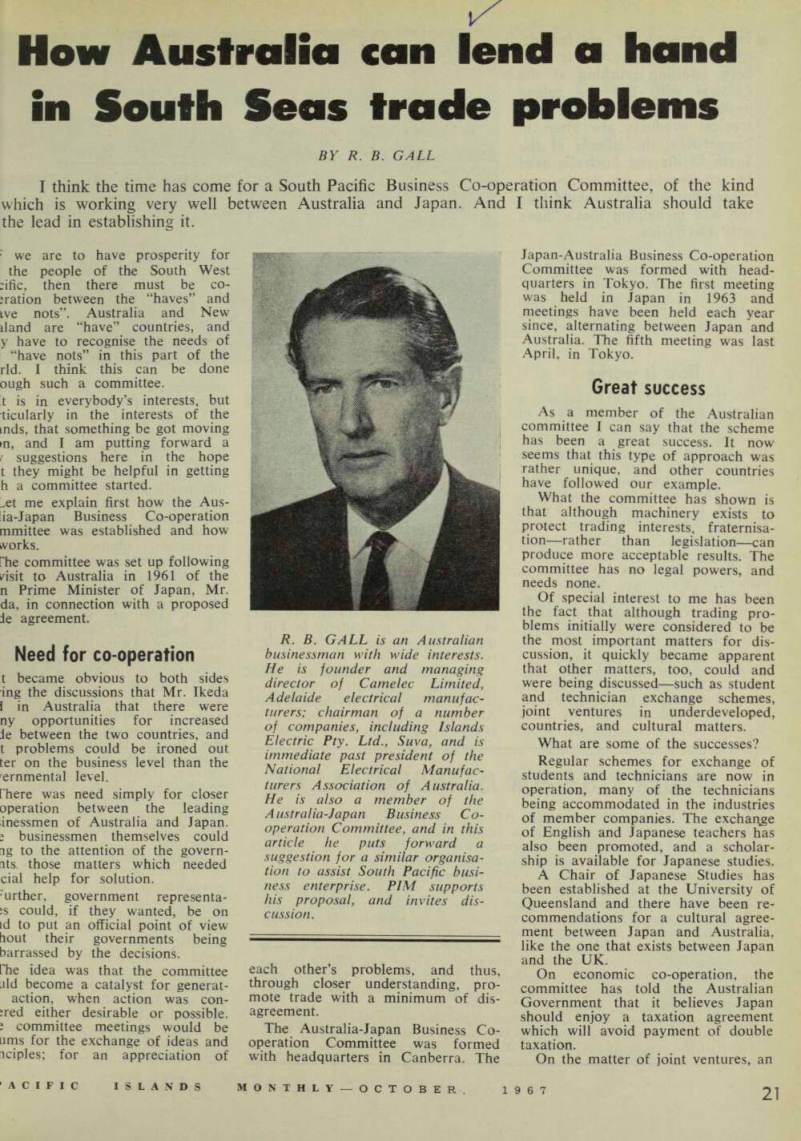
R. B. GALL is an Australian businessman with wide interests.
He is founder and managing director of Camelec Limited, Adelaide electrical manufac turers; chairman of a number of companies, including Islands Electric Pty. Ltd., Suva, and is immediate past president of the National Electrical Manufac turers Association of Australia.
He is also a member of the Australia-Japan Business Co operation Committee, and in this article he puts forward a suggestion for a similar organisa tion to assist South Pacific busi ness enterprise. PIM supports his proposal, and invites dis cussion.
investigation has been made into establishing a timber processing in dustry in New Guinea; and the establishment of a joint shipping line, mainly to ship Australian ore to Japan.
How it works
On trading problems I can give a personal example. As president of the National Electrical Manufacturers Association of Australia I voiced the apprehension of Australian electrical manufacturers about the level of Japanese electrical imports into Aus tralia. This led to the matter being referred to the Japan Electric Machine Industry Association.
The Japanese association sent a mission to Australia last December, and the members saw for themselves the extent of electrical manufacturing in Australia, and were given the op portunity to appreciate the reasons for tariff protection in some areas.
This helped us.
These brief notes give some idea of the scope of the Japanese com mittee. Certainly the problems are not all the same in the South Pacific, but there is no doubt in my mind that the highly fragmented South
Pacific community must benefit from the operation of a committee formed to discuss common problems.
A great deal of preliminary in vestigation would need to be under taken. Organisers would need to determine the general direction of planning.
Steering committee
In my opinion the most important thing to do first is to set up a steering committee to see whether territory businessmen really do think a com mittee is desirable. From my talks in the Pacific, particularly in Fiji, I think there is support for such a committee.
The steering committee could consist of interested persons from say, Fiji, Tonga, Western Samoa, Australia and New Zealand. This group would recommend permanent
representation, and plan the genei direction of the committee’s work.
A provisional chairman, depu chairman and executive officer con be selected to get the idea off t ground. The executive officer wou need to have access to secretari and public relations facilities.
Members of the steering committ should have high standing in t! community and some experience international affairs.
For instance, members of tl Australia/Japan Committee inclui Sir Edward Warren, as presidei Sir Robert Webster, of Bradfo: Cotton Mills; Mr. R. W. C. Ande son, Associated Chambers of Man factures of Australia; Mr. J. Bate Australian National Travel Associ tion; Dr. A. Callaghan, Austalh Wheat Board; Sir William Gun Australian Wool Board; Sir Th< Kelly, Woolworths Ltd.; Sir Arch bald Glenn, of ICI, Sir lan McLe nan, Broken Hill Pty.; Mr. R. \ Norman, Bank of NSW; Sir Jam Vernon, Colonial Sugar Refinin Sir Roland Wilson, Commonweal Banking Corporation; Mr. I, I Seppelt, Australian Wine Board; ar Mr. T. M. Ramsay, Kiwi Polh Company.
Another method of starting wou be to invite representatives from son territories to attend the next meetir of the Australia/Japan Business O operation Committee to see for then selves how it operates.
What territories should be ii volved? That’s a matter for a steerir committee. But there is no reasc why every territory that is covere by the South Pacific Commissio should not be represented, includic of course the French territories.
Let’s kick this ball around. Let start something, for all our sakes.
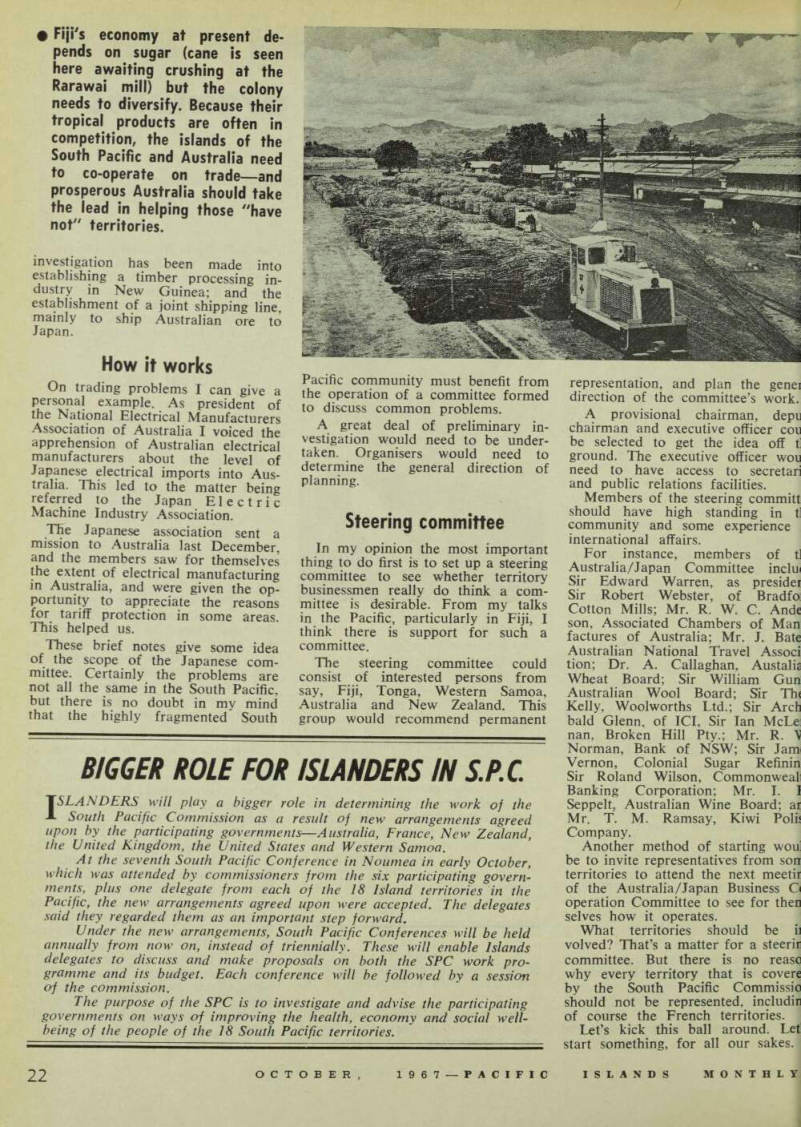
• Fiji's economy at present de pends on sugar (cane is seen here awaiting crushing at the Rarawai mill) but the colony needs to diversify. Because their tropical products are often in competition, the islands of the South Pacific and Australia need to co-operate on trade—and prosperous Australia should take the lead in helping those "have not" territories.