Deaths Of Islands People
pp. 142-143 · Read in the full issue
Mr. M. Wright Mr. Maitland Wright, former soldier and a well-known sportsman, died in Suva on August 14, aged 73.
Mr. Wright, or Maity as he was known to his legion of friends, was born in Fiji at Fort Carnarvon, Natuatuacoko, a station selected by his father in the early 1870’s during a punitive expedition against hill tribes in the area.
He was educated in Australia and on his return to Fiji joined the Government service as a produce in spector.
On the outbreak of World War I he and a brother, Edgar, joined the Ist AIF, and served in Palestine, where Edgar was killed.
Returning to Fiji he joined the staff of Burns Philp, and was stationed in Tonga and Rotuma.
He left Burns Philp to form a firm known as Suva Haulage, which en gaged chiefly in work on the water front.
Mr. Wright gave up active work about seven years ago, and lived quietly at his home at Nasese.
In the sporting field he was an accomplished member of the Im perials Rugby team, and as a cricketer was a left-hand bowler, with more than a little “bite” in his spin.
He played cricket till he was 64; at that age he confined his ap pearances to friendly Sunday matches as a member of the Garrick Hotel team.
He married Miss Nessier Boyer, of Tonga, who died in Suva in Decem ber, 1959.
He leaves two sons and a daughter.
Mr. Rob Wright, the Fiji Govern ment public relations photographer, is a brother. Another brother, Mr.
Oscar Wright, died earlier this year.
Mr. Justice Bignold A former Judge of the Supreme Court of Papua-New Guinea, Mr.
Justice Esme Baron Bignold, died in Sydney recently.
Mr. Justice Bignold was appointed Crown Law Officer of Papua in 1928.
After the war, he was acting Crown Law Officer with the Provisional Ad ministration until his elevation as a judge of the Supreme Court in 1948, He retired in 1962.
Judge Bignold, who was 67, was educated at the Sydney Church of England Grammar School and called to the Bar of NSW in 1923.
During World War II he served as an officer of the RAAF.
As a judge of the Supreme Court, Mr. Justice Bignold went on circuit at a period in the territory when facilities were austere and the rule of law not understood to the same degree as now. Although his duties were onerous, he was a conscientious and humanitarian judge.
He is survived by his widow and two daughters. His sister, Sister V.
Bignold, is well known in nursing circles in P-NG.
Pastor John Hartwig Pastor John Hartwig, a 26-year old Australian Lutheran Missionary, who had spent three years at Menya mya in the Kukukuku country of New Guinea, was drowned when at tempting to cross the Korlte River, near Menyamya, on August 13.
Pastor Hartwig was leading a patrol when he met his death. He walked ahead of the patrol to the river. He apparently slipped and was washed downstream before the rest of the patrol reached the river.
Pastor Hartwig’s widow is a teacher at the mission school at Menyamya.
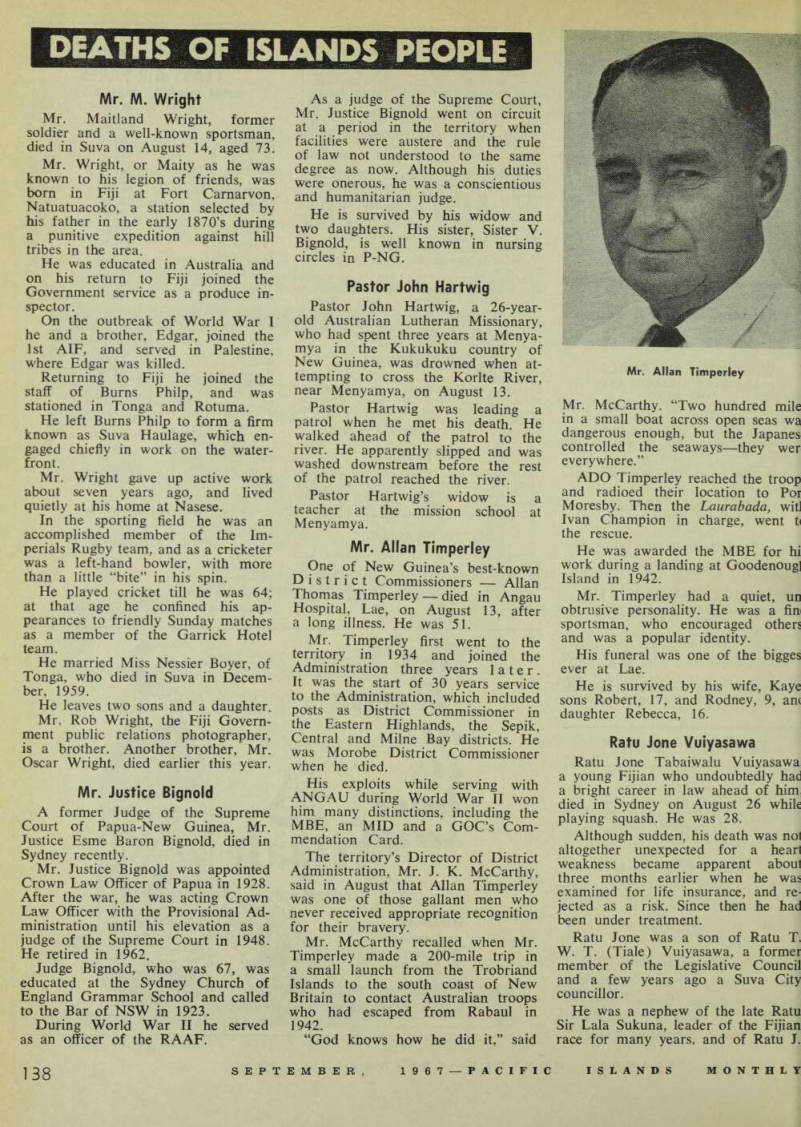
Mr. Allan Timperley One of New Guinea’s best-known District Commissioners Allan Thomas Timperley died in Angau Hospital, Lae, on August 13, after a long illness. He was 51.
Mr. Timperley first went to the territory in 1934 and joined the Administration three years later.
It was the start of 30 years service to the Administration, which included posts as District Commissioner in the Eastern Highlands, the Sepik, Central and Milne Bay districts. He was Morobe District Commissioner when he died.
His exploits while serving with ANGAU during World War II won him many distinctions, including the MBE, an MID and a GOC’s Com mendation Card.
The territory’s Director of District Administration, Mr. J. K. McCarthy, said in August that Allan Timperley was one of those gallant men who never received appropriate recognition for their bravery.
Mr. McCarthy recalled when Mr.
Timperley made a 200-mile trip in a small launch from the Trobriand Islands to the south coast of New Britain to contact Australian troops who had escaped from Rabaul in 1942.
“God knows how he did it,” said
Mr. McCarthy. “Two hundred mile in a small boat across open seas wa dangerous enough, but the Japanes controlled the seaways—they wer everywhere.”
ADO Timperley reached the troop and radioed their location to For Moresby. Then the Laurabada, wit] Ivan Champion in charge, went t( the rescue.
He was awarded the MBE for hi work during a landing at Goodenoug] Island in 1942.
Mr. Timperley had a quiet, un obtrusive personality. He was a fin sportsman, who encouraged others and was a popular identity.
His funeral was one of the bigges ever at Lae.
He is survived by his wife, Kaye sons Robert, 17, and Rodney, 9, am daughter Rebecca, 16.
Ratu Jone Vuiyasawa Ratu Jone Tabaiwalu Vuiyasawa a young Fijian who undoubtedly had a bright career in law ahead of him died in Sydney on August 26 while playing squash. He was 28.
Although sudden, his death was nol altogether unexpected for a heart weakness became apparent about three months earlier when he was examined for life insurance, and re jected as a risk. Since then he had been under treatment.
Ratu Jone was a son of Ratu T.
W. T. (Tiale) Vuiyasawa, a former member of the Legislative Council and a few years ago a Suva City councillor.
He was a nephew of the late Ratu Sir Lala Sukuna, leader of the Fijian race for many years, and of Ratu J.
Mr. Allan Timperley
. R. (Tom) Dovi, who holds a high jst in the Fiji Medical Department.
Ratu lone was educated at Queen ictoria School, Matavatucou, where : matriculated, after which he en red Government service. Some ars later he made an overseas tour, id then decided he would like to How a legal career.
He received a Government scholar ip and entered Wesley College, Syd y University.
A year later the Methodist Mission ve him a scholarship which allowed m to continue his studies for an her year. After that he was on a *SM scholarship, Ratu Tone was in his final year of v and hoped to return to Fiji next ar to practise as a lawyer.
Although law was his first love he cepted that he would eventually ter politics, and to that end kept nself well abreast of modern poli al trends. He has written articles out Fiji politics for PIM.
He was one of very few Fijians to idy law, and had he lived to be me a lawyer in his own land he
would have been only the third of his race to currently engage in legal prac tice.
Mr. D. A. Shah Mr. Dildar Ali Shah, who arrived in Fiji 50 years ago from India to be come headmaster of the first Gov ernment school in the colony, Nata bua Primary School, died on August 20 after a long illness, aged 75.
Mr. Shah was in charge at Natabua for 29 years, later serving at the Rakiraki Sangam School and Andrew Government School, Nadi.
He retired in 1948 to become a farmer at Waimari, Rakiraki, where he was instrumental in establishing the Waimari Indian School.
He was married twice and is sur vived by his second wife and eight sons and eight daughters. One of his sons is Mr. C. A. Shah, MLC.
Mr. B. Shambhu Mr. B. Shambhu, a well-known farmer and businessman of Lawaqa, Sigatoka, died recently, aged 78.
He was born at Navua and started business at Kavanasagau, near Siga toka as a storekeeper.
Later he became a tailor at Siga toka and bought a cane farm at Lawaqa.
He leaves a widow, five sons and seven daughters.