Rabaul's Fearsome Night Of
pp. 83-87 · Read in the full issue
Pacific Islands Monthly
Magazine Section
The sea rose, buildings were demolished on...
Rabaul's Fearsome Night Of
The Exploding Volcanoes
• The series of severe earthquakes that rolled through the Rabaul area of New Britain in mid-August, causing extensive damage to houses and property, inevitably led many Rabaul people to wonder whether there might be a repetition of the notorious volcanic eruptions of mid-1937. On that occasion, a new crater, belching fire and brimstone, formed at what was then Vulcan Island in Blanche Bay, and the old Matupi Island crater exploded. Rabaul, which was then the capital of the Mandated Territory of New Guinea, and the neigh bouring countryside were smothered under a heavy pall of ashes and dust; and Rabaul's population, after spending a night of terror in the town, was removed to Kokopo. Many women and children were subsequently evacuated to Australia.
What was it like for the people who lived through it all? The following article, written by the late GORDON THOMAS ("Tolala" of RIM from 1946 until his death last year), tells the story. Gordon Thomas was editor and publisher of the "Rabaul Times" at the time of the eruption. His description of what occurred appeared in an emergency issue of his paper on June 4, 1937, and subsequent issues. The paper was roneoed on a machine at the Catholic Mission at Vunapope because part of the roof of the "Rabaul Times" office had fallen in under the weight of pumice stone, damaging machinery.
After a succession of severe earth tremors, which commenced on Friday, May 28 (1937), residents )f Rabaul were first aware of any untoward circumstances when word came through that the home of Vlr. and Mrs. Furter, at Keravia, had been demolished and Mrs. Furter had a narrow escape from )eing pinned beneath a falling wardrobe.
rHE Keravia district has always been noted for the severity of arth tremors ostensibly due to a ;eological fault which runs across llanche Bay to the Matupi crater.
It is in the area that Vulcan Island 5 situated—that island which “came p in a night” [in 1878] and was most ppropriately named.
Saturday morning brought no ces ation of ’quakes; they were still eing registered unofficially at the ate of about one every two minutes; ome of them with a duration of alf a minute to a minute and a alf. On the island of Matupi, it is ecorded that numerous cracks in lie earth had occurred across the lain roadway.
It was reported that two small ilands had made their appearance i close proximity to Vulcan Island nd curious residents during Saturday fternoon visited the site.
One narty consisting of Mr. and Irs. Chinnery [the Director of
Native Affairs and his wife] and Mr. G. H. Murray [Director of Agriculture] actually cruised close to these newly-formed islands when, during their inspection, they noticed the gradual rising out of the water of huge boulders. Hardly had this occurred when the whole area of water became agitated and their launch hit the bottom and shortly afterwards a column of smoke and rocks was precipitated upwards.
Hurried escape
The party made a hurried escape towards the shore and were fortunate in missing this first outburst from Vulcan.
Rabaul residents were first aware of the eruption at approximately 4.25 p.m. on Saturday. Nearly every one rushed to the waterfront and beheld there a spectacle so colossal that it left the spectators spellbound.
From Vulcan Island there arose
a huge column of white clouds, rol ling skywards in undulating folds, impregnated with rocks and pumice.
At frequent intervals loud explosions were heard, followed immediately by dark brown volumes of smoke.
The wind was from the south-east, but fortunately very moderate, with the result that the cloud reached up wards and drifted but slowly to the north-west.
The waters of the harbour were disturbed, rising and receding, but at this time with no suggestion of a tidal wave.
As the outbreak continued with renewed intensity, residents became apprehensive for their safety.
There was the immediate danger of the town being enveloped in a suffocating cloud of smoke and the possibility of a tidal wave.
Motor cars were put into com mission without delay, suitcases hastily packed with a few urgent necessities, and residents departed
for Namanula and the North Coast district, most of them with the idea that it was perhaps a matter of only vacating the town for a day or so.
The first “black cloud” swept over the town about 5 p.m. depositing a fine pumice ash. This was accom panied by an ever-recurring series of explosions, loud peals of thunder, and vivid flashes of forked lightning.
Branches of trees becoming weight ed down with the pumice crashed to the ground, affecting light and telephone connections.
The sun went down on a scene of desolation in a town sheeted beneath a panoply of grey dust. The night grew fearsome with deafening detona tions as each fresh explosion oc curred; thunder pealed continuously; forked lightning lit the sky for a second or two, enabling spectators to visualise the huge smoke column rising ever upwards; ball lightning pricked the blackness for a few seconds, like intermittent northern lights in colder climes.
Long streams of natives made up the Rataval Hill for the security of the North Coast.
Here must be recorded the valuable work of Pug Noble, who remained constantly at the telephone exchange and kept the operators at their posts. It was not his task, but lie did a job of work which made for
the preservation of more confidence and the line to Namanula was kept open throughout the night.
At approximately 8 p.m.—approxi
mately because in the reign of terror watches were forgotten—a tidal wave occurred which wrought damage along the water front.
Small craft were lifted high and dry; buildings demolished and wharves swept away. It is reported that the rise was 9 ft above the normal.
Rabaul at night presented a town lying beneath a cover of snow— pumice snow. Streets were blocked with fallen tree branches; where traffic could pass, deep wheel tracks of cars furrowed the highways.
Homes deserted
Here and there the street lights pierced the darkness and great credit is due to Jack Barrie for his untiring efforts in maintaining the service especially the Namanula circuit.
The bars of the hotels were closed down; every residence was in dark ness. Homes were deserted; the floors thick with pumice ash, furniture covered with the same grey coating.
Tea tables, with cups and saucers, appeared Pompeiian, left in the hurried departure for safety.
Namanula Hospital was the Mecca of half the refugees, and here the work done by the hospital staff and their able and willing volunteers will never be forgotten by the 200-odd people who were cared for during Saturday night and Sunday morning.
Tea and refreshments were always available throughout the night; in quiries for missing relatives given the promptest attention. Nothing was left undone which could have been done by Matron McKinnon and her helpers.
Fortunately, no serious accidents occurred to residents; many sufferers from dirt-infested eyes were treated and sedatives administered to those suffering from shock and nervous prostration.
But, on the whole, Rabaul behaved itself admirably and accept ed the nerve-racking ordeal with a stoicism worthy of mention.
Sunday morning brought no ces sation in the volcanoes’ activities.
They were more intense, if anything, and early in the morning a meeting was convened by Judge Phillips [who had taken charge of the Administra tion in the absence of the Admin istrator and his deputy] at the Police Station, when principal business men combined with officials in reviewing the situation, and deciding on what action should be taken for the safety of the residents.
Evacuation plan
It was agreed that residents should be advised to evacuate the town, and arrangements were made for all available ships to assemble off Nodup where embarkation would take place.
Namanula was cleared of all re fugees and the Nodup waterfront be came filled with Europeans, Asiatics and native employees. Here they waited for the arrival of sea trans port.
The US vessel Golden Bear was the first on the scene [followed by] the Induna Star, the Muruk, Kwong Chow and the Nereus —the latter under the captaincy of Mr. Jackson making a very fine dash past the dense smoke clouds of the volcano for the open seas.
The business of embarking was slow; fortunately the wind was favourable and Nodup was not affected from the smoke clouds, and the assorted assembly proved most patient.
Discipline among the ranks of the natives was most marked. There was not the slightest indication of panic at any time.
The majority of the European women boarded the Induna Star and the Golden Bear and those vessels
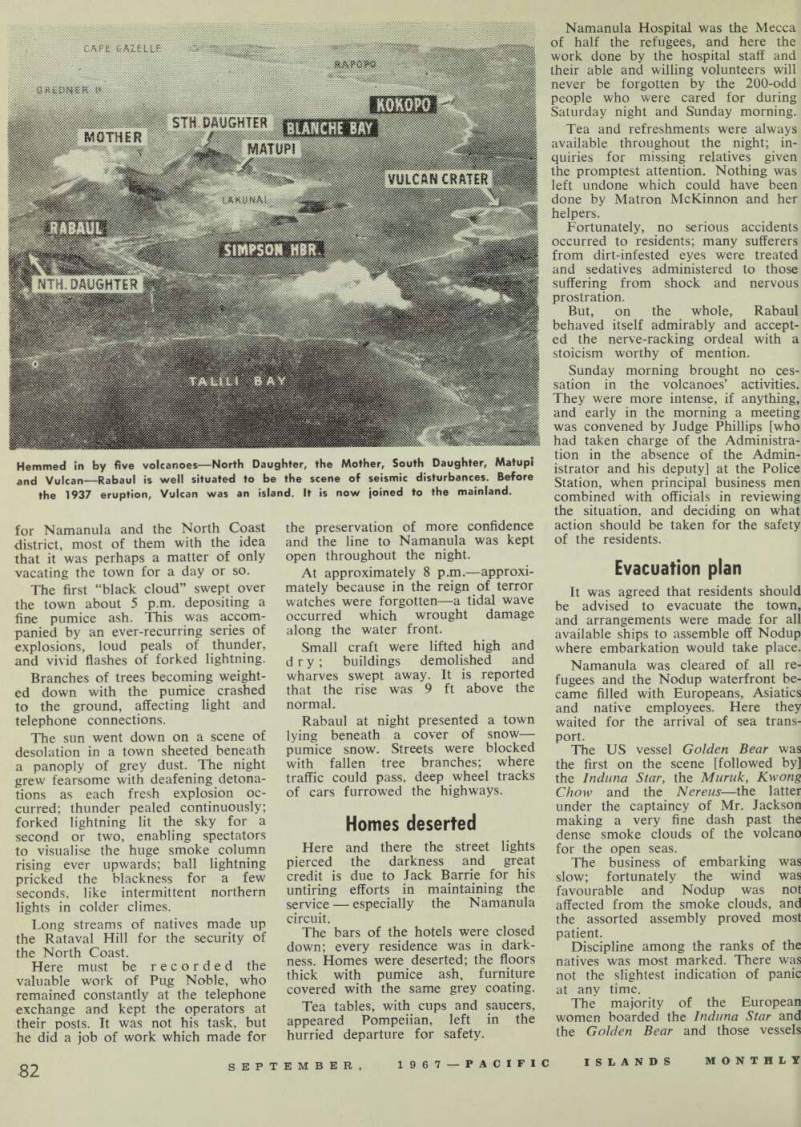
Hemmed in by five volcanoes —North Daughter, the Mother, South Daughter, Matupi and Vulcan—Rabaul is well situated to be the scene of seismic disturbances. Before the 1937 eruption, Vulcan was an island. It is now joined to the mainland.
had orders to disembark their pas sengers at Kokopo.
At approximately 1.30 p.m., after the European women and patients from the Namanula Hospital had embarked, a loud explosion, followed by dense clouds of black smoke, ising from behind the Mount Mother, icralded the fact that another volcano lad broken out in the vicinity of the Matupi crater.
First meal
This made the situation more ;erious as the dust from the clouds vould fall more directly on the ownship. It was at this juncture that he Montoro hove in sight and the ;ood old ship was most welcome as ;he came along at full speed, with ifeboats over the side. The master Captain Mitchie) is to be con gratulated for the prompt manner n which he quickly got into action ind took on board the remaining Europeans and over 5,000 natives— nen, women and children, to say lothing of dogs, baskets or a couple )f cockatoos!
The original number of natives lad been greatly increased by the ate afternoon owing to Matupi latives evacuating their island after he crater eruption.
By sundown the last boatload was m board, and the Montoro steamed tut for Kokopo. It was on this essel that many had the first meal or the day, and the ship’s staff
worked with a will which was greatly appreciated by the tired, nerve-racked refugees.
On Sunday evening, the Golden Bear and the fleet of schooners arrived off Kokopo where every preparation was made by the Catholic Mission to receive the refugees and the patients from Namanula.
The Montoro arrived during the evening and stood off until the morning when the work of disem barking was commenced.
Shortly after the arrival of the Montoro, a meeting was held on board, convened by District Officer Waugh and official arrangements made for quartering, rations and the general supervision of details.
All local stores were com mandeered; officials deputed to their various duties and some organisation brought to bear on the situation, which was a serious one.
Administrator arrives
At 12.30 p.m. a Guinea Airways aircraft flew over the town, with Pilot Turner, bringing His Honour the Administrator, Brig.- General W. R. McNicoll, and Mr.
C. R. Feld (Director of Public Works) from Lae . . . After circling the town once, a perfect landing was made on the new ’drome at Taliligap.
On his arrival His Honour decided immediately to proceed to Rabaul by the Induna Star which left at 2.20 p.m.
The task of billeting and rationing the evacuated people was no light one, and too much credit cannot be given to the Catholic Mission of Vunapope where the majority of the refugees were given shelter and cared for with every comfort.
The organisation of the Mission was marvellous, and will long be remembered. The work of allocating European, Asiatic and native refugees to their various areas was carried on through the day; all neighbouring plantations became homes of refuge and the willing spirit with which everyone worked was one of the out standing features of the situation.
Clouds of steam
Throughout the day and night small groups stood on the beach or wharves watching the huge clouds of steam, smoke and dust being hurled upwards to 10,000 feet.
Rumours became general from time to time; Mount Mother had broke out; Toma had followed suit; Rabaul was a mass of buried build ings and the North Coast a sham bles . . .
On June 1, His Honour the Admin istrator issued a circular dispatch in which it was stated that Rabaul would be untenable for many weeks, that the water supply had become polluted and no sanitation arrange ments were at present tenable.
“The present bad situation,” con tinued the dispatch, “will be in-
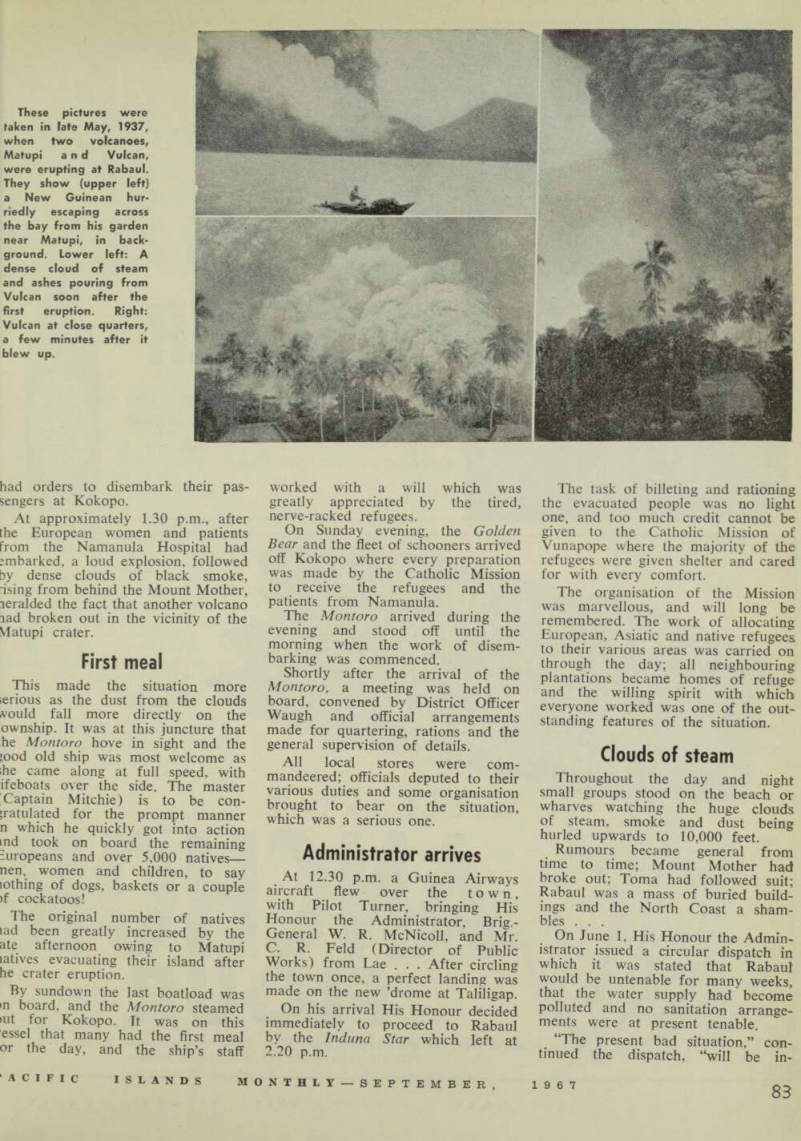
These pictures were taken in late May, 1937, when two volcanoes, Matupi and Vulcan, were erupting at Rabaul.
They show (upper left) a New Guinean hur riedly escaping across the bay from his garden near Matupi, in back ground. Lower left: A dense cloud of steam and ashes pouring from Vulcan soon after the first eruption. Right: Vulcan at close quarters, a few minutes after it blew up.
nsified when rain comes, as the ofs of all houses are thickly •vered with volcanic dust which ill become thick mud directly it comes wet.
“Under the circumstances, it is cessary to restrict the number of rsons that may be permitted to Jit Rabaul. Only those officials on ity and others with urgent business attend to will be permitted to oceed from Kokopo and land at xlup. It is essential that written thority be first obtained . . .
“In every way we will hasten the >rk of clearing the debris, but, of urse, some little time must elapse, is extremely desirable that at the ry first opportunity as many ►men and children as possible Dceed to Australia.
Patrol system
‘A complete patrol system of haul has been organised by the perintendent of Police and every deavour is being made to protect uses and their contents. ‘A cursory examination of resi des shows that they are affected ly by the dust covering. The con its of houses are in no way affected i any anxiety in this respect may allayed...”
Shortly after the Administrator led his dispatch, Gordon Thomas isited Rabaul and reported that tropical beauty of the town had m wiped out in a single night. He nt on ... down on Chinatown from Namanula Road is to gaze on a /n of grey be-daubed houses with k brown roofs; lifeless, with rib is of muddy roads dividing the nes. fhe most impressive feature of the m is its appalling ugliness and its form drabness; the sight of a bit colour brings joyous relief, saw a twisted black mass of
twigs and stems of a hibiscus bush and underneath—half hidden—the welcome colour of a red flower, It said: All is not dead. In some parts, the übiquitous kunai grass has already forced its way through the mantle of grey mud.
Namanula street is a long, dark grey road with two lighter-coloured narrow wheel tracks made by the busy lorries carrying rations from the stores to the Nodup beach for trans shipment to the evacuation camp at Kokopo. Nearly every street and avenue was blocked by fallen branches of trees; in many places long detours had to be made by cars because of one or two branches across the road ...
The roofs are covered with about an inch of grey mud—the volcanic ash hardened by the rain; in some places it is already peeling off under the sun’s heat.
The buildings of the town are intact, with the exception of one or two, including the old picture theatre portion of the Times Building, where the roof has collapsed.
The harbour from the old wharf was a beautiful expanse of water, with a brown strip of pumice near the Beehives, and then beyond towards Vulcan Island there was nothing but a pall of smoke and steam and falling dust...
Better and better
Jt was several weeks before Gordon Thomas was again able to print his newspaper on his own premises, but Rabaul returned to normal much faster than was at first expected. In an emergency issue of his paper on June 18, 1937, he reported that...
Every day and in every way, Rabaul is becoming better and better.
Nature is determined that the mud and dust shall be overcome.
Helpful rain at irregular intervals has cleaned up the surrounding hills
and the trees in the town are send ing out green shoots through the layers of dust and mud.
The work of clearing away the tons of dirt is being carried on unremit tingly and will occupy several weeks.
Much of this dirt is being dumped along the foreshore and will form part of a reclamation system, so the volcanic dust and mud, which tem porarily destroyed the beauty of our town, will be put to a useful purpose...
As the days pass and the work of clearing the town progresses under the systematic team of energetic workers, it becomes apparent that the fears which assailed some of the residents immediately following the eruption, and which prompted them to bring forward suggestions that the capital of the territory should be removed, are now groundless, and no substantial or logical reason can be advanced for any change in the location of the capital...
Footnote ; Gordon Thomas’ view on Rabaul’s continued suitability as the capital of the Mandated Ter ritory was not the one finally taken by officialdom, which, in 1939, decided to transfer the capital to the rapidly-growing goldfields port of Lae. The transfer had begun when the Japanese invaded Rabaul in January, 1942. After the war, despite official opposition at first, Admin istrative headquarters for the East New Britain District were established at Rabaul, but the Administration set up an expert vulcanological service to keep an eye on the volcanoes.
• Rabaul residents of 1937 wait on the beach at Nodup to be evacuated to Kokopo aboard the "Montoro," seen at left. The late Gordon Thomas, who wrote the accompanying article, is second from the left in the right hand picture.