Fiji's Flowers
pp. 71-75 · Read in the full issue

Really Are
Fantastic
By Jane Gregor
“Fantastic” is a word often used by visitors to Fiji when they first encounter the riot of colour provided by the islands’ richly varied flora. But I doubt if they know just how right they are!
THE initial impact made by the vivid colour is one thing; what really impresses the flower-lover who stays longer and has time to delve more deeply among the riches offered, is the quality of strangeness possessed by some of the plants . . . strange to the point of fantasy.
To many of us it is already enough that instead of walls or fences, gardens are divided by great, bounc ing hedges of yellow allamanda with its custard-yellow, non-stop show of flegant, trumpet-shaped flowers and its glossy, dark leaves.
And that these are apt to be backed by, or interspersed with, flumps of ti plant in shot-silk min cings of pink, purple, red green and yellow; or by sturdy copper-plant rushes. The less attractive name for these striking, glowing plants, is beefsteak plant.
Beefsteak pledge
It must be admitted though, that the leaves could be pared from a rich, red steak, so far as colouring goes. They grow as high as 10 ft tall, belong to the Acalypha family and are specially lovely seen in the evening sun.
In direct contrast to the sturdy masculinity of the beefsteak hedge, s the Brunfelsia. This is more com monly known by its apt if clumsy name of the yesterday-today-and tomorrow plant and is covered with
delicate, slightly scented flowers of three separate colours . . . purple, lavender and cream; a quick glance makes you think of a bunch of pansies indiscriminately scattered on some alien shrub.
In other cases, too, the everyday name of a plant gives an apt de scription of its appearance and some that come instantly to mind are the scrambled egg plant, actually a cassia, with its almost perpetual bloom of rich, golden splodges among a delicate leaf formation.
Paper flowers
And shrimp plant, another every day inhabitant of Fiji gardens , . . and chenille plant whose furry red tails you would swear were man-made from that good old fabric beloved of the Victorians for curtains and table-cloths, antimacassars and foot stools.
Then there are the wood roses, which are just that; on first seeing them it is impossible to believe that they, too, were not turned out by nimble-fingered girls in back-rooms.
Actually, it is a first cousin to the morning-glory and the “rose” is in fact the dried seed pod of a species of this familiar flower.
About three months are required for the blossom to appear and the seed pod to ripen to the point where it may be cut; after that, so far a*
I can tell, it is a true everlasting unless insects attack it.
Slipper flowers, crucifix orchids, cat’s claw climber, golden shower, coral shower, pink and white shower, butterfly tree, tulip tree . . . well, these may all be unfamiliar to the newcomer to the Pacific area but he’d soon recognise them, so true are they to their descriptive names.
And who dare say which is more fantastic in its beauty, wealth of blossom or strangeness of form?
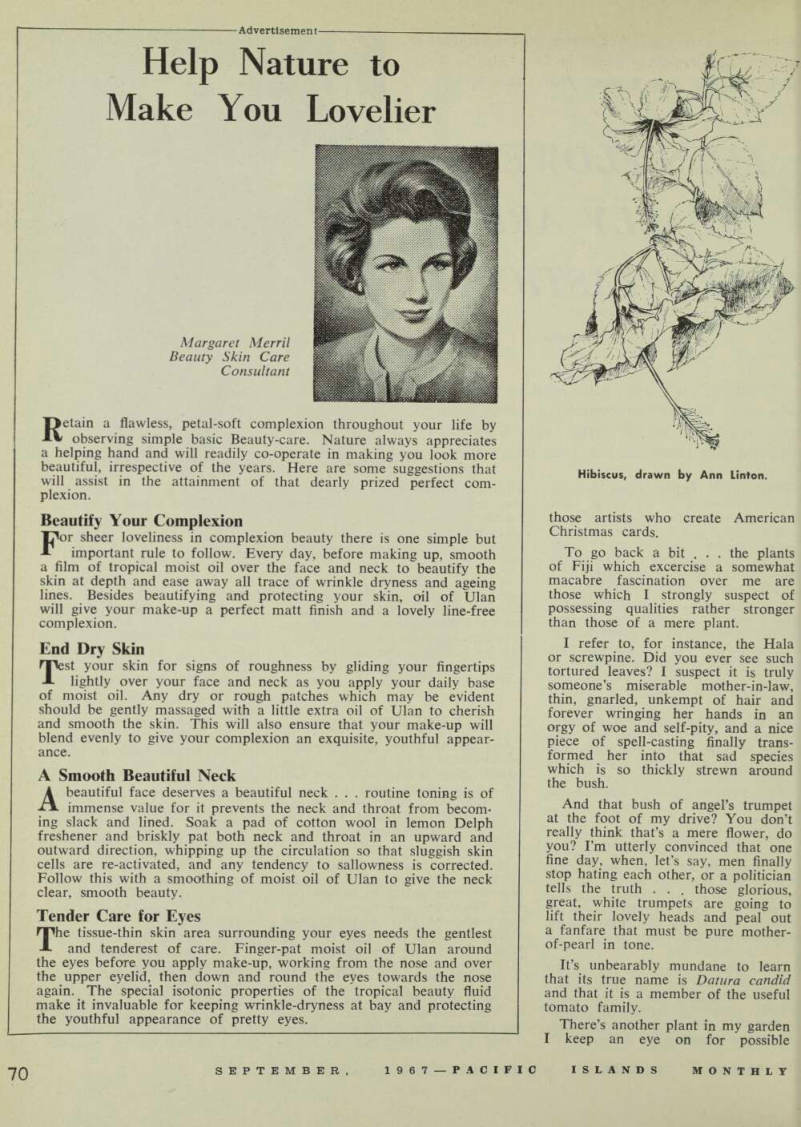
Before I go on to what I consider are the real characters among Fiji plants and flowers, I suppose it ought to be said that even the familiar hibiscus is, if one can so far stand back from its übiquity as to really see with a fresh eye its glories of form and colour, a marvel of design.
As, of course, are the different species of orchids which one so quickly takes for granted, forgetting that in colder climates a single one of the lavish blooms which most of us grow without even trying to, would command the price of a square meal for a simple man in these parts.
Tortured
For some of us, too, the hitherto almost fabled flower of the poin settia becomes just another spl««h of colour in a garden. We forget that not so long ago we thought it was a figment of the imagination of
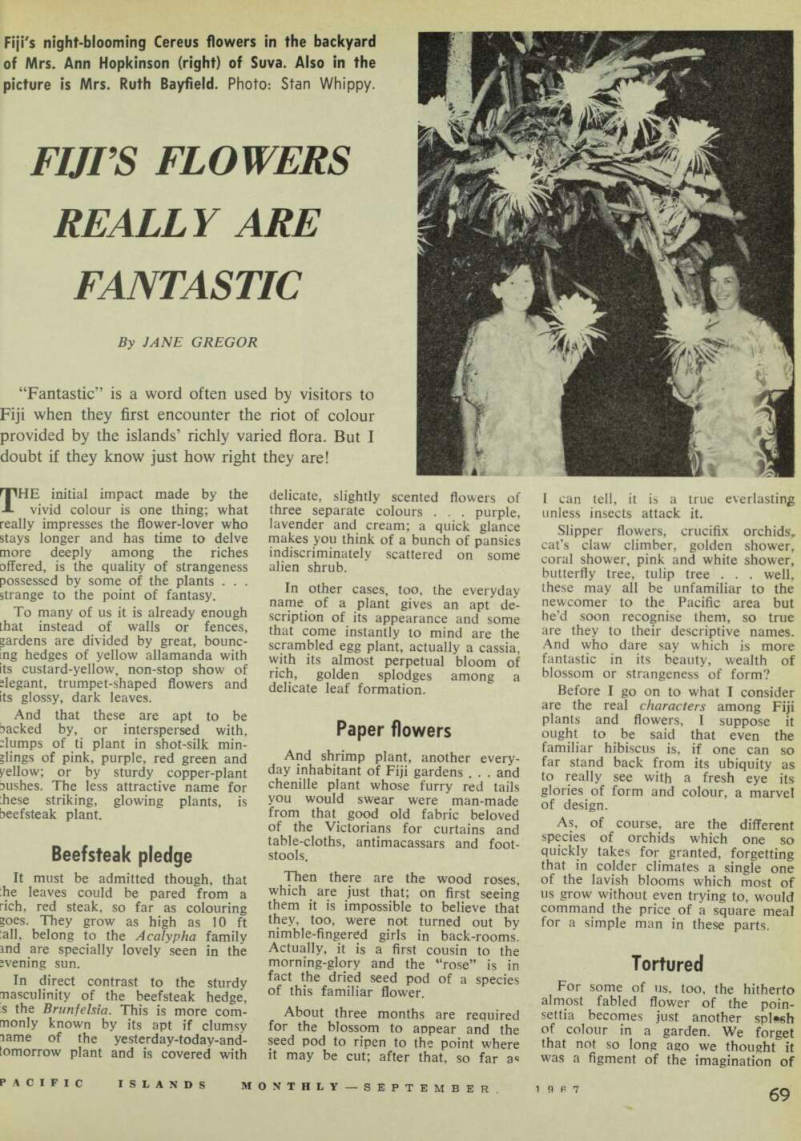
Fiji's night-blooming Cereus flowers in the backyard of Mrs. Ann Hopkinson (right) of Suva. Also in the picture is Mrs. Ruth Bayfield. Photo: Stan Whippy.
those artists who create American Christmas cards.
To go back a bit . . . the plants of Fiji which excercise a somewhat macabre fascination over me are those which I strongly suspect of possessing qualities rather stronger than those of a mere plant.
I refer to, for instance, the Hala or screwpine. Did you ever see such tortured leaves? I suspect it is truly someone’s miserable mother-in-law, thin, gnarled, unkempt of hair and forever wringing her hands in an orgy of woe and self-pity, and a nice piece of spell-casting finally trans formed her into that sad species which is so thickly strewn around the bush.
And that bush of angel’s trumpet at the foot of my drive? You don’t really think that’s a mere flower, do you? I’m utterly convinced that one fine day, when, let’s say, men finally stop hating each other, or a politician tells the truth . . . those glorious, great, white trumpets are going to lift their lovely heads and peal out a fanfare that must be pure mother of-pearl in tone.
It’s unbearably mundane to learn that its true name is Datura candid and that it is a member of the useful tomato family.
There’s another plant in my garden I keep an eye on for possible
Hibiscus, drawn by Ann Linton.
eventualities, too . . . but it’s a wary eye that I cast on this . . . the heli conia or lobster claw. I shouldn’t be at all surprised if, some quiet dusk, as I was bending near it to weed a patch of the border, it bent oyer and gave me a quick nip! A wide berth is the safest bet.
And who’s to say that the virile club ginger won’t up and cudgel the unsuspecting gardener some day when the thermometer’s high in the eighties and tempers wax a little un certain?
Florists' joy
As for the anthurium . . . that waxy, florists’ joy . . . with its moulded red, scarlet, white or sal mon pink dignity . . . and it’s pro truding spike, which in fact carries the true flowers, what we normally take to be the flower being, botanic ally speaking, a modified leaf . . .
It is known in polite circles as the flamingo flower ... but Fiji calls it the little boy plant. And I can quite see what people mean . . . it’s exactly like a little boy poking his tongue out at a scolding aunt. Or, is that what people mean? I wonder!
I’ve more than a suspicion too, that the timid bleeding heart has suffered an onslaught from the beak of that haughty dowager who masquerades in the shape of the strelitzia, or bird of paradise flower.
Well, maybe some of the fantasy I see in Fiji’s flowers stems more from my own imagination than from nature, although you must admit that nature really doesn’t need much help.
Take, for example, that lovely water lily which I have only ever seen in Fiji ... the one which smothers ponds with a rich profusion of flowers which are pink and blue, all at the same time, so that looking at a mass of them floating upon the water . . . covering it, in fact ... is like looking at a rainbow come to earth.
And as if their lavish colouring were not enough, they even have a delicious fragrance. Isn’t a stretch of them pure fantasy?
If you want a final argument to prove to you just how fantastic Fiji’s flowers really are, let me tell you the story of my favourite garden denizen.
On arrival in Suva, I discovered in my garden a poor, ragged, half dead cactus. I don’t like cactuses .. . not even if you call them cacti ... I started to throw it on the rubbish bean. But something stopped me.
“Oh give the poor thing a chance,”
I said to myself, so just to prove I wasn’t utterly callous I dug it in,
rmed the earth round it and forgot Some weeks later I noticed it had iken root and had some little red ish protuberances along its spiky :ems. So what?
About this time I heard tell of a abled night-blooming flower and lade arrangements to go and view a week or two later. And also bout this time I picked up a book i a shop, riffled through its illustra ons and recognised my ungainly actus. What’s more, it was labelled s being a treasure . . . and none ther than the stunning plant I hoped ) see shortly.
And I had it in my own garden! actually owned a night-blooming ereus!
If you’ve ever seen one in bloom, needn’t explain anything to you.
But to see, for the first time ever, lis awkward, stiff, plant give birth d the miracle flower which only looms at night, is pure magic.
If you can experience it, do any ling to take the chance. You’ll never arget it.
The large white bloom opens so apidly that you can watch it move ;s petals and spread its delicate Duntain of quivering stamens to the ight. On a moonlight night even the tiff spears of the stems which bear le flowers take on a sculptural uality and the flowers themselves re an ethereal glory.
With the light of day they die. lut while they live they truly fulfil ly dictionary’s definition of fantasy . . by being of “fanciful design”.
Not to put too fine a point on the latter, they are, to me, quite the lost beautiful and wonderful pheno lenon of the flower world which I ver hope to see.
Alamanda, drawn by Ann Linton.