Its a calendar,
pp. 58-61 · Read in the full issue
Tonga’s mystery arch Its a calendar, the king says
By Robert Langdon
One of Tonga’s most famous and interesting tourist attrac tions—the mysterious Ha’amonga-’a-Maui trilithon in the north eastern corner of the main island of Tongatapu—is sporting a couple of brand-new signboards these days.
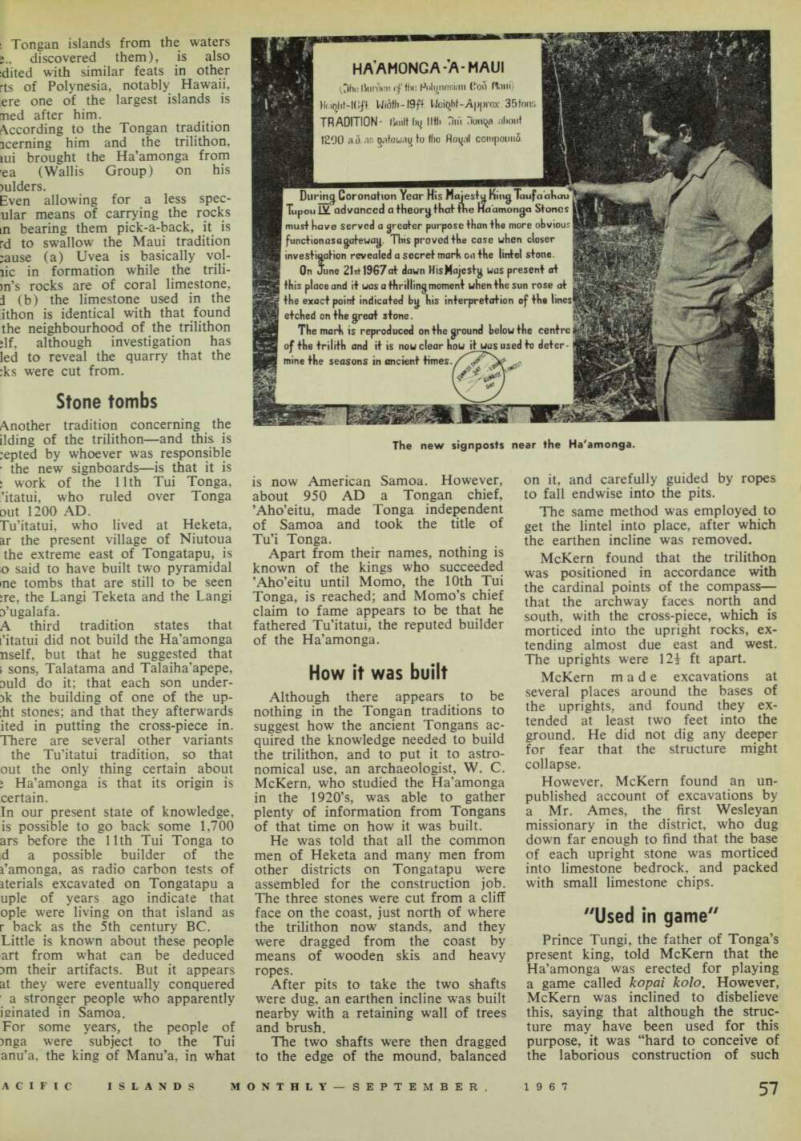
ONE of the signboards says that during coronation year, Tonga’s King Taufa’ahau Tupou IV advanced a theory that the Ha’amonga must have served a greater purpose than the more obvious function of gateway, and that investigations have shown that it was used to determine the seasons in ancient times.
The king’s investigations, the signboard says, revealed a “secret mark” (it is actually a V-shaped notch) on the cross-piece of the trilithon, and that the king was present for the thrilling moment on June 21, 1967 (the shortest day of the year) “when the sun rose at the exact point mdicated by his interpretation of the lines etched on the great stone”.
The signboard does not say—as
the king himself told newsmen in Nukualofa recently—that further sightings will be taken on December 21 to confirm whether the other angle of the V-notch points to the position of the sun as it rises on the longest day.
However, all the sightings and in vestigations so far made indicate that this will prove to be the case, as it has been found that one angle of the V-notch points to the Tropic of Cancer and the other to the Tropic of Capricorn, Tonga’s king therefore appears to have done his bit in providing a solu tion to one of the Pacific’s most en during mysteries. But in doing so, he has also emphasised an even more baffling one.
Why is it—l, for one, would nov like to know —that of all the far flung Polynesian peoples, only the ancient Tongans built a trilithon tc determine the start of the various seasons?
Why was there no trilithon ir Tahiti, Samoa, Rarotonga or Hawaii' Why no trilithon even on Eastei Island, where the building of massive stone statues was once a national pastime?
There is also, of course, a supple mentary mystery.
How did they know?
Where did the ancient Tongans obtain their astronomical knowledge?
Did they bring it with them from somewhere in the east, north or west? Did someone bring it to them?
Or did they work out such things as equinoxes and summer solstices all for themselves?
Tongan traditions concerning the trilithon are so confused and un certain as to be of little apparent value in helping to solve these mysteries.
The full name of the trilithon, Ha’amonga-’a-Maui (meaning “burden of Maui”), is apparently derived from a Tongan tradition concerning the semi-mythical Polynesian god Maui.
Maui, who is said to have fished
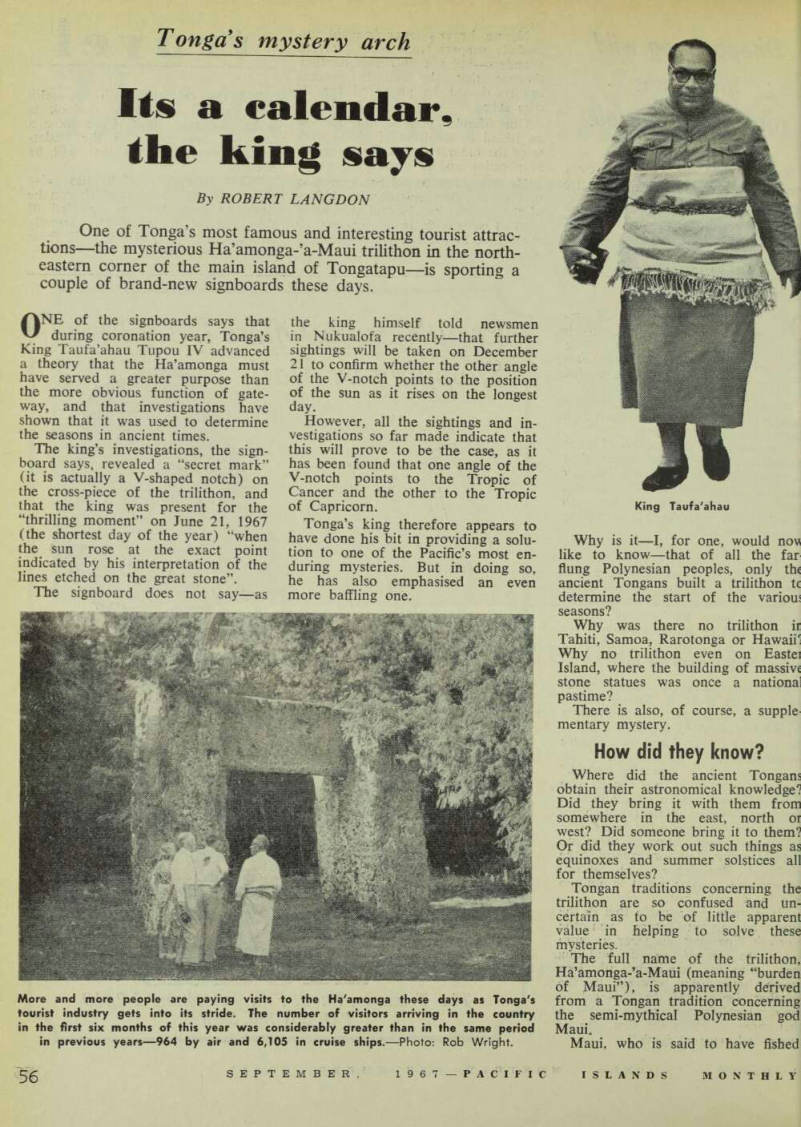
More and more people are paying visits to the Ha'amonga these days as Tonga's tourist industry gets into its stride. The number of visitors arriving in the country in the first six months of this year was considerably greater than in the same period in previous years—964 by air and 6,105 in cruise ships, Photo: Rob Wright.
King Taufa'ahau
Tongan islands from the waters discovered them), is also dited with similar feats in other rts of Polynesia, notably Hawaii, ere one of the largest islands is med after him.
According to the Tongan tradition icerning him and the trilithon, mi brought the Ha’amonga from ea (Wallis Group) on his mlders.
Even allowing for a less spec ular means of carrying the rocks in bearing them pick-a-back, it is rd to swallow the Maui tradition :ause (a) Uvea is basically vol lic in formation while the trili m’s rocks are of coral limestone, i (b) the limestone used in the ithon is identical with that found the neighbourhood of the trilithon ;lf, although investigation has led to reveal the quarry that the ;ks were cut from.
Stone tombs
Another tradition concerning the llding of the trilithon—and this is :epted by whoever was responsible ■ the new signboards—is that it is ; work of the 11th Tui Tonga, ’itatui, who ruled over Tonga out 1200 AD.
Tu’itatui, who lived at Heketa, ar the present village of Niutoua the extreme east of Tongatapu, is o said to have built two pyramidal me tombs that are still to be seen ;re, the Langi Teketa and the Langi o’ugalafa.
A third tradition states that I’itatui did not build the Ha’amonga nself, but that he suggested that ► sons, Talatama and Talaiha’apepe, ould do it; that each son under lie the building of one of the up lit stones; and that they afterwards ited in putting the cross-piece in.
There are several other variants the Tu’itatui tradition, so that out the only thing certain about j Ha’amonga is that its origin is certain.
In our present state of knowledge, is possible to go back some 1,700 ars before the 11th Tui Tonga to ,d a possible builder of the I’amonga, as radio carbon tests of iterials excavated on Tongatapu a uple of years ago indicate that ople were living on that island as r back as the sth century BC.
Little is known about these people art from what can be deduced am their artifacts. But it appears at they were eventually conquered a stronger people who apparently iginated in Samoa, For some years, the people of inga were subject to the Tui anu’a, the king of Manu’a, in what
is now American Samoa. However, about 950 AD a Tongan chief, ’Aho’eitu, made Tonga independent of Samoa and took the title of Tu’i Tonga.
Apart from their names, nothing is known of the kings who succeeded ’Aho’eitu until Momo, the 10th Tui Tonga, is reached; and Memo’s chief claim to fame appears to be that he fathered Tu’itatui, the reputed builder of the Ha’amonga.
How it was built
Although there appears to be nothing in the Tongan traditions to suggest how the ancient Tongans ac quired the knowledge needed to build the trilithon, and to put it to astro nomical use, an archaeologist, W. C.
McKern, who studied the Ha’amonga in the 1920’5, was able to gather plenty of information from Tongans of that time on how it was built.
He was told that all the common men of Heketa and many men from other districts on Tongatapu were assembled for the construction job.
The three stones were cut from a cliff face on the coast, just north of where the trilithon now stands, and they were dragged from the coast by means of wooden skis and heavy ropes.
After pits to take the two shafts were dug, an earthen incline was built nearby with a retaining wall of trees and brush.
The two shafts were then dragged to the edge of the mound, balanced
on it, and carefully guided by ropes to fall endwise into the pits.
The same method was employed to get the lintel into place, after which the earthen incline was removed.
McKern found that the trilithon was positioned in accordance with the cardinal points of the compass— that the archway faces north and south, with the cross-piece, which is morticed into the upright rocks, ex tending almost due east and west.
The uprights were 12i ft apart.
McKern made excavations at several places around the bases of the uprights, and found they ex tended at least two feet into the ground. He did not dig any deeper for fear that the structure might collapse.
However, McKern found an un published account of excavations by a Mr. Ames, the first Wesleyan missionary in the district, who dug down far enough to find that the base of each upright stone was morticed into limestone bedrock, and packed with small limestone chips.
"Used in game"
Prince Tungi, the father of Tonga’s present king, told McKern that the Ha’amonga was erected for playing a game called kopai kolo. However, McKern was inclined to disbelieve this, saying that although the struc ture may have been used for this purpose, it was “hard to conceive of the laborious construction of such
The new signposts near the Ha'amonga.
i amazing piece of work to accom odate the playtime fancy of chil •en”.
McKern was unable to learn ally ing else of consequence about the a’amonga; and the idea that the ructure may have been used for itronomical purposes seems not to ive occurred to him, despite his dis >very that it faced north and south.
Thor Heyerdahl, the leader of the on-Tiki expedition, who wrote 30ut the Ha’amonga in his book merican Indians in the Pacific, also /erlooked the possible astronomical urpose, although he was aware that was “astronomically oriented”.
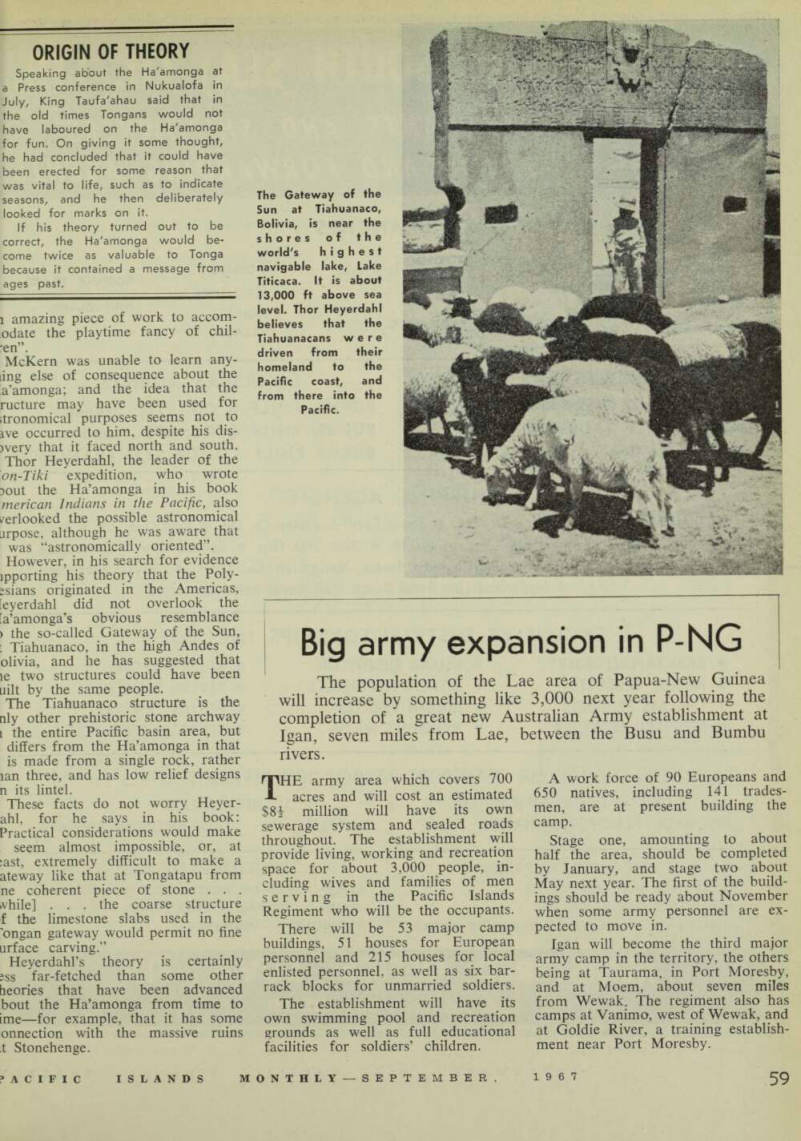
However, in his search for evidence ipporting his theory that the Poly ssians originated in the Americas, [eyerdahl did not overlook the [a’amonga’s obvious resemblance > the so-called Gateway of the Sun, : Tiahuanaco, in the high Andes of olivia, and he has suggested that le two structures could have been uilt by the same people.
The Tiahuanaco structure is the nly other prehistoric stone archway i the entire Pacific basin area, but differs from the Ha’amonga in that is made from a single rock, rather mn three, and has low relief designs n its lintel.
These facts do not worry Heyer ahl, for he says in his book: Practical considerations would make seem almost impossible, or, at ;ast, extremely difficult to make a ateway like that at Tongatapu from ne coherent piece of stone . . . while] ... the coarse structure f the limestone slabs used in the ongan gateway would permit no fine urface carving.”
Heyerdahl’s theory is certainly ;ss far-fetched than some other heories that have been advanced bout the Ha’amonga from time to ime—for example, that it has some onnection with the massive ruins t Stonehenge.