G.E.I.C. Tourism
p. 55 · Read in the full issue
Majuro Link Seen
As "Must" For
A modern, 32-bed hotel at
Tarawa costing $400,000 and
three “atoll camps” costing
$20,000 are needed if the Gil bert and Ellice Islands Colony is to start a tourist industry, ac cording to a recent survey of the
colony’s tourist potential.
BUT the survey says it would be “unwise” to start any hotel project before it is known when there will be a regular air link between Tarawa and Majuro Atoll in the Marshall Islands of the United States Trust Territory.
Bairiki site
At present, the colony is at the end of the line—on the way to no where. Its only air link with the out side world is Fiji Airways’ weekly service by Heron from Suva via Funafuti in the Ellice Group, although Fiji Airways will begin flights with a new Hawker Siddeley 748 turbo-prop jets on October 22.
There is no internal air service, although the government hopes a commercial operator will start one before 1969.
The report on the colony’s tourism potential was made by a British firm. Hallway Hotels (Overseas) Ltd.
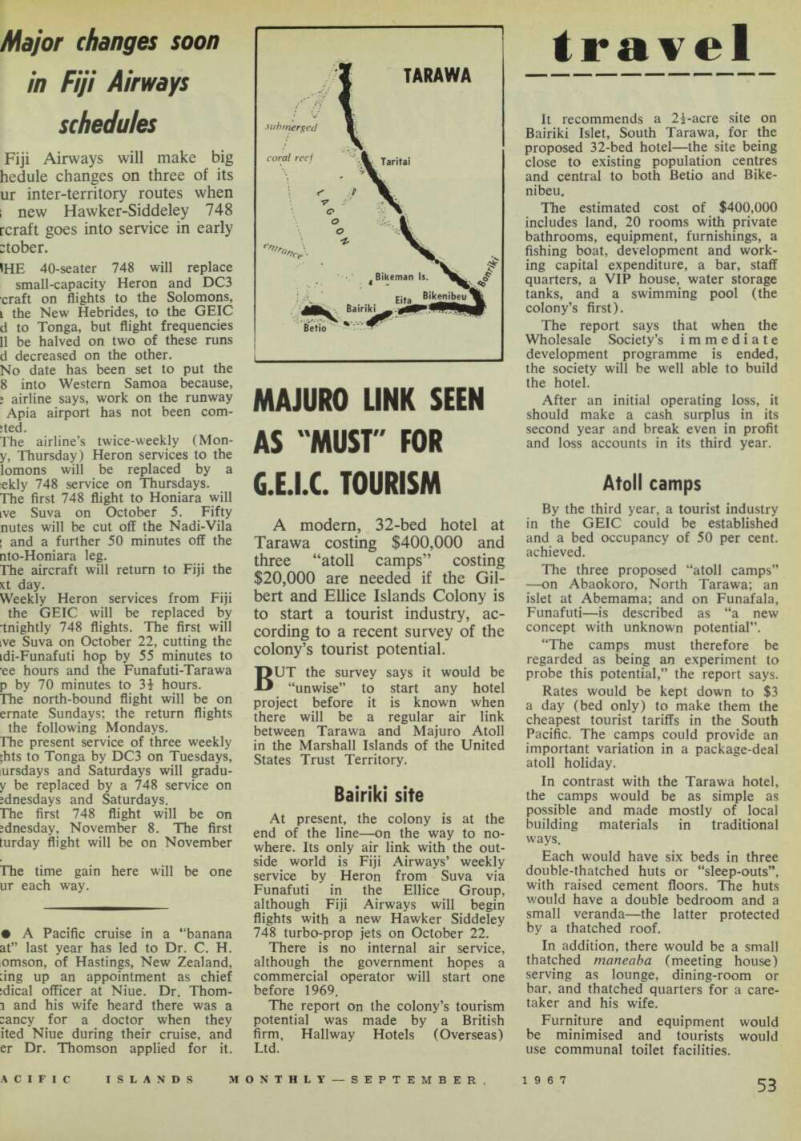
It recommends a 2i-acre site on Bairiki Islet, South Tarawa, for the proposed 32-bed hotel—the site being close to existing population centres and central to both Betio and Bike nibeu.
The estimated cost of $400,000 includes land, 20 rooms with private bathrooms, equipment, furnishings, a fishing boat, development and work ing capital expenditure, a bar, staff quarters, a VIP house, water storage tanks, and a swimming pool (the colony’s first).
The report says that when the Wholesale Society’s immediate development programme is ended, the society will be well able to build the hotel.
After an initial operating loss, it should make a cash surplus in its second year and break even in profit and loss accounts in its third year.
Atoll camps
By the third year, a tourist industry in the GEIC could be established and a bed occupancy of 50 per cent, achieved.
The three proposed “atoll camps” —on Abaokoro, North Tarawa; an islet at Abemama; and on Funafala, Funafuti—is described as “a new concept with unknown potential”.
“The camps must therefore be regarded as being an experiment to probe this potential,” the report says.
Rates would be kept down to S 3 a day (bed only) to make them the cheapest tourist tariffs in the South Pacific. The camps could provide an important variation in a package-deal atoll holiday.
In contrast with the Tarawa hotel, the camps would be as simple as possible and made mostly of local building materials in traditional ways.
Each would have six beds in three double-thatched huts or “sleep-outs”, with raised cement floors. The huts would have a double bedroom and a small veranda—the latter protected by a thatched roof.
In addition, there would be a small thatched maneaba (meeting house) serving as lounge, dining-room or bar, and thatched quarters for a care taker and his wife.
Furniture and equipment would be minimised and tourists would use communal toilet facilities.