They're still talking about
pp. 39-40 · Read in the full issue
"The Thing in the Bush"
From JUDY TUDOR, in Vila Whether “The Thing in the Bush” at Big Bay, Santo, is a wall built by Spaniards over 300 years ago or just the remains of a pig-pen or a trade-store, or any of a dozen other more recent relics, it has given the New Hebrides something to talk about in recent months.
OCALLY, in Vila, they refer to it 4 as “Langdon’s Wall”, and even e most rabid sceptics freely knowledge the tremendous amount research PlM’s Robert Langdon is done on the subject of Quiros’ tivities in the early 17th century id on those of planters, missionaries, tid-seekers and others in the mid to te 19th century.
A secondary result of the contro rsy is that Big Bay has had more fitors in the last few months than generally has in a decade. One of e latest was Mr. Reece Discombe Vila who, in 1962, pin-pointed the
wreck of the Boussole, the second ship of La Perouse’s expedition, which was lost at Vanikoro, Solomon Islands, in 1788.
Reece, an engineer here, is one of the New Hebrides best - known characters and drives a fearsome jeep that is almost as antique as the famous wall.
He first saw the wall in 1950 when he was trading up that way and went fishing in the river near by.
At that time, he says, he had no interest in local history and dismissed the stone-work as part of an old house. He forgot about it until the story first appeared in PIM in March (p. 12) but then took the first oppor tunity to visit the site again.
This was in mid-July, when he went up from Vila in a New Zealand yacht and with a party inspected the ruins. He came away convinced they are the remnants of a building about 22 ft square and not a Spanish wall.
His reasons
Here are some of his reasons: When he first saw the area in 1950 it was covered by bush and only the wall was visible. But some months before this last visit, a local New Hebridean had cleared about an acre of ground for a garden. This has the stone wall in the middle of it and, with the trees down, but not cleared away, it is now possible to see other pieces of masonry as well as the standing wall.
The wall itself is four feet high and 22 ft long. About 22 ft away, on the beach side, and running parallel to the wall, is a set of four steps, built of the same masonry as the wall and with the top step four
feet from the ground—that is, level with the top of the wall.
To the left and the right of the steps and the wall, and at right angles to them, are other slabs of masonry that Discombe says look as though they could be part of side walls that have now partly disappeared. Other pieces of stone and cement masonry are lying about inside what once apparently were four walls, in Dis combe’s view.
To the left of the steps, when facing the wall, and near the remnant of the left side, is a square riveted steel tank that has been demaged by an old tree that has fallen across it. (This is the “rusted drums” referred to in PlM’s July article.) To the right of the steps is a large tree, with a blaze on it. and what appears to be these marks cut into it: 990 H
Inian
04VI About 90 ft beyond the existing “Quiros” wall and back into the scrub, are the ruins of a bush baker’s oven, of which there are reputedly dozens, if not hundreds, scattered over the New Hebrides and New Caledonia. The oven is domed, the outside made of stones and cement (like the wall) and the inside lined
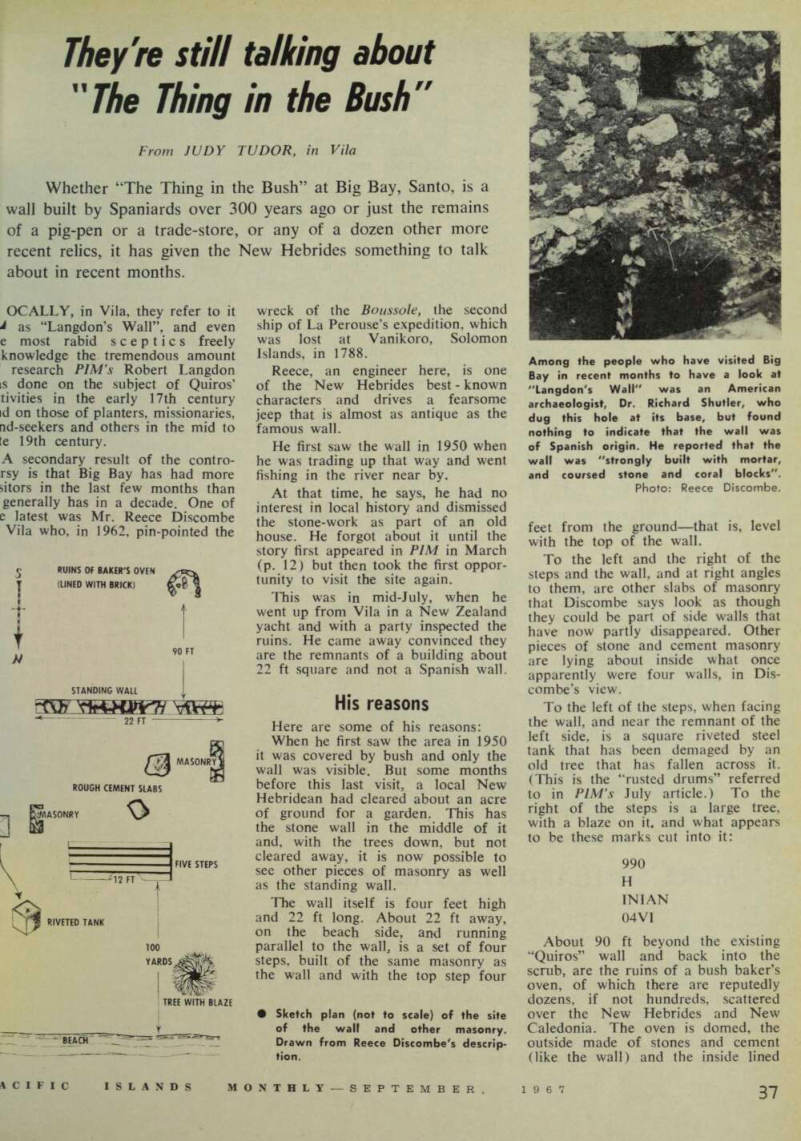
• Sketch plan (not to scale) of the site of the wall and other masonry.
Drawn from Reece Discombe's descrip tion.
Among the people who have visited Big Bay in recent months to have a look at "Langdon's Wall" was an American archaeologist, Dr. Richard Shutler, who dug this hole at its base, but found nothing to indicate that the wall was of Spanish origin. He reported that the wall was "strongly built with mortar, and coursed stone and coral blocks".
Photo: Reece Discombe.
They'd all like it to be Spanish
with Mont Dore bricks. (These bricks according to Reece Discombe were first made by a Yugoslav who arrived in Noumea about 1850 and started a brick and tile works.) These ovens were heated by lighting a wood fire inside them, the coals being scraped out before the bread was put in.
Made of cement
In his opinion, the wall and all the other pieces of masonry, are made of cement and not the kind of mortar that the Spaniards are likely to have used; nor, he thinks, are they likely to have faced both sides of the stones, as they are faced, if they were doing a rush job of putting up fortifications.
His guess is that the Big Bay ruins constitute the remains of the base ment of a small house or a trade store that was built either in the late 1890’s or at the turn of the century, by the Compagnie Cale donienne (John Higginson) or by the Societe Francais des Nouvelles Hebrides which took Higginson over in 1894. The land still belongs to
SFNH and possibly some clue to the whole mystery is hidden somewhere in their early records.
Nor does Discombe agree with Robert Langdon’s theory that the people who built the bread ovens (or “small ruin” as it is called in July PIM ) could have been unaware of the wall and the rest of the masonry. Anyone who arrives at the site, then or now, must do so via the beach and it would be impossible to get from the oven to the beach with out passing the wall, the steps and the other bits and pieces. * * * Probably no where but in the Condominium of the New Hebrides could this sort of argument persist.
This place, with its two names, three of most other things but no constitu tion and 76,000 natives who have no national status, could, it seems to me, be harbouring the original remains of the Ark, much less a Spanish wall a mere 300-odd years old.
It would be incredible, in any other place, that the existence, or non-existence, of this wall 70 years
ago could not be proved today. Bu sitting here in Vila, it is easy tc believe that the New Hebrides wai a no-man’s-land far later than that In Sydney, Robert Langdon ha: made a good case for the existence of the Spanish wall. In Vila, Reece Discombe, whom I left only a couple of hours ago, is equally adamant am convincing that it is the remains o 1 a building less than 100 years old In the last few days I have beer forced into discussing the wal whether I liked it or not, and gener ally I have not liked it because ] have not seen it myself and there seems to me to be still too man} ends to be tied up, whichever wa\ you look at it.
But of one thing I am sure— everyone here would like to have £ genuine Quiros relic. Although the New Hebrides doesn’t need this to pul it in a class by itself—it is in a class already in many ways that aren’i Spanish—it would be a piece ol South Pacific one-upmanship pleasing to all residents, French, British and otherwise.
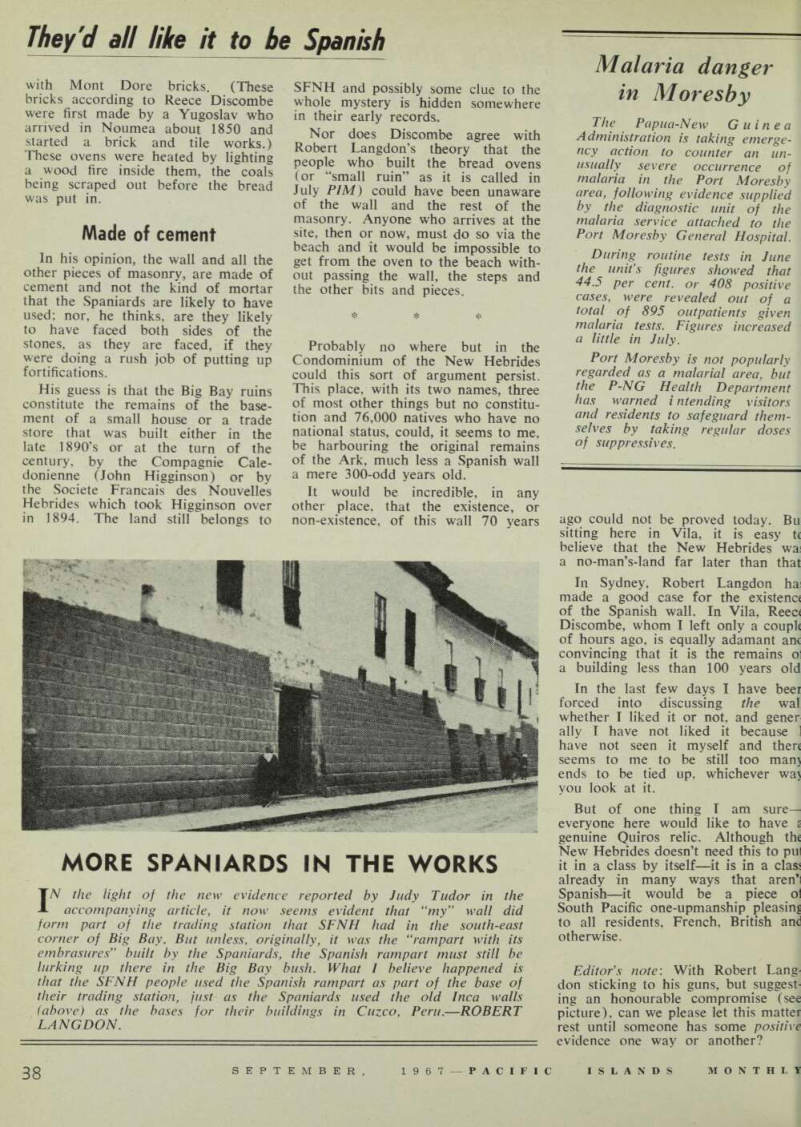
Editor’s note: With Robert Lang don sticking to his guns, but suggest ing an honourable compromise (see picture), can we please let this matter rest until someone has some positive evidence one way or another?