Tropicalities
pp. 32-34 · Read in the full issue
When Australia’s newest submarine arrived in Sydney on delivery August there was a chord struck in our memory. Wasn’t there an Islands mystery surrounding Aus tralia’s first submarine, the AEI? There was. We looked up the facts and found that September is the 53rd anniversary of her mysterious disappearance off Rabaul, New Guinea.
AND perhaps—who knows?—the mystery could yet be solved. In 50 years there have been spectacular advances in underwater equipment, and the bones of the AEI may still be off Rabaul, awaiting discovery by adventurous skin divers.
The AEI, and her sister submarine the AE2, were delivered to Australia from Britain just before the opening of World War I. (Australia’s latest, HMAS Oxley, her first submarine for 36 years, was also delivered from the UK).
The AEI and the AE2 of 800 tons, each had Royal Navy commanders and their crews were half-and-half Britons and Australians.
They made a rendezvous with the Australian fleet off Rossel Island, Papua, on September 9, 1914. The fleet, and the troopship Berrima, was headed for Rabaul to take German New Guinea for Australia.
Last picture
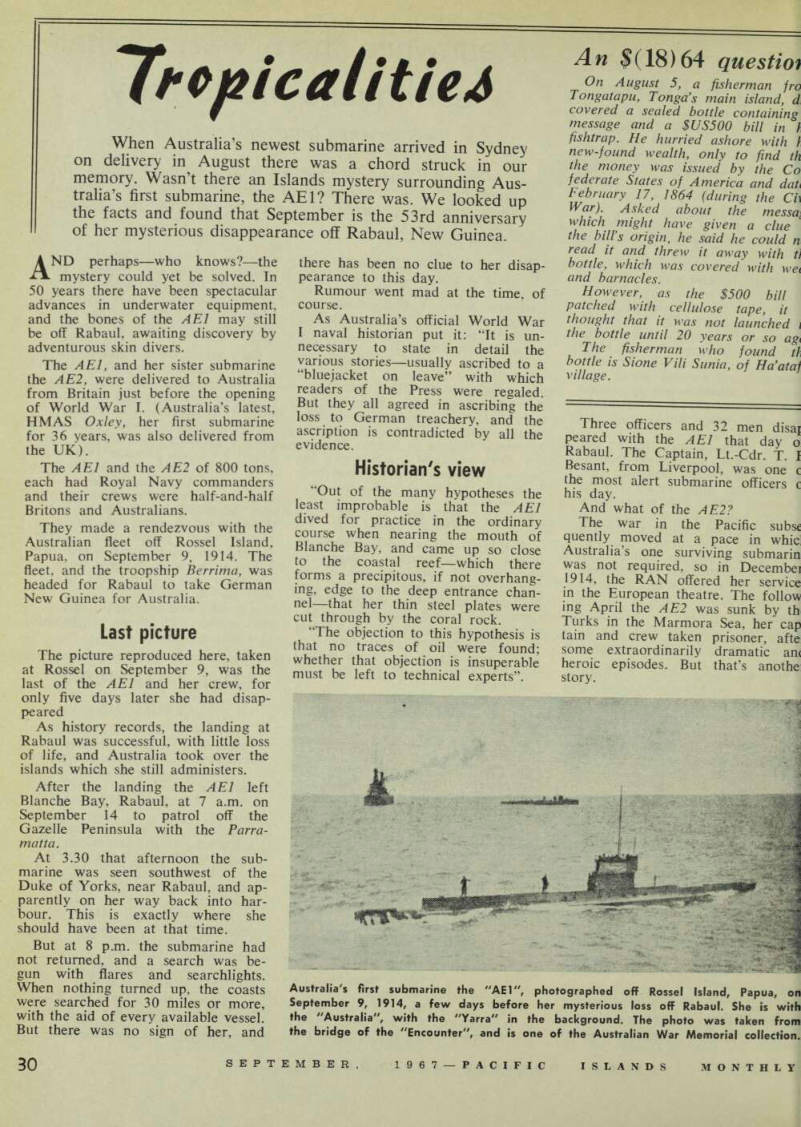
The picture reproduced here, taken at Rossel on September 9, was the last of the AEI and her crew, for only five days later she had disap peared As history records, the landing at Rabaul was successful, with little loss of life, and Australia took over the islands which she still administers.
After the landing the AEI left Blanche Bay, Rabaul, at 7 a.m. on September 14 to patrol off the Gazelle Peninsula with the Parra matta.
At 3.30 that afternoon the sub marine was seen southwest of the Duke of Yorks, near Rabaul, and ap parently on her way back into har bour. This is exactly where she should have been at that time.
But at 8 p.m. the submarine had not returned, and a search was be gun with flares and searchlights.
When nothing turned up, the coasts were searched for 30 miles or more, with the aid of every available vessel.
But there was no sign of her, and
there has been no clue to her disap pearance to this day.
Rumour went mad at the time, of course.
As Australia’s official World War I naval historian put it: “It is un necessary to state in detail the various stories—usually ascribed to a “bluejacket on leave” with which readers of the Press were regaled.
But they all agreed in ascribing the loss to German treachery, and the ascription is contradicted by all the evidence.
Historian's view
“Out of the many hypotheses the least improbable is that the AEI dived for practice in the ordinary course when nearing the mouth of Blanche Bay, and came up so close to the coastal reef—which there forms a precipitous, if not overhang ing, edge to the deep entrance chan nel—that her thin steel plates were cut through by the coral rock.
“The objection to this hypothesis is that no traces of oil were found; whether that objection is insuperable must be left to technical experts”.
Three officers and 32 men disar peared with the AEI that day o Rabaul. The Captain, Lt.-Cdr. T. I Besant, from Liverpool, was one c the most alert submarine officers c his day.
And what of the AE2?
The war in the Pacific subse quently moved at a pace in whic' Australia’s one surviving submarin was not required, so in Decembei 1914, the RAN offered her service in the European theatre. The follow ing April the AE2 was sunk by th Turks in the Marmora Sea, her cap tain and crew taken prisoner, afte some extraordinarily dramatic am heroic episodes. But that’s anothe story.
Australia's first submarine the "AEI", photographed off Rossel Island, Papua, on[?] September 9, 1914, a few days before her mysterious loss off Rabaul. She is with the Australia", with the "Yarra" in the background. The photo was taken from the bridge of the "Encounter", and is one of the Australian War Memorial collection.
[ow to make money
ithout really trying
LJRING preparations for the changeover to decimal currency Niue recently, the radio station iadcast special programmes to icate the public. fhese programmes, according to • correspondent, did do some good, t there was still some confusion, fhe Postmaster, for example, had put a notice in the daily news et denying local rumours that if Post Office Savings Bank pass )k holder failed to convert his ance from pounds, shillings and ice to dollars and cents on change ;r day, he would lose his money. \nother instance of the confusion llustrated by the story of the local der who converted his prices from [ to decimals by using the formula, claimed on the conversion chart, it one cent equals one penny, ereas it is actually worth 1-1/5 £ a result, a customer who wanted buy a 4/4 (52d) tin of meat md himself being asked to pay cents (5/3) for it. .
According to Niue’s newssheet, the logue at the store went like this: ‘Please may I have a tin of meat?” ‘Yes. Here you are. That will cost n 52 cents.” ‘Thank you. But last week the ce was only 4/4.” ‘Yes, that is so. We have now averted the price to cents. One it, according to the chart, is one iiiy. The old price was 52 pence, ;refore the new price is 52 cents, herwise, the store would be losing >ney.”
inding a word
)r it
»HE Pacific Theological College at Suva, which at present has idents from 10 Islands’ territories d can expect incomers from many jre, has to scale a Tower of Babel get its Christian teaching across.
The problem of expressing the iths of Christianity, with all the irsbreadth divisions of theology, in s language of the Islanders has en pinpointed by the principal of 2 college, the Rev. Dr. George light, in one of his chatty news ters.
“Words such as grace, justification, conciliation, conscience, devil, urch, covenant, Lord, stewardship, inity, crucify, gospel, comforter, aven, sin, ransom, redeem and any others simply don’t exist in any Islands’ languages,” Dr. Knight
points out. “The Ellice language, on the other hand, has several hundred words for palm-tree!
“Those with even a slight know ledge of anthropology will realise how far out the New Hebridean congregation is when it solemnly sings ‘Tapu, tapu, tapu’ for our hymn Holy, Holy, Holy. The same lan guage, again, has no verb for ‘to
believe’. The local church has to make do with the verb ‘to swallow’.
“In Samoan the word ‘world’ has an evil connotation.
“In another language ‘Trinity’ can only be ‘three ones’. Often you see the English, or Latin, or even Greek word just transcribed in a local language: ekalesia, gratsia, paraka lesis, gospel. But what content do these words have for their readers?
“ ‘Spirit’ gives trouble everywhere.
In Tongan it means ‘mood’. Fancy invoking the Holy Mood! ‘Lord’, of course, is usually translated by the word for chief, with all its connota tions in the local social system.
“ ‘Covenant’ may be translated by ‘served with a bowl of kava’. Before a fight there is a kava (yaqona) party. At it, one warrior calls out, I will kill the first enemy’. The chief then hands him the bowl to drink, and solemnly claims him as the first killer.
“What can you do then with the content of the words: ‘This cup is the new covenant in My blood?’
“Do you see the problem we have to face in helping our students to put the Gospel into their own lan guage?
“ ‘God’, in Tongan, is any object of fear, such as a shark, ‘Congrega tion’, in Samoan, means ‘Council of Elders and Chiefs’. The ordinary people seem to have slipped out of sight here, “The Tongan language has two words for ‘he’, one for an ordinary man, one honorific for an aristocrat.
Which pronoun then should you use in the phrase ‘He ascended into heaven? Was He still the carpenter of Nazareth, or was He now one with God?
“How a theology class laughed when Fr. Jones asked them to think how they would say ‘Of one sub stance with the Father’ in their own language, or how they could express the idea of the Trinity.
“How much easier it was for the early missionaries to slip into mere moralism, and to preach on such topics as ‘Thou shalt not eat people’, or even ‘Thou shalt not smoke’!”
Just 820 sq. miles
where you can’t go
RESTRICTED areas in Papua- New Guinea—those areas where visitors can’t go without permission because of possible danger from natives—have been reduced from 820 square miles to 670 square miles, it was announced in Port Moresby in August.
Areas still restricted are 480 square miles in the north-west of the West-
ern Highlands and 190 square miles in the south-west of the Sepik District. The Sepik area concerned lies between the headwaters of the Sepik River and the Fiak-Aki divide.
About 1,500 people, who are admin istered from Telefomin, live in the area.
The Administration first placed restrictions on uncontrolled or partially controlled areas in 1951.
The areas were in the Sepik, West ern Highlands, Eastern Highlands, Morobe and Southern Highlands.
They covered 25,974 square miles of the territory's total of 183,540 square miles.
Schoolboy “Test”
for New Guinea
AN international “Test” will be the highlight of a six-match tour of Papua-New Guinea being under taken by a team of New South Wales schoolboy Rugby League foot ballers. The team, comprising 20 players, a manager and a coach, flew to Port Moresby from Sydney on August 25.
The NSW team is making its second tour of the territory and hopes to do better this time than two years ago, when local teams beat it in most centres. Last season Papua- New Guinea visited NSW and was successful in two of the three “Tests” played.
NSW on the current tour were scheduled to meet Papua in Port Moresby, Northern District at Popon detta, Morobe District at Lae, New Britain District at Rabaul, Eastern Highlands District at Goroka and Papua-New Guinea at Port Moresby.
A shield and individual trophies, donated by Brownbuilt, for the best and fairest player from either team, will provide a special incentive for
these participating in the “Test” on September 9. The Brownbuilt Trophy will be competed for annually.
The touring NSW team represents the combined high schools through out the State and was selected after a series of trial matches. The boys vary in ages from about 13 to 17.
All were required to meet an 8-stone weight limit.
Western Samoa is
fashion conscious
AN Apia correspondent is enth siastic at the chances of Ap becoming the Paris of the Sou Seas, fashion-wise. Interest was ge crated in locally designed fashio following a fashion show put on the recent Heart of Polynesia Visit Conference, and already Air Ne Zealand has arranged to sponsor show of Samoan fashions (wi Samoan models) in New Zealand ai Australia later this year. There is ta of similar shows being planned 1 other airlines in Hawaii and the I mainland.
Those involved in the conferen fashion show, which was organis< by Mrs. J. Gerakas, were Mi Freida Paul, of Carol ’n Mark. Mi Tommy Burr of Tommy Fashior and Mrs. Sophia Rankin, of Islar Styles.
Another fashion show was put c in Apia during August organised I Mrs. Aggie Plowman. Some 3( ladies turned up to Apia’s Casir Hotel to see fashions by Island Styl< and newcomer Miss Leone Bethar of Leone Fashions.
The production of local women fashions has emerged as an industi only over the past year, with th establishment under the Enterpris( Incentives Act of Island Styles, an now employing 10 women sewing i its Vaoala factory.
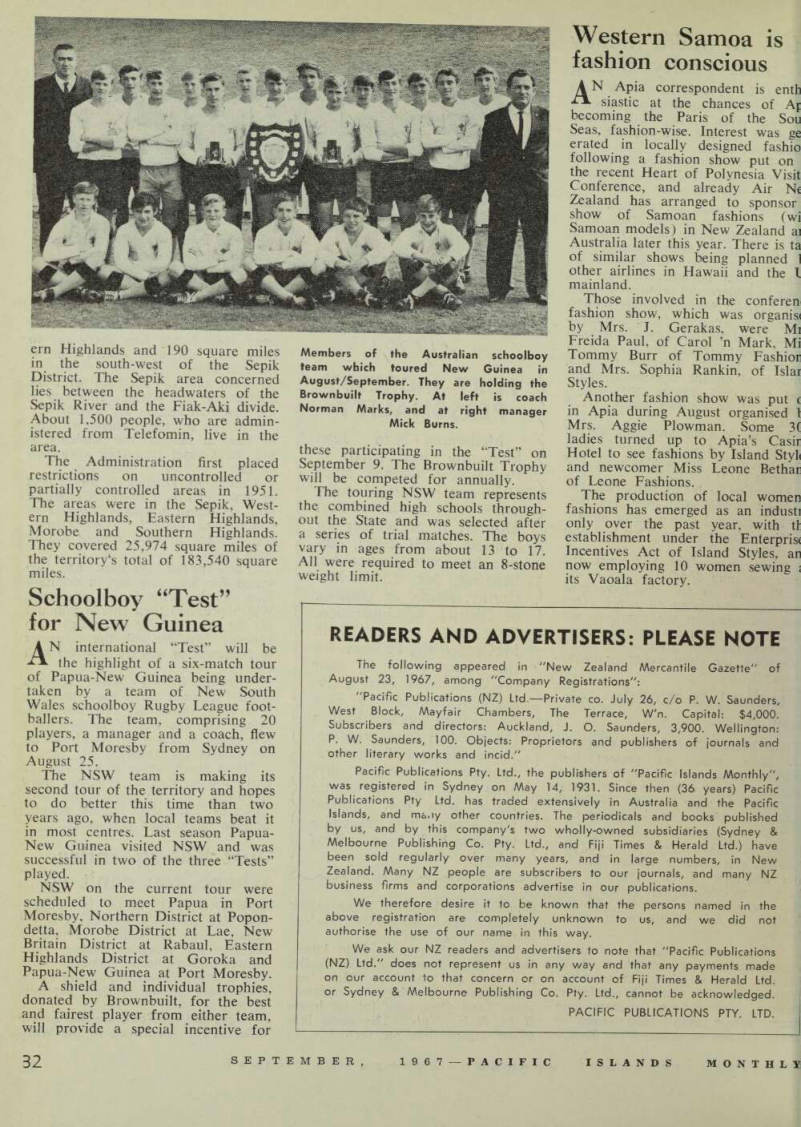
Members of the Australian schoolboy team which toured New Guinea in August/September. They are holding the Brownbuilt Trophy. At left is coach Norman Marks, and at right manager Mick Burns.