The U.S. Marines
p. 26 · Read in the full issue
Remember
From a Honiara correspondent The Battle for Guadalcanal—2s years after—was com memorated here on August 7, and the US Marines didn’t forget.
Ten hand-picked Marine veterans of Guadalcanal flew into Henderson Field in a special Navy aircraft from Marine head quarters on Hawaii.
THEY were joined by exservicemen from Australia and New Zea land, and many of the 1,200 pas sengers from P & O’s Orcades on a cruise.
Prominent during the occasion, and specially honoured by the Ame ricans, was Sgt.-Major Vouza, once of the Constabulary, whose wartime exploits contributed to the success of the campaign. He is now 73.
It was at dawn on August 7, 1942, that the first assault on Guadalcanal was made by United States Marines and Allied servicemen.
By dusk, hundreds of men were already dead and the toll began to mount in the days that followed as the bitter fighting continued.
Bitter price
When the Japanese resistance ended in defeat in February 1943, an estimated 600 Japanese planes had been shot down. Their ship losses were heavy, and 14,000 were posted as killed or missing while another 9,000 had died of disease.
The Allied forces lost nearly 2,000 men in enemy action and almost 5,000 were wounded.
It was a bitter price to pay, but this battle halted the Japanese drive
south and spelt the death of Japanese might in the Pacific.
So on August 7, in the blistering heat in the small, tree lined town of Honiara—a town far different from the malaria ridden, settlement near where they fought 25 years ago— the war veterans of Guadalcanal stood in silence as they listened to special messages from U.S. President, Lyndon Johnson, and from the Foreign Minister of Japan, Takeo Miki.
“We have not forgotten the Battle of Guadalcanal and the brave efforts of the men who participated in this first American land offensive in the Pacific during World War II,” said Mr. Johnson’s message.
“Times change, and our former enemy is now a staunch ally. I am happy to learn that the growth of Honiara has all but eliminated the scars of that fiercely fought conflict.
But the memory of Guadalcanal reminds us all of the price that free men must be willing to pay in order to preserve their precious freedom.”
Takeo Miki in his message said: “It is the determination of the entire people of Japan to live in peace hereafter without going into another war with any other country.
“It is the sincere hope that the
people of the Solomon Islands > understand this position of Jaj because we wish for nothing bel than the creation of friendship w the United States, and the t countries will maintain their frien relations for ages to come.”
Tortured
The veterans, wearing ribbons a medals, stood stiffly at attention a bronze commemorative plaque v unveiled at Honiara’s cenotaph Sgt.-Major Vouza. It was Vouz day in many respects.
During the Guadalcanal campai Vouza was captured by the Japam and tortured while tied to a tr for refusing to reveal the position the American troops.
Left for dead, he escaped a staggered back to the American lin where he made a full report to 1 Marines. His information enabl the Marines to cut off and destr a sizeable enemy force.
For his bravery he was award the George Medal and the Americ Silver Star in 1943.
Letter from Marines
Vouza spent 12 days in a fie hospital after his ordeal, and return to the Marines. He stayed to condi numerous patrols and gathered ; valuable information for the Air ricans about the enemy.
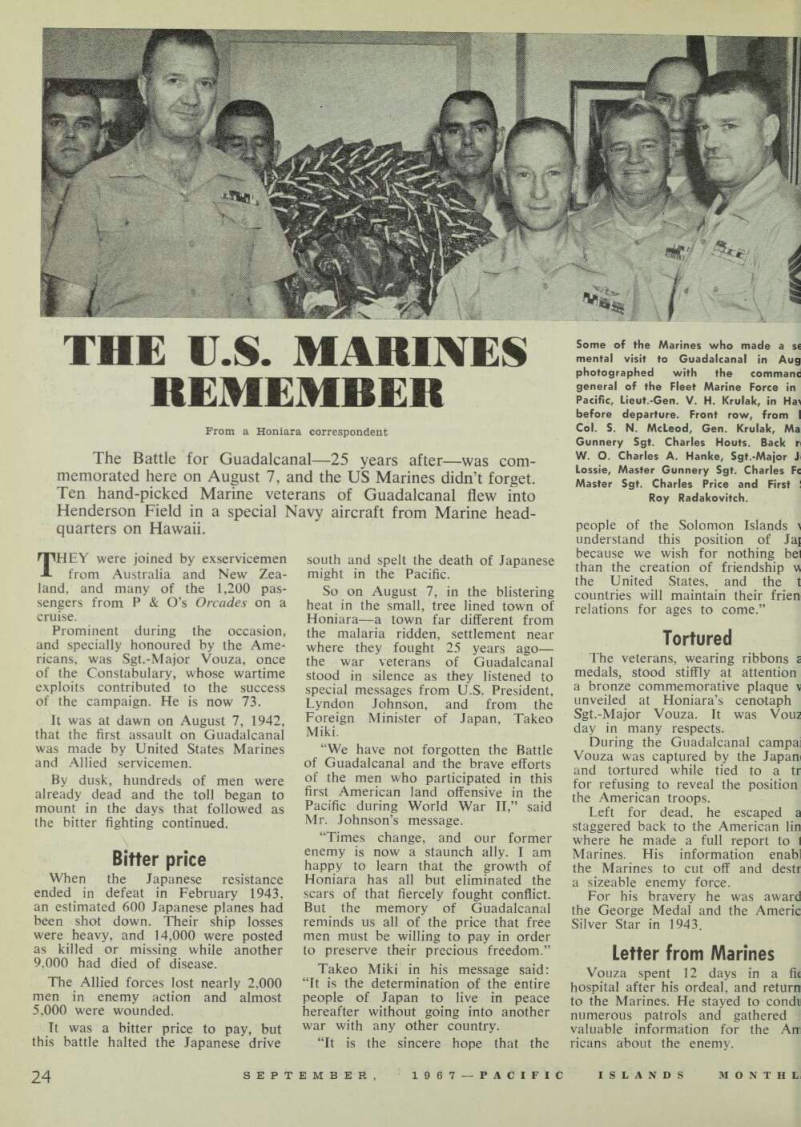
Some of the Marines who made a se[?] mental visit to Guadalcanal in August photographed with the command[?] general of the Fleet Marine Force in Pacific, Lieut.-Gen. V. H. Krulak, in Ha[?] before departure. Front row, from Col. S. N. McLeod, Gen. Krulak, Ma Gunnery Sgt. Charles Houts. Back r[?] W. O. Charles A. Hanke, Sgt.-Major J[?] Lossie, Master Gunnery Sgt. Charles F[?] Master Sgt. Charles Price and First [?] Roy Radakovitch.