(with $140 million to spend!)
pp. 20-21 · Read in the full issue
'Economic development' is the 'in' phrase for New Guinea (with $140 million to spend!)
From a STAFF WRITER in Port Moresby The spectacular economic development of Papua-New Guinea over the past few years is to be pushed even harder in the next 12 months under the Budget brought down by the territory’s Treasurer, Mr. A. P. J. Newman, at the end of August. The Budget’s first overriding purpose, Mr. Newman told the House of Assembly in his Budget speech, was to “in tensify the impetus of economic development, with particular emphasis on the expansion of exports”. As a matter of policy, plans for development had been drawn up on the basis of the greatest possible participation by the native people.
MR. NEWMAN said that the total proportion of the Budget de voted to economic purposes was “rather higher than last year”. Much more money was to be spent on roads, bridges, ports, coastal shipping and posts and telegraphs.
The budget is not only a record but the 17 per cent, increase in its size over last year’s figure of $l2O million is the biggest in its history.
The total Budget figure of $140.6 million is made up of a Common wealth grant of $77.6 million ($7.6 million higher than last year), inter nal revenue of $55 million (up nearly $ll million), and loan raising of $8 million (up $1 million). In addition, the Commonwealth will spend a further $44 million on “various departmental and defence activities”.
Eight new revenue raising measures will hit the pockets of terri tory residents, particularly those in the larger centres. The most im portant of these is an increase to 22i per cent, in the rate of tax on private and public companies, which is esti mated to yield $500,000. (The pre sent differential between private and public companies will be abolished.) Stamp duties will be raised from three to five cents to produce an extra
$Loo,Ooo.
An additional $250,000 will be raised by increasing the excise on locally manufactured beer by 10 cents a gallon (five-eighths of a cent on a 10 ounce glass). An increase of $1 per gallon (16 to 20 cents per bottle) on the import duty on spirits will yield an extra $lOO,OOO.
Other new revenue will be raised
internally by charging a 20 cent treatment charge and an inpatient charge of $2 at the base hospitals of Port Moresby, Lae and Rabaul.
There will also be higher charges for sewerage, sanitation and water.
Items of particular interest in the Budget are proposals to: • Recruit a total of 2,664 officers for the Public Service, of whom four out of five will be indigenous, com pared with the present ratio of three out of four. • Spend $lOO,OOO on external publicity to promote trade with and investment in the territory. • Spend 13.5 per cent, more on education, most of which will go in increased pay to teachers, including 370 new ones.
• Set aside $158,000, compar with $2,814 last year for a hydi graphic survey. “This recognises tl there are still areas of territory wat( requiring detailed surveying for t future benefit of this country,” N Newman said. • Spend $3 million on accomm dation for local officers in the Pub Service, plus further large sums f the accommodation of local teache and police. • Spend $361,000 on the Dz River bridge, and other works that New Britain area associated wi the development of the new oil pal industry. • Begin work on cargo sheds Port Moresby and Lae to ease co gestion, and begin work on wharv at Wewak, Lorengau and Rabaul. • Purchase 286,000 acres of lai
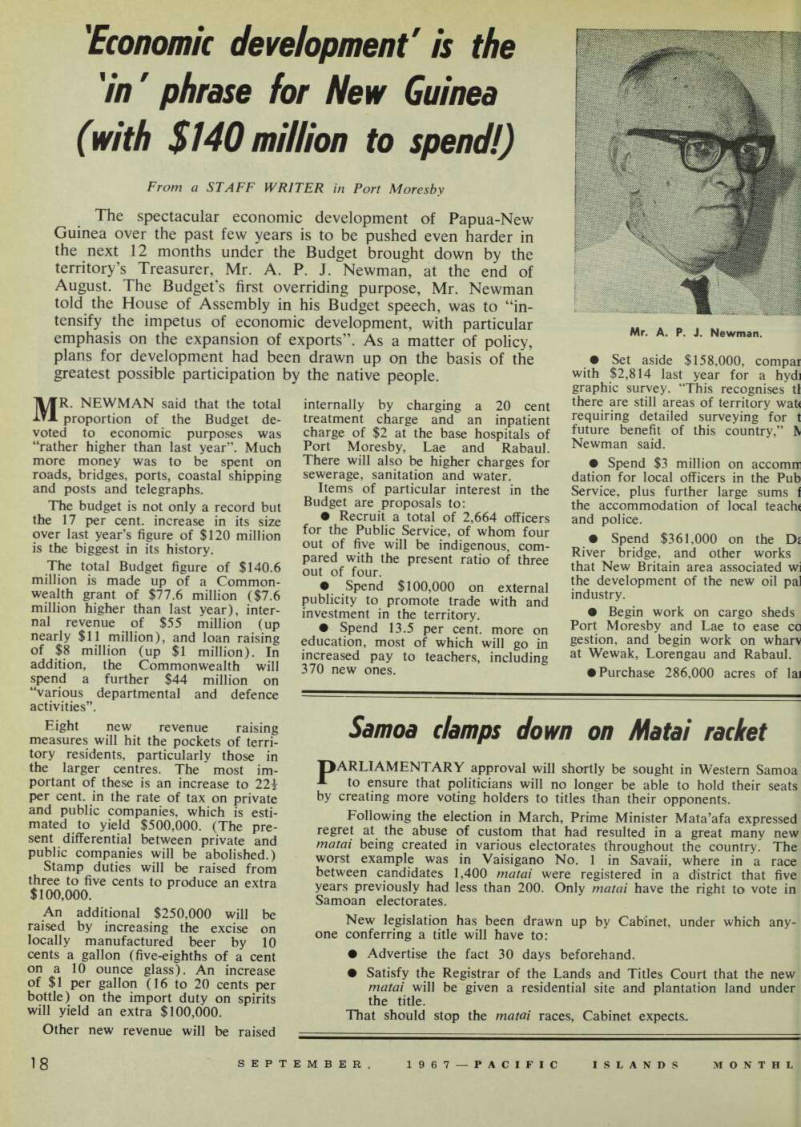
Mr. A. P. J. Newman.
he most ambitious land purchase gramme ever attempted in the tory”—for economic and urban ilopment.
Provide $2.5 million in addi al capital for the Papua-New aea Development Bank to bring esources to almost $3.5 million.
Spend $2.9 million on the P-NG /ersity, an increase of 63 per . over the previous year.
Spend $l.l million on the Li te of Higher Technical Educa , an increase of $740,000. bout the only industry that the isurer spoke of as needing some help was the tourist industry. In ng that $50,000 had been set for the Tourist Board to “de p an industry which appears to ; good prospects,” Mr. Newman “it must be recognised by those ddual organisations involved in dties which will benefit from ism that their support of the d will also be expected.”
Tax details
fie increased company tax applies 967-68 earnings. Company un ibuted profits will not be taxed i 1967-68, thus enabling com es to plough profits back and ex -1 their businesses. But new lations will prevent profits being in “a manner which would evade ompany provisional tax is being inated under a new system of >sment, which will mean that i the end of 1968-69 (after a id of adjustment) companies will issessed for tax on the previous ’s income, and will pay this the •wing year, as in Australia.