tea-growing industry
pp. 149-155 · Read in the full issue


The Practical Planter
Some overseas practices in the tea-growing industry
Handy Hints
For Tea
Planters
From a special correspondent Dozens of different varieties of tea leafs are grown by the big tea-producing nations of Ceylon, India, Indonesia, Russia and Kenya, but only two kinds of plant form the basis of all tea grown. These two, which differ markedly, are the delicate Assam type and the hardy China variety.
f is essentially Assam tea which is being grown today in the High ids of New Guinea, where several I Australian plantations and numer s smaller ones run by natives should producing some 4,000 tons of pre ssed tea a year by the mid-1970’5.
The New Guinea tea industry, which is first envisaged in 1939, did not ally get going until 1962 when the NG Administration gave a firm :ommendation on tea production.
' far, only a few small quantities high grade tea have been sold on s London market.
Much of the Assam tea grown in e territory was originally brought in the form of seed plants from aeensland experimental tea gardens.
There are five different types of >sam tea plants, the light-leaved ssam, the dark-leaved Assam, the anipuri. the Burma and the Lushai.
C. R. Harler, in a book Tea Grow g published by Oxford University ess in 1966 ( $4.65). says the life of e single-stemmed Assam plant is
much shorter than that of the China bush, which can grow up to nearly 100 years. An average of one per cent, of the Assam stand in north east India may die each year over the first 50 years and in this region, where yields of up to 2,000 lb tea acre occur, the life period is only 30-40 years, Mr. Harler’s book does not deal with tea-growing in New Guinea, but much of what he says can be applied to that territory.
He says plants should be selected from a two-year-old nursery put with well-known, proven seed. A know ledge of the age of the trees and local weather conditions is vital when look ing at the leaves.
It is a good idea to have the seed gardens in isolated areas, and so avoid cross-pollination with other nearby tea plants.
In Java, Indonesia, tea planters have their seed gardens at least 1,100 yards away from all other tea, and outside the Assam Valley, seed bearers
grow at least two miles from other areas of flowering tea.
Seeds grow over all the surface of the seed bearer, and when you come to spacing your trees you should keep this in mind. A general guide for Assam plants would be 134-194 trees in a 16-18 ft square or triangular.
Care should be taken when manur ing the seed gardens during their early years and for young tea in plucking.
After the fifth year the make-up of the mixture should be changed.
Increased dosage
In the early years the mixture should be spread around the young trees, ranging from 10 oz to 20 oz per tree, as the spread ranges from one ft to five ft. When the spread increases and the trees start to approach one another, the mixture should be scattered and the dose increased.
For a young seed garden, green cropping is necessary to protect the soil from the sun and also to re duce weeding costs. Make sure your gardens are well drained, otherwise your trees may catch Violet root rot.
Cu’tivation must be shallow.
On the testing and grading of tea
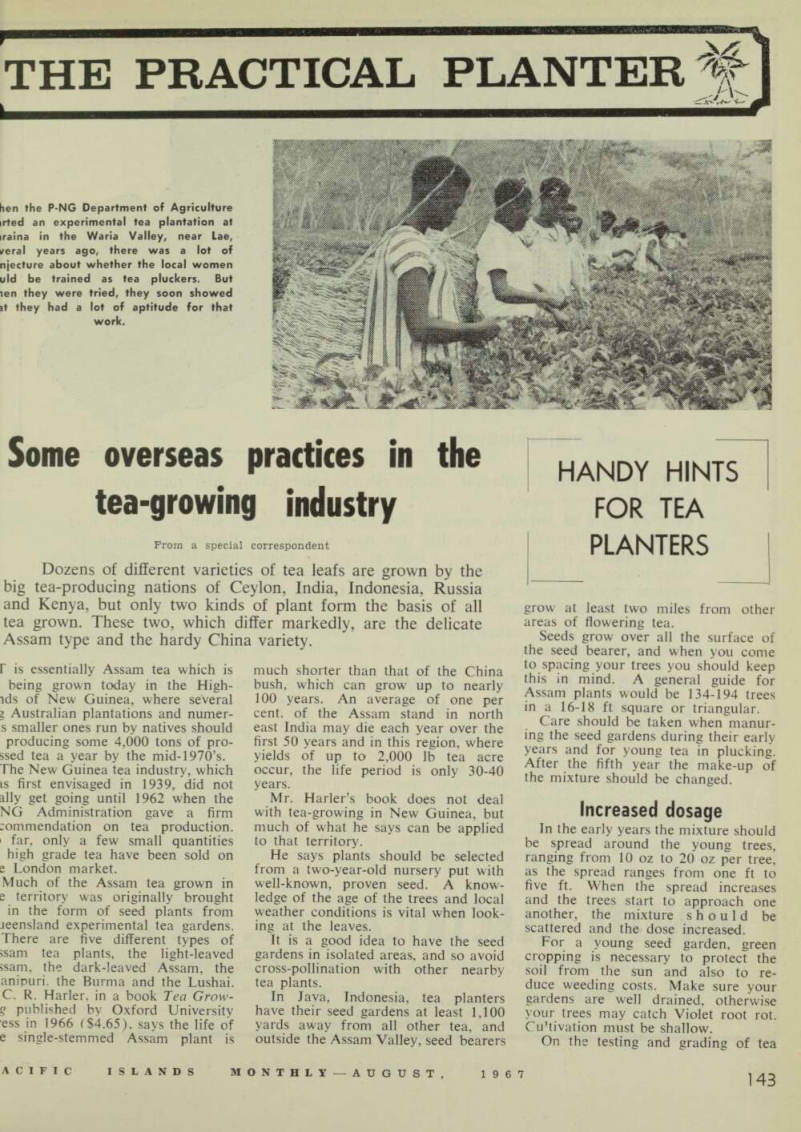
[?]hen the P-NG Department of Agriculture [?]rted an experimental tea plantation at [?]raina in the Waria Valley, near Lae, veral years ago, there was a lot of conjecture about whether the local women [?]uld be trained as tea pluckers. But [?]en they were tried, they soon showed it they had a lot of aptitude for that work.
and, Mr. Harler advises growers to lect the seed daily from the ground er it falls —not to pick it from the e.
You can grade it by using a sieve rotary-type sifter, usually of per iled aluminium. The size of the and varies with the age of trees and : weather.
LJse a mesh of a half an inch in ! sieve and throw away the seed »sing through. Manipuri seed is lerally graded over a ins in. mesh.
Floaters, sinkers
Large seed will usually germinate icker than small seed, and the mts at first have an advantage in e, though this advantage may be t in later growth.
Small seeds carry the risk that they iy produce plants with some of the ina strain in them.
After you have sifted the seed, ice the seed in a large bin of water i leave it for half an hour.
Most seeds will sink, some will
float, and others will float some distance down.
Remove the half-floaters and floaters and put them in another bin or in a cool shed and leave them for a few days. Then repeat the floating test, and many of the floaters or half floaters will become sinkers.
Put the sinker seed wet on a tar paulin and pick them over to remove cracked and split seed.
Such seed may come good if you put it immediately into a nursery.
Flat-sided or twin seeds are perfectly good.
For transporting the seed, pack your picked seed. Use wooden boxes, lined with strong brown paper, and pack the seed in layers with a mixture of damp sand, ashes or charcoal. The mixture may contain up to 15 per cent, moisture but there is no set figure.
Selection of plants
A good test to see if there is enough moisture is to grip a handful of the mixture. If the impression of your fingers just remains when you release the mixture, then it is OK.
If you intend selling your seed, before you pack it, it must be tested.
To do this crack 100 seeds with nut crackers and examine the half-seed for cheesiness, seed that has been punctured by the tea seed bug, or otherwise damaged seed.
If your percentage of sound seed falls below the guaranteed figure, dis card the lot because most estates carry out the same test on their purchases.
It is best to plant the seed as soon as you can after it falls from the tree because the percentage of seed that germinates drops rapidly as time
goes by. Seed kept for a month may show only 25 per cent, germination, after two months 10 per cent., and after three months, six or seven per cent.
Assam seed is planted in a nursery with the seed spaced 10 inches square.
After two years, select the plants first for leaf appearance, then for size of stem, general spread and sturdiness.
In north-east India, growers take into account the covering of soft down on the leaves and stems of the plants when selecting plants.
To do this, hold the first leaf of a shoot with its back to the sunlight.
If the hairs cover the back of the midrib only, the plant has a value of one.
If the hairs extend about halfway across the back of the leaf, their value is two, and if they extend to the serrations of the edge of the leaf, three is given.
A leaf with heavy down, reaching to the stalk, is given a value of four.
To determine these values on a stand of nursery plants or a stand of tea seed trees, these tests should be made on 20 typical plants and aver aged out. Your plants should have roughly the same value.
A good seed garden of the Betjan type (with downy leaves of the dark leaved variety), should give an aver age figure of not less than 2.6, while an average of carefully-selected Mani puri plants may be I£, and Burma plants, 0.75.
The selection of leaves with soft down is worthwhile because about 75 per cent, of plants with downy leaves give teas with marked quality, while only 25 per cent, of plants with hair less, bald leaves may give the same quality. (Over)
[?] employee at a tea nursery near Mt. [?] gen inspects a tea plant for planting out.
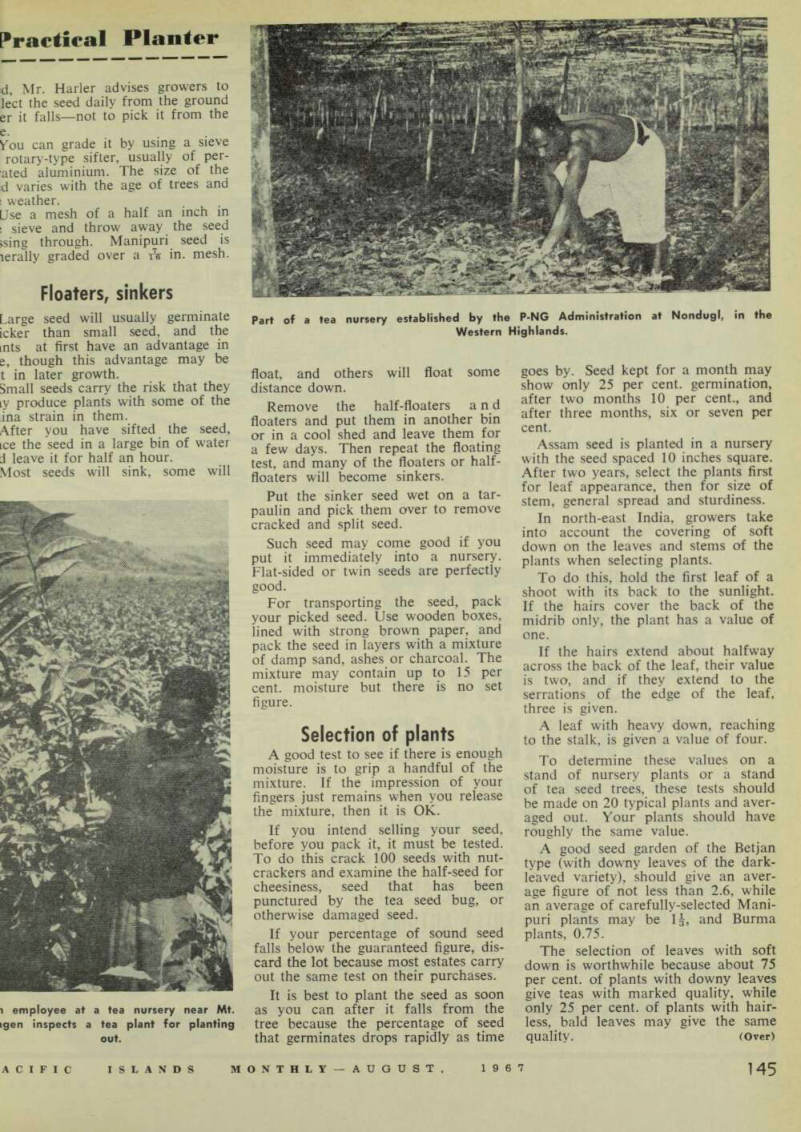
Part of a tea nursery established by the P-NG Administration at Nondugl, in the Western Highlands.
Tea can be propagated from leaf ttings, and every tea-producing untry is looking closely into studies selection and propagation. All ttings from one bush, whether of ; first or subsequent generations, £ called a clone.
Clonal selection
D. M. Forrest, in his book A undred Years Of Ceylon Tea 'hatto and Windus, Lond., 1967, .30), says the Tea Research In tute of Ceylon became extremely tive after World War II in experi snting with clones, or, as the pre ss is otherwise called, vegetative opagation.
Mr. Forrest says the whole essence clonal selection is based on find g suitable clones for all the varied imatic and soil conditions yof tea >untry.
He says hundreds of Ceylon tea tates have experimental plots where e planters test their own, or their fighbours’, or the institute’s cut igs.
“The influence of re-planting with gh-yield clones is something to be ckoned with during the next quarter mtury or so, not at this moment,” i says, “There may be a progressive estate ;re and there whose output graph is already been given a steeper curve trough clonal tea coming into bear ig, but the fact that the total area of ich tea yielding leaf by the end of J 55 was not more than 5,000 acres me per cent, of all Ceylon’s tea land), ats the matter in perspective,” Mr. orrest says.
Sir Percival Griffiths, in his book, The History of the Indian Tea In dustry (Weidenfeld and Nicolson, Lond., 1967, $26.20. Available in Australia in October) says that vegetative propagation was first tried in Japan at the end of the last century.
Thirty years passed before similar experiments were tried in India and the process did not become the sub ject of serious study until between the World Wars.
“Production of high-quality bushes by this process is a lengthy affair, but it is already beginning to show results in India in high yields and improved quality,” Sir Percival says.
He says Indian tea institutes and some tea companies have evolved highly efficient ways to select parent bushes for making clones, and for reliable tests of yield and quality.
“Polyclonal seed obtained by allow ing two or more clones to pollinate one another offers a means of com bining the merits of specially selected clones and so of getting populations of tea bushes with some variation but of high value, and also of retaining the advantages of propagating by seed,” Sir Percival adds.
Downy, top growth
Mr. Harler’s book, Tea Growing, gives an outline of the method of selecting Assam tea plants as a source of leaf cuttings or clones. This timing and statistics refer to plains’ condi tions in north-east India.
From a high-yielding area giving good quality tea, bushes of 10-20 years of age are selected.
About 4,000 bushes are selected in
September and examined for the downy appearance of their leaves.
These are then pruned and selected for frame, reducing the original num ber to perhaps 500.
The following May another selec tion for downy and top growth is carried out, and the numbers may be reduced to about 200.
Leaf cuttings are then taken and planted out, and by September the best rooters are taken. The number of selected plants, by then, is probably reduced to 50.
The following March, the leaf from each selected bush is manufactured and the teas tasted.
Five or six of the 50 bushes may give above-average teas, and one may be outstanding.
Vegetative propagation
After your clone has been selected and the nucleus bushes set up under Assam conditions, cut off the shoots in the spring, leaving half an inch of new wood.
Take the pruned stems to the pro pagating area or nursery, but don’t expose them to the sun.
Don’t use young tender leaves for good cuttings. Discard the top most three or four leaves of the stem, or the two top leaves of a banjhi (dormant) shoot, whatever the case may be. Also, the hard and
Resettlement areas in the Wahgi Valley New Guinea are being prepared for [?]me 20,000 New Guineans who are [?]entually expected to take part in the [?]verelopment of the Western Highlands industry. The P-NG Department of agriculture is establishing nurseries to [?]wide tea plants for the plantations and [?] seedlings for building and firewood [?] Some 3,200 acres at Kinding, [?]ndepina and Nondugl have been bought the Administration for settlers to plant on blocks ranging from eight to 22 yes.
Photo shows farmers preparing the [?]und for kau kau planting as a means improving the soil before tea planting.
ody portion at the lower end of the m should not be used.
Dnly leaves which are hard and re dormant connecting buds are eptable. items of each cutting should be U long, the top of the cut immedi ly above the connecting bud and lines of the cut and basal cuts the same plane as the leaf. fhe callus growth at the lower end the cutting should start two to four jks after planting, rootlets should •ear in six to eight weeks and root nation should begin in 10 to 14 ;ks.
Ihoot formation and leaf growth uld start in 14 to 18 weeks.
'ou must plant your cuttings as n as possible after you get them. ;n an average of 80 per cent, uld strike. ndian, Ceylon and African re •chers have experimented with it hormones to improve tea leaf ings without encouraging results.
Seed or clonal planting?
he complex problems of clonal ction and the still more difficult lal seed production have yet to be ed. Currently, if the Assam type of it is grown, as in the New Guinea ilands, it would pay to use good [mercial seed, if this is readily liable. iter years of study and experi it, scientists from Tocklai Experi ital Station, Assam, have selected ics and released them to estates. he first batch of three became lable in 1949, the second batch of in 1959, and the third batch of in 1963. he clones haven’t succeeded on age estates in Assam, one of the Id’s most prolific tea-producing ,s. ne large combine there has worked the problem for 20 years, during ;h over 500,000 plants have been nined and 30,000 of them given ity trials. f this enormous total, a scant 10 ts satisfied the criteria for crop quality.
There are many other aspects of Wanting besides those outlined . In future issues, PlM’s Practical ter section will deal with such sets as bush formation and prun the art of good plucking, soil ice, fertilisers and shade.