Business and Development
pp. 131-142 · Read in the full issue
$1M. Timber Plan
For Solomon
Islands
Kolombangara, a large,
volcanic island in the Western Solomons, is to be the location
of a $1 million timber project
in the protectorate —subject to
certain arrangements with the
BSIP Government.
LEVER’S Pacific Timbers Limited, which is associated with the United Africa Company (Timber) Limited and with Unilever, plans a long-term, large-scale log extraction operation on the island.
Kolombangara is an almost cir ular extinct volcano rising to about 5,000 ft and covering an area of about 250 square miles.
Lever’s have been extracting hard wood logs from Gizo Island, eight miles away, since 1964 at the rate of about 500,000 cubic feet a year.
Their equipment will be moved to Kolombangara.
The undertaking on Kolombangara will be much bigger than the one on Gizo because Lever’s plans to step up annual production rates to about three million cubic feet of Calophyllum, Pometia and Dillenia.
A spokesman for the United Africa Company, which is lending timber eperts from Ghana to Lever’s for the project, said in July that equipment would be transferred by sea from Gizo to Kolombangara about June next year.
Extra equipment would be shipped about the same time, and a small harbour and accommodation for a laour force of 300 men would be built.
Bank of Western
Samoa under fire
AN unprecedented attack on the Bank of Western Samoa and its manager was made in Western Samoa’s parliament in July.
Afamasaga Maua, member for ana Alofa No. 3, who is now serving s second term, called for the set ig up of a new government bank assist development, and asked
parliament to demand the appoint ment of a new manager of the Bank of Western Samoa.
“It does not seem proper that we should call the present bank the Bank of Western Samoa, when the Bank of New Zealand has more say than our own government,” said Afama saga. (Fifty-one per cent, of the bank’s shares are owned by the Bank of New Zealand and 49 per cent, by the Samoan Governrpent. Control of the bank is centred in Wellington.) Afamasaga said: “We all know that the people who are getting benefits are those who have property, but the majority who cannot supply property for security cannot get any loans.”
He said that the only way to rectify the position was to set up “our own government bank so that the people will be able to benefit from the de velopment of their plantations and other facilities that they need”.
Afamasaga said that as the only source of credit in the country, the Bank of Western Samoa’s monopo listic position was most unsatisfactory.
He compared it with a single store in a village.
“Those people will have to buy what the store has,” he said. “In the same way we have only one bank and we can go nowhere else to seek satisfaction of our needs.”
Afamasaga asked the House to de mand the appointment of a new manager of the Bank of Western Samoa because, he claimed, the pre sent manager was unable to satisfy the people’s needs.
In an interview after his speech, Afamasaga claimed that two-thirds or more of the members supported his criticism of the bank and favoured the setting up of a new bank. They were in favour of inviting other banks to set up business in Samoa.
New bank opened
in P-NG
ANEW bank, the Development Bank of Papua and New Guinea, opened for business in modest offices in Port Moresby on July 6, It has an allocation of $1 million from the Australian Govern ment and a policy of stimulating private enterprise in P-NG with loans to small producers and business men.
Australia’s Minister for Territories,
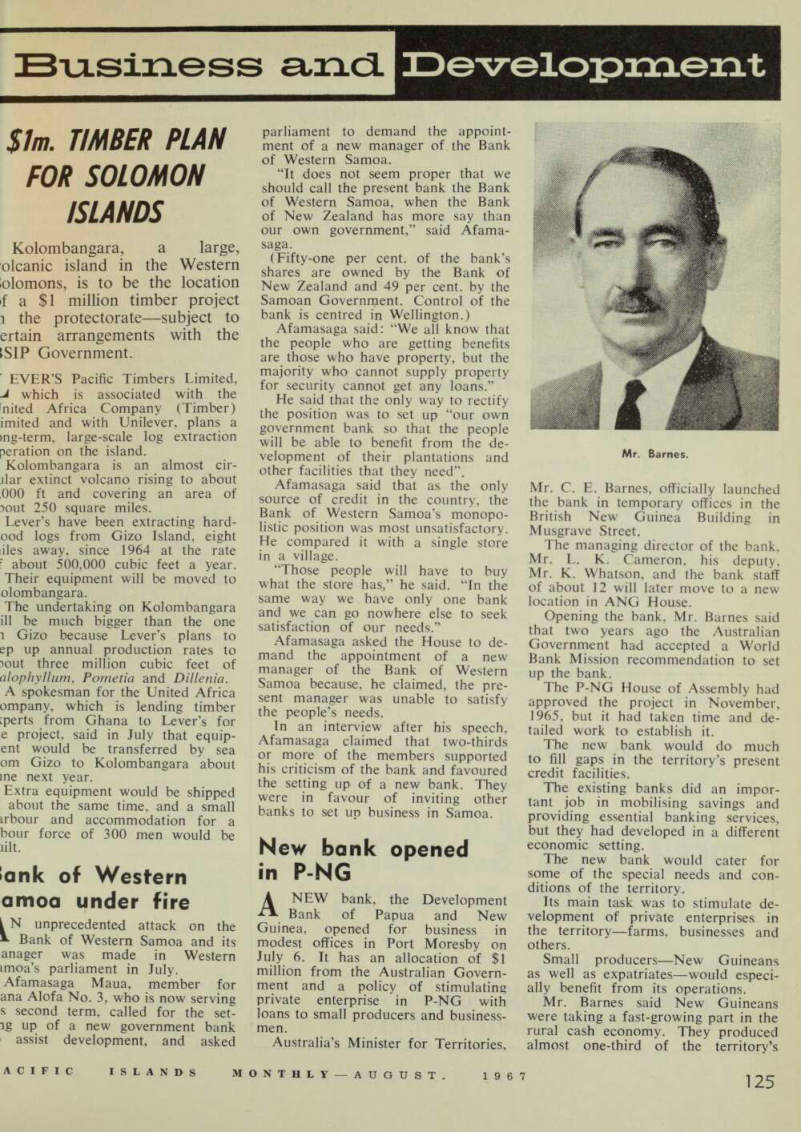
Mr. C. E. Barnes, officially launched the bank in temporary offices in the British New Guinea Building in Musgrave Street.
The managing director of the bank, Mr. L. K. Cameron, his deputy, Mr. K. Whatson, and the bank staff of about 12 will later move to a new location in ANG House.
Opening the bank, Mr. Barnes said that two years ago the Australian Government had accepted a World Bank Mission recommendation to set up the bank.
The P-NG House of Assembly had approved the project in November, 1965, but it had taken time and de tailed work to establish it.
The new bank would do much to fill gaps in the territory’s present credit facilities.
The existing banks did an impor tant job in mobilising savings and providing essential banking services, but they had developed in a different economic setting.
The new bank would cater for some of the special needs and con ditions of the territory.
Its main task was to stimulate de velopment of private enterprises in the territory—farms, businesses and others.
Small producers—New Guineans as well as expatriates—would especi ally benefit from its operations.
Mr. Barnes said New Guineans were taking a fast-growing part in the rural cash economy. They produced almost one-third of the territory’s
Mr. Barnes.
copra, two-thirds of its coffee and owned all the pyrethrum plantings.
Also, they were taking a keen in terest in production of tea and palm oil.
When people asked for loans from the Development Bank, bank officers would be guided more by the pros pects of a successful operation than by the security offered.
But the borrower would have to convince the bank he was a good proposal, and that he was hard work ing and honest and would repay the loan.
Mr. Barnes said he hoped that be fore long the bank would develop as one of the territory’s key financial institutions.
The bank’s board of directors has two New Guinean members, Mr. M.
Tibu, of New Britain, and Mr. M. R.
Rarua, of Port Moresby.
P.l. Mines shares
at 1967 peak
SHARES in Pacific Islands Mines Ltd., which with Cultus Explora tion Ltd., of Canada, is looking for gold and other minerals on Misima Island, Papua, reached a 1967 top peak of 58 cents in mid-July.
This contrasted with their drop to 27 cents in June {PIM, July, p. 132) when Cultus announced it was ex
periericmg a shortage of funds. Tl par value is 25 cents.
The apparent reason for their ri in July was that a top executive ( Cultus paid a whistle-stop visit Australia early in the month to r assure directors of Pacific Islan< Mines that plenty of capital w; available to continue exploration c Misima.
PI Mines’ chairman, Mr. G. \ Noe, told PIM that the rise in tl shares, if for reasons other than tl visit of the Cultus executive fro: Canada, was “purely speculative”.
“We believe our prospects c Misima are as good as ever,” he sai “We and Cultus are both sendii men to Misima in early August i pick up assays and bring them ba< to Sydney for examination.
“I expect the results of the: examinations will not be known uni early September so until then ar change in the value of our shares speculative.”
The shares levelled off to 50 cen in early August when it was learne that the British mining giant, Conzii Riotinto, had applied for minir leases on Misima that PI Mines di not hold.
Ups and downs
in the BSIP
rE growth of investment t private enterprise and the poc showing of agricultural productic were features of the economy in tl British Solomon Islands Protectorai last year.
Stir Robert Foster, High Con missioner for the Western Pacifi said this in opening the eighth sessio of the BSIP Legislative Council i July.
Sir Robert said production of th main export crop, copra, was on! 23,300 tons—the lowest since 196( Cocoa production was only 9 tons, a mere 23 tons more than i 1965.
Referring to copra, Sir Robe] said: “The experts tell me that th specific reasons for the decline elud them, but being a simple soul, I woul imagine that had all the nuts whic were on the ground been collecte we should have done rather bette than we did”.
He said a hybrid nut, capable c a 30 per cent, increase over eithe of its parents, was already in prc duction.
Log exports had exceeded on million cubic feet for the first time Exports of sawn timber were value at $400,000.
The sawn timber production o
bout 180,000 cubic feet was also a jcord.
Four timber companies were in reduction and this industry was rowing in confidence, knowledge, tperience and capacity.
Trials on oil palms by the Com lonwealth Corporation would pro ved; and a trial shipment of four >ns of dried chillies would be sent > Britain.
Recently an additional 4,500 acres ad been allocated to Guadalcanal lains Limited for further mech lised agricultural development, and i 1968 the company planned to ex and production substantially of both ce and soya beans.
Sir Robert said air travel had lurled forward” in 1966. Passen ;rs carried internally totalled 5,200 -a 45 per cent, increase over 1965.
Also, the number of people arriv g from overseas had reached 2,500 year.
uture seen for
'ongan vanilla
i USTRALIAN vanilla buyers are a- agreed that samples of Tongan milla beans, grown by planters at avau, are up to world standards, id that if the kingdom can produce milla in quantity, it will sell on a impetitive basis on world markets.
Although vanilla was introduced to Tonga as long ago as the early ?00’s by French missionaries, it jver got going until 1953 when ing Taufa’ahau (then Prince Tungi) introduced it as a cash crop to avau.
It has taken 14 years of experi icntation to produce beans of world andard.
Australian importers, Bush, Boake, Hen (Aust.) Ltd,, early this year iceived samples of the beans from ic Tongan Government.
A director of the company, Mr. N. roadbent, told PIM in July that the jans had been thoroughly tested, id that they compared well with milla beans from Madagascar, hich were regarded as the world’s jst. and from Tahiti.
“The Tongan beans have a laracter of their own,” he said, “If lything, they are possibly nearer the ladagascar variety than the Tahiti ;ans.
“If Tonga can export the beans my impany will be in the market for lem.”
Other buyers said they would pay 1.50 for the beans landed in Aus alia. Allowing for freight and ustoms charges in Australia, this as expected to return $2 per lb to ongan growers.
Prices for Tahiti vanilla beans were $6.50 and $6.60 in late July.
So if Tonga can export beans at the prices acceptable to Australian buyers they stand an excellent chance of making inroads in the Australian market. New Zealand buyers would be equally interested.
Both countries buy from Madagascar and Tahiti at present. ~r,, t . , .
King Taufaahau, told reporters m Nukualofa in July that Tonga had high hopes of a lucrative export business in vanilla and planned to build it up.
“Exports have already started,” he said.
r nnrA c r ® m ° rKeT IS
yn slightly
r 3 * IV/fR- McDONALD, chairman LtJ. of the P-NG Copra Marketing Board, said in Port Moresby on July 21 that the average price fixed by London Copra Association in June for Philippine FM Copra was £Stg.72/5/- per ton, quite a sharp rise from the average of $ 6 5/17/6 fixed f or tfi e previous month. His re port continued “ Prices drop ped back early in July to ar ound £7O/10/-, but have since reacted upwards and indications are that the average for July will turn
out to be somewhere around £72.
“Developments in the oils and fats market have again been diverse, with prices for copra and coconut oil ris ing because of short nearby supply brought about by the closing of the Suez Canal, combined with the Nigerian situation, which has seri ously affected palm kernel supplies.
"But there are indications of in creasing supply pressures in copra and coconut oil, mainly from the Philippines, where production is re covering. Consequently further price rises can hardly be expected, par ticularly when one considers that there are also fairly good supply prospects ahead this year as far as most other edible oil seeds and oils are concerned.”
Big job in P-NG
copper project
DILLINGHAM Corporation of New Guinea Pty. Ltd. has won a $500,000 contract to drill an exploratory 3,000 ft deep sampling tunnel for Conzinc Riotinto of Aus tralia on the Bougainville copper project, 22 miles north of Kieta.
Work is to begin in late August and will take 18 months.
It is the third major job Dilling ham has undertaken since it began in the territory in late 1965.
The company is due to complete a $3.2 million road from Goroka to Kainantu in the Eastern Highlands by September.
In July, it was awarded a $527,000 contract by the Administration to build a section of the Lae-Madang road from Gusap to Dumpu.
A few weeks later, the company won another contract worth $573,690 to build 26 miles of road in the Ramu Valley area.
W. Samoa fries
new cases THE first shipment of Portuguese cases for Western Samoa’s fruit export trade arrived at the end of July. The shipment consisted of 40,000 banana cases and 10,000 taro cases.
Minister of Agriculture Laufili Time said that if the cases prove satisfactory all future supplies will be bought from Portugal.
Previous to this, apart from some locally made cases, all cases were imported from New Zealand.
Portuguese banana cases land at Apia at 4/8 each compared with the New Zealand price of 6/10. Normal Banana exports average about 600,000 -cases annually.
The industry
thut AV>ii* tmuineu
euuld ttuve hud
There are plenty of indications that some of the kenaf seeds that were planted in Papua in the 1950’s are now metaphorically springing up all the way from Iran to Korea; and that one of Australia’s hidden handouts to Asia might turn out to be a fibre in dustry.
BETWEEN 1948 and 1954 when the excessive price of Indian and Pakistani jute used in the manufac ture of woolpacks, wheat sacks, burlap, etc., threw a heavy burden on Australian primary producers, planting and business interests in Papua were encouraged to establish a kenaf industry.
Seeds were obtained from abroad, a number of experimental plantings were made and from the long straight stems of the shrub—a relation of the hibiscus—burlap and woolpacks, as good as if not superior to similar articles made of jute, were manu tured.
Assuming that they still had the backing of the Commonwealth Gov ernment, one group, in 1954, prepared to set up kenaf-growing and milling on a large commercial scale. The Commonwealth Government, how ever, refused to give the infant in dustry protection and nothing has been heard of kenaf in Papua—or New Guinea—since.
It has always been assumed that Australia was forced into a trade deal with Pakistan and India over Papua kenaf and that part of the deal was to kill off the local industry. One official view was that kenaf had achieved its purpose in that it had brought the price of jute tumbling down.
As a result of the no-support-for kenaf policy, Papua-New Guinea still imports its copra sacks and Australia still brings in the material for its wool-packs and wheat sacks although some of this material may no longer be jute, but kenaf.
Since Papua showed how it was done, an interest in kenaf-growing has sprung up all over Asia and is now outstripping jute in popularity.
In East Pakistan, where kenaf was banned for years, it is now being grown in increasing amounts.
But perhaps the most extraordinary results have come from Thailand which produced 4,000 tons of fibre in 1957 and is now producing
600,000 metric tons of kenaf fibre per annum—the country’s seconc largest export.
This result has been repeated although to a smaller extent, in Indo nesia, Burma, Cambodia, Vietnam Taiwan and even Iran. In the lasi few years, the United States agenc} that provides aid to agriculture ir under-developed countries had beer instrumental in the rehabilitation 01 construction of 18 textile mills in 1] countries—all but three of them tc deal with kenaf.
New nickel company
for New Caledonia
A CONSORTIUM of French com -Cl- panics and at least two foreigi companies is being formed to exploi New Caledonia’s vast low-grad< nickel ore deposits.
The French High Commissioner ii the Pacific, Mr. Jean Risterucci, sai( this in Noumea in July on his retun from a conference in Paris of head: of France’s overseas territories.
At present, New Caledonia’s nicke industry is solely controlled by th< Rothschild-owned Societe le Nickel.
The establishment of a seconc company has been a hot politica issue for some time, but it was no until last December that the Frencl Minister for Overseas Territories General Billotte, announced ii Noumea that a second company would be allowed into the territory ( PIM , Jan., p. 142).
Mr. Risterucci said that the crea tion of the new company had beet delayed because of “long discussion: and negotiations with French capital ists”.
If the present negotiations came tc fruition, the new complex would star operating “very soon”. It would be “essentially French and open to Nev Caledonian participation”, with £ capital of “around SAIOO million”
Newspapers in Noumea stated thai the world’s biggest nickel producer International Nickel, was included ir the new complex.
This company was one of several which applied to the French Govern ment last year to join the complex (PIM, June, 1967, p. 129).
In June an experimental shipment of 240 tons of low-grade nickel ore was shipped to International Nickel in Canada by Mr. Edouard Pente cote, of New Caledonia.
Meanwhile, a correspondent in London of the Australian Financial Review has reported that Societe le Nickel has contracted to mine nickel in Venezuela.
The correspondent said that the
(Continued on p. 136)
Societe was interested in mining i Venezuela because its work in Ne’
Caledonia was “to be limited” by th arrival of the second company.
Pechiney and Ugine on the Frenc side, and Inco, Amax, Denison c Canada, and Hanna of the Unite States, on the foreign side, wei named by the Review as negotiatin with France to form the consortiun It added that Japan had alread agreed to a 15 per cent, increase i nickel ore prices under an agreemer to import about 1.8 million ton from New Caledonia in the year t March, 1968.
s6m. P-NG oil plot
ESSO Exploration and Productioi Australia Inc. have joined Oi Search Limited in a “farm-out agreement to explore 3,900 squan miles of Oil Search’s concession area in Papua.
Esso will spend up to $6 millioi on exploration around the mouth o: the Turama River and Deceptior Bay, in the Gulf of Papua, to gair a 50 per cent, interest in any oil oi gas finds in the area.
The new partner will carry ou seismic work to define prospective structures for test drilling and ther drill four exploratory wells to locate gas or oil accumulation.
The first work is due to start ir early August with a seismic survey around the Paibuna River, north ol the Turama.
News of this agreement and speculation that Oil Search had in terested British Petroleum in a similar oil survey agreement in one of its extensive concession areas in Papua sent the company’s 50 cent shares on Sydney and Melbourne stock exchanges to 18 cents in earlv August, nearly the highest for 1967.