Ellice Islands
pp. 99-100 · Read in the full issue
German Study Of
Music Shows How
Reviewed by Sydney music critic
Curt Prerauer.
Die Musik der Ellice-Inseln (The Music of the Ellice
Islands), published by the
Museum fur Voelkerkunde, Ber lin, is among the most important ever to come under my notice.
It is strictly scientific.
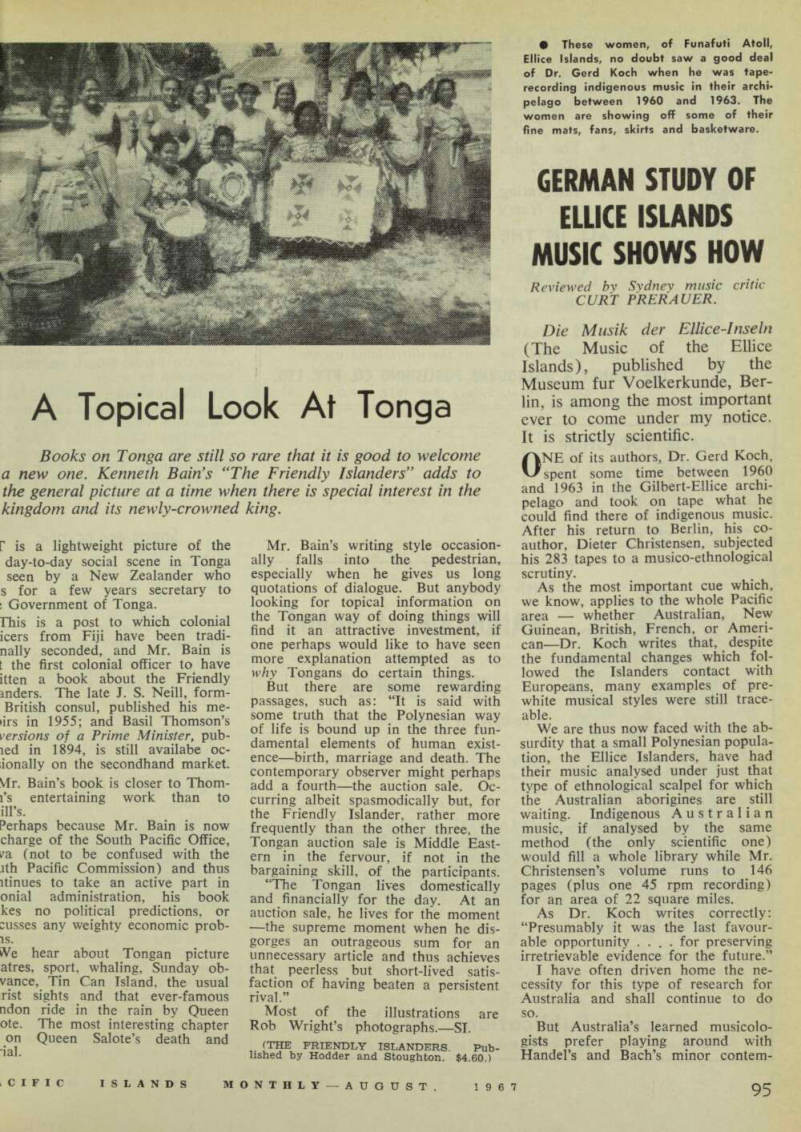
ONE of its authors, Dr. Gerd Koch, spent some time between I960 and 1963 in the Gilbert-Ellice archi pelago and took on tape what he could find there of indigenous music.
After his return to Berlin, his co author, Dieter Christensen, subjected his 283 tapes to a musico-ethnological scrutiny.
As the most important cue which, we know, applies to the whole Pacific area — whether Australian, New Guinean, British, French, or Ameri can —Dr. Koch writes that, despite the fundamental changes which fol lowed the Islanders contact with Europeans, many examples of pre white musical styles were still trace able.
We are thus now faced with the ab surdity that a small Polynesian popula tion, the Ellice Islanders, have had their music analysed under just that type of ethnological scalpel for which the Australian aborigines are still waiting. Indigenous Australian music, if analysed by the same method (the only scientific one) would fill a whole library while Mr.
Christensen’s volume runs to 146 pages (plus one 45 rpm recording) for an area of 22 square miles.
As Dr. Koch writes correctly; “Presumably it was the last favour able opportunity ... for preserving irretrievable evidence for the future.”
I have often driven home the ne cessity for this type of research for Australia and shall continue to do so.
But Australia’s learned musicolo gists prefer playing around with Handel’s and Bach’s minor contem
poraries—or with learning the did geridoo (as if you just had to lean the piano to understand the “Ar of the Fugue”) and strumming al sorts of Elizabethan instruments— while every day more aborigines an dying out, taking their aborigine ethnological heritage with them int< their graves.
While, according to Dr. Koch, th first white man probably came t< the Ellice Islands in the 1560’5, actua christianisation only began then about 1865.
Koch-Christensen’s book, being no only scientific but also modern, ab stains from that ready trap fo mediocrity and ignorance, conjectur ing.
We read facts, nothing but fact —and they’re interesting enoug] never to be “dry”—and not only be cause the Pacific Islands are liberal! surrounded by water.
Koch-Christensen give the exac circumstances connected with a melod —not only where they heard it, br whom they heard singing it, how ol he or she was, and what the perso said about the sources of the song.
“Very old” or “traditional” is at solutely unacceptable to them.
Songs are cryptic
Dr. Koch found through questior ing that the songs deal with situs tions about which the words them selves give only a very cryptic ides The actual event is often omitted.
Example: “My beloved child, carried him on my back. We wer into the surf. What a woe for m child! No sound of his voice. Little little, little (he was)”. This is th song of a father whose child wa washed away by a wave.
Koch and Christensen give, o course, a comprehensive view o every ethnological aspect (subdivisio of songs into working, fishing, pla> ing songs, etc.), not to speak o a most thorough musical analysis including a listing of the manner i: which the singers sometimes wee “out of tune,” etc.
The “instrumental” accompanimer consists of hand-clapping or beatin on mats, or on slot-drums (with tW' sticks).
Summing up, I should like to sa that Die Musik der Ellice-lnsel ought to become THE standar reference work on how ethno-musicc logical research must be carried ou —and for the whole Pacific Island area, not only Polynesia—but espe dally for the Australian aborigine —before it is too late.