Guadalcanal, 1942
pp. 85-89 · Read in the full issue

Pacific Islands Monthly
Magazine Section
It’s now 25 years since...
Guadalcanal, 1942
A Time To
Remember
From a special correspondent
The Japanese engagement in World War II lasted for three years and eight months—eight months of brilliant success and breathtaking expansion, followed by three years of unremitting defeat and withdrawal that ended in Tokyo Bay. The turning point in Japanese fortunes came at Guadalcanal, where on August 7, 1942—25 years ago this month—the Ist Division of the US Marine Corps, commanded by General Vandergrift, landed to stem the thrust that threatened America’s vital line of communication with Australia (vital, because America needed Australia for her ultimate offensive against Japan).
rHUS began the six-month cam paign on the jungle-clad, fever idden island bearing the code name if Cactus. The name was apt in the ontext of the thorny problems of upply at that early stage of the war, Ithough to the Marines and the Gl’s /ho followed them the tangled under rowth of the jungle concealing an dversary renowned as a jungle fighter /as better described as “green hell”.
One US war correspondent de cribed it as “Passchendaele crossed dth the Gran Chaco”, and most if the Americans who fought there ame away with memories of mos (uitoes, ants and bugs of one sort md another. But it was the unceasing ain and wetness that apparently got hem down more than anything.
“It was always raining,” said Corporal John Conroy, USMC, who was evacuated with shell shock after six weeks on the ’canal. “We fought virtually afloat in our fox holes.
You’d get wet one day and stay wet for the next three.”
Untrained, untried
The conditions may have seemed worse than they really were, for the American troops were raw, untrained in tropical conditions and untried in battle.
But they held on until growing sea and air power enabled them to take the initiative and drive the Japanese from the strategically-placed island, beginning the long process of rolling back the Japanese.
In Honiara today—itself a creation of the war—it is hard to imagine the horrors and discomforts of the war.
Business and government are con ducted from air-conditioned offices, football and golf are played on the old battlefields, and malaria, the scourge which accounted for half the US casualties and about 9,000 Japanese deaths, is now largely elim-' inated from Guadalcanal, thanks to the WHO-BSIP malaria eradication campaign.
Who would guess that for two months the front line cut right through the present capital of the Solomons, extending from the present Hotel Mendana through Coronation Gardens to the power house and up Cruz Creek to Skyline Ridge?
Rather than suffer the heavy casualties that a frontal attack on the strong Japanese defences in that sector would have inflicted, General Patch held it with one division while with another division he swept the hinterland hills and hooked around to the coast at Kakambona, where he overran the Japanese 17th Army field headquarters.
But that offensive was right at the end of the campaign, when the Ameri-
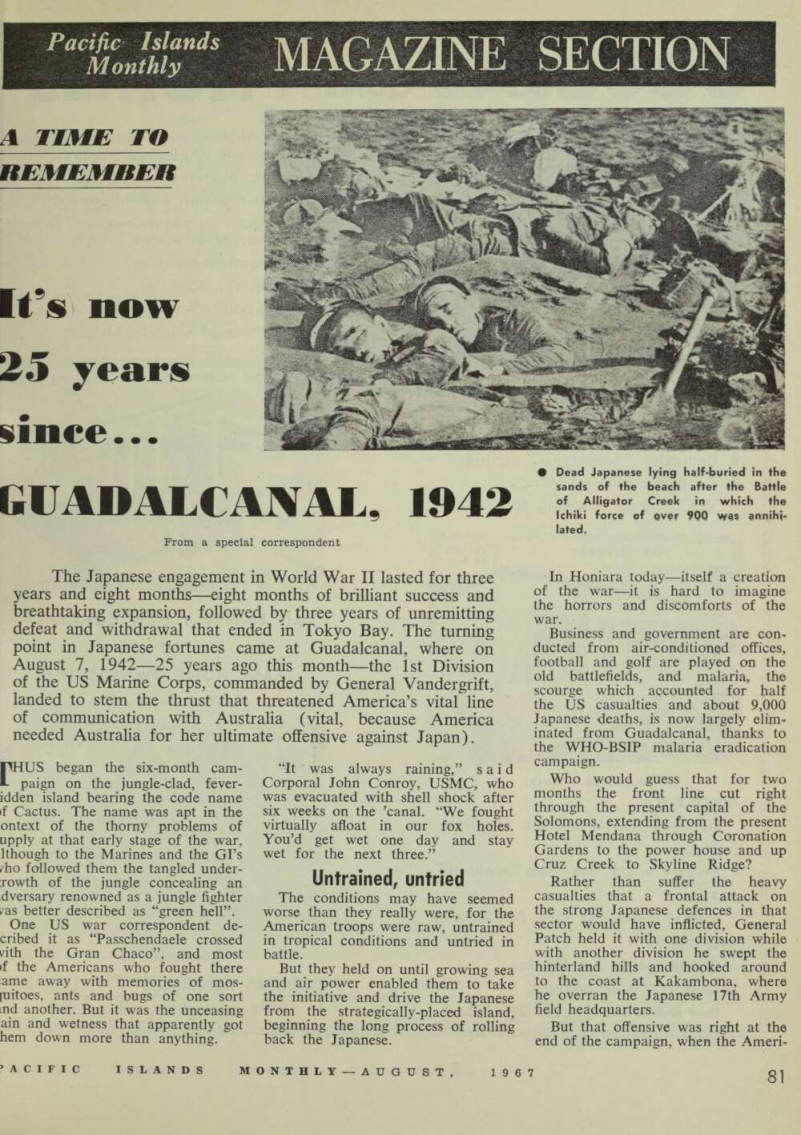
• Dead Japanese lying half-buried in the sands of the beach after the Battle of Alligator Creek in which the lchiki force of over 900 WaS annihi lated.
Marines abandoned by carriers
m forces had wrested local com land of the sea and air from the ipanese, and had built up their -ound forces to a safe strength.
In the beginning the situation was tceedingly precarious, for the unching of the campaign was a ish job undertaken with a bare inimum of troops, ships and planes, id, as it happened, only half of the ansported supplies.
The Japanese had occupied Tulagi tie pre-war capital of the British jlomons) since May, 1942, and had ;arly completed a large airfield at mga Point on Guadalcanal when e American Marines landed on ugust 7. Tulagi and the adjacent lall islands with a seaplane base sre taken after two days of hard 'hting, but the landing on Tenaru ;ach, Guadalcanal, was virtually un >posed. The troops moved gingerly rward through what was described jungle (actually it was Lever’s mga Plantation, but admittedly un ushed for six months) and on the cond day captured the airfield that as shortly to be named Henderson eld. The name commemorates a arine Corps hero, Major Lofton enderson, who was killed in the ittle of Midway.
No large-scale ground fighting de
veloped until August 21, when a Japanese force of over 900 reinforce ments from Rabaul attacked the American perimeter at the mouth of Alligator Creek (also, but wrongly, called the Ilu River and the Tenaru River) and were annihilated. Their commander, Colonel Ichiki, com mitted suicide. History does not record whether the chosen weapon was a pistol or his Samurai sword.
CalamitOUS encounter
The first and most caiamitous with the Japanese Navy ed on the seco J night afle r Battle of Savo was one sjx major nava , battles rem'embered^'because 1 “ * MS Navy admitted that it was the ' v ? rst gating their ships had ever takf ; n at sea - but " orse ,. was *° fon . o " next . morning when the three US cove , r ' n 8 ‘he landing opera hpn (from the Coral Sea side of Guadalcanal) decided ‘hat the situa tlon was unhealthy and fled.
The commander’s excuse was that
his ships were running short of fuel.
But Morison, the official US naval historian of the Guadalcanal cam paign, wrote that the three aircraft carriers were unlikely to suffer any more serious consequences from stay ing on than severe sunburn. An analysis by the American defence authorities showed that the carriers were not short of fuel.
Anyway, the aircraft carriers abandoned the Ist Marine Division to its fate on Guadalcanal with only 30days’ supplies and half the cargo transports unloaded. It was not till the glorious Battle of Guadalcanal (November 13 to 15), and, ironically, after the loss of three US carriers in Solomons waters, that the US Navy redeemed its honour, and success in Guadalcanal became assured.
Keypoint
Henderson Field was the keypoint to the Guadalcanal campaign, but although Admiral King had listed it as a prime objective for the US in vasion force, its development as an offensive weapon was completely neglected in the early planning of the campaign. Thus it was that although the Americans held Henderson from August 8, for lack of ground instal lations at the airfield—ground crews, bomb hoists, refuelling, maintenance and repair facilities—they were un able to use aircraft to chase the Japanese garrison off the island and prevent reinforcement.
So they were committed to the miseries of a war of attrition. Mean
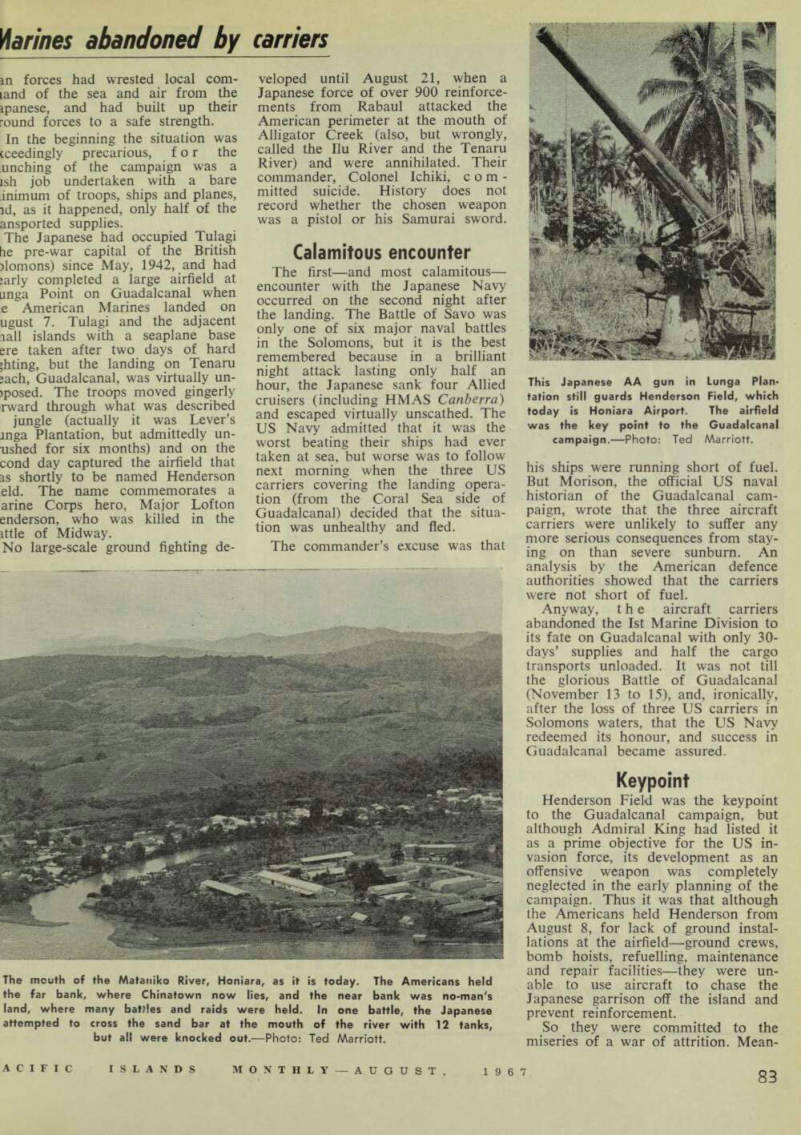
The mouth of the Mataniko River, Honiara, as it is today. The Americans held the far bank, where Chinatown now lies, and the near bank was no-man's land, where many battles and raids were held. In one battle, the Japanese attempted to cross the sand bar at the mouth of the river with 12 tanks, but all were knocked out. —Photo; Ted Marriott.
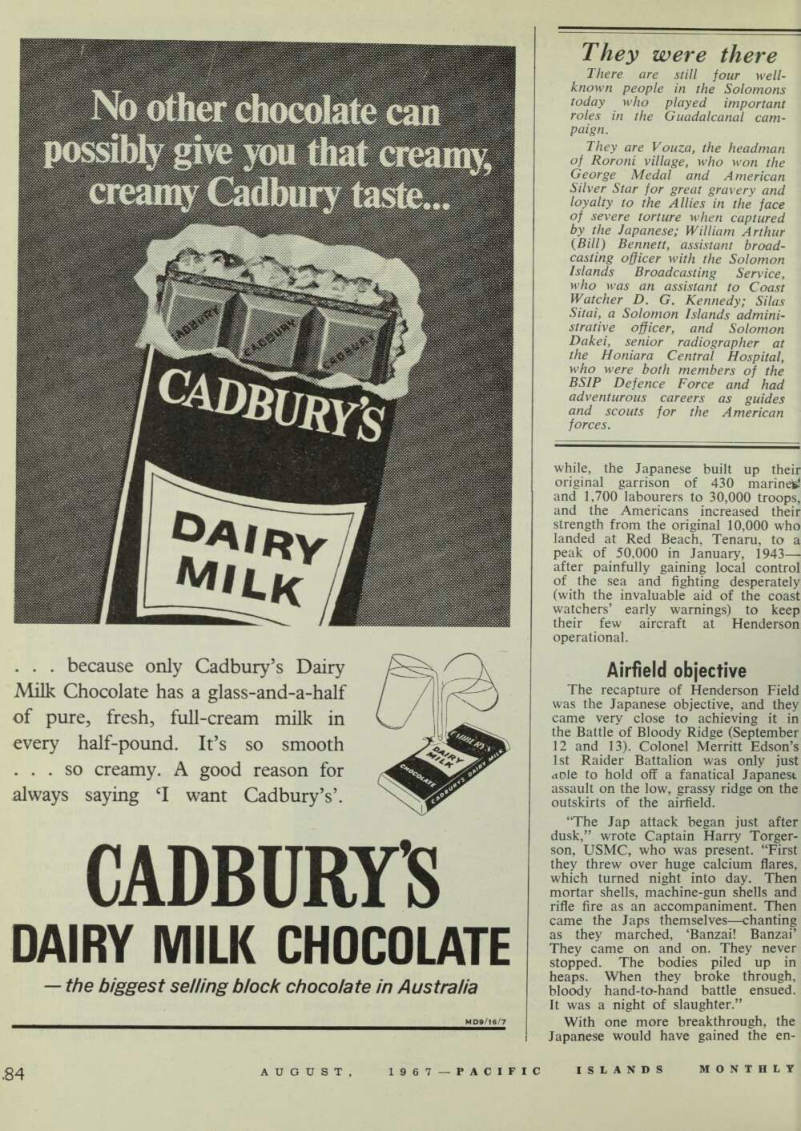
This Japanese AA gun in Lunga Plan tation still guards Henderson Field, which today is Honiara Airport. The airfield was the key point to the Guadalcanal campaign.—Photo: Ted Marriott.
while, the Japanese built up their original garrison of 430 and 1,700 labourers to 30,000 troops, and the Americans increased their strength from the original 10,000 who landed at Red Beach, Tenaru, to a peak of 50,000 in January, 1943 after painfully gaining local control of the sea and fighting desperately (with the invaluable aid of the coast watchers’ early warnings) to keep their few aircraft at Henderson operational.
Airfield objective
The recapture of Henderson Field was the Japanese objective, and they came very close to achieving it in the Battle of Bloody Ridge (September 12 and 13). Colonel Merritt Edson’s Ist Raider Battalion was only just dole to hold off a fanatical Japanest assault on the low, grassy ridge on the outskirts of the airfield.
“The Jap attack began just after dusk,” wrote Captain Harry Torger son, USMC, who was present. “First they threw over huge calcium flares, which turned night into day. Then mortar shells, machine-gun shells and rifle fire as an accompaniment. Then came the Japs themselves—chanting as they marched, ‘Banzai! Banzai’
They came on and on. They never stopped. The bodies piled up in heaps. When they broke through, bloody hand-to-hand battle ensued.
It was a night of slaughter.”
With one more breakthrough, the Japanese would have gained the en-
tire ridge, and the way would have then been open to the airfield. With the airfield lost, the Americans would have lost Guadalcanal, and the whole Pacific strategy would have had to be recast. But the Marines held, and the day was saved.
The Marines were inspired by the personal leadership of their CO, Colonel Edson, who stayed with his troops all through the action, was nicked several times by bullets, and was later awarded the US Medal of Honor.
The action was the most critical of the whole campaign, for although there was to be another battle at Bloody Ridge the following month (when Maruyama sent 6,000 men from Kakambona through the jungle south of Mt. Austen to attack Hender son Field), and the battles on Mt.
Austen, at Point Cruz and on the Galloping Horse Hills were all hard fights, success and failure were never so critically poised in the balance again.
Not only did the Japanese assault Henderson Field in two all-out ground offensives, but they pounded it un ceasingly from the sea, from the air and from a battery of 150-mm howitzers safely placed near Kakam bona, where they were out of reach
of the lighter US guns at Lunga Point. On the nightly raids of the “Tokyo Express”, as the Japanese warships sailing down “the slot” from Rabaul came to be known, Hender son would be subjected to a systematic bombardment with everything up to 14-in guns. Then, while the Tokyo Express sped away to safer waters before dawn, “Washing Machine Charlie” would drone overhead, drop ping the occasional flare or bomb— enough to keep the American troops in their mud-filled, mosquito-ridden slit trenches.
When daylight came, “Pistol Pete” at Kakambona would begin firing on Henderson every 15 minutes, and by mid-day the massed air raids from Rabaul would begin arriving. Hender son Field was eventually knocked out of action on October 14, but the adjoining Fighter I airstrip had by then been partly built and served until Henderson was made opera tional again by the resourceful Sea bees a week later.
Heavy bombardment
On the worst night Henderson was hit by 914 rounds of 14-in. high ex plosive that left the airfield a sea of flames. “Next morning,” remarked Sir David Trench, who was present, “the ground was littered with the purple-stained base plates that looked like giant tiddleywinks.”
Ordinance men, the scrap-metal merchants and souvenir hunters have removed many of the old war relics, but the hills behind Honiara are still littered with shrapnel, an occasional bomb explodes when someone is burning off in his garden, and only recently a skeleton was found sitting against a tree close to a crashed Bell Aircobra fighter plane on the out skirts of Honiara. One big bomb dis posal job remains at Hell’s Point ammunition dump at Lunga, where Australian Army Engineers worked for three years but left an estimated 15,000 tons of high explosive still buried and grown through with the roots of trees. Sappers from the Royal Engineers are beginning work again on a section of this clump to enable Henderson Field to be lengthened sufficiently for jet aircraft, but while plenty of first-class agricultural land is available on the north Guadal canal plains, no one is anxious to clear the main part of the dump.
Tenaru Beach, where the American forces landed on August 7, 1942.
Much of the action in the Battle of Guadalcanal took place in the vicinity of Honiara, which did not exist in those days. The Americans landed at Tenaru Beach (not seen [?]at left in picture) and captured Henderson Field and Lunga Point. After several battles in that area, the Japanese landed reinforcements near Kakambona (extreme right).
From there, they attacked the Americans at the Mataniko River and Kola Ridge (to the left of Point Cruz, foreground) and also marched inland, skirting the town site, to attack Bloody Ridge, the key to Henderson Field.