Extraordinary, Dies
pp. 76-79 · Read in the full issue
A pioneer of the golden days of New Guinea aviation
Ray Parer, Adventurer
Quietly In Brisbane
By a staff writer
On the morning of March 31, 1927, hundreds of Rabaul’s townspeople gathered near a makeshift airstrip at the end of the local golf course to watch a tiny De Havilland 37 aircraft take off on a flight, via Lae, to the booming, newly-discovered goldfields at Wau.
TO cheers from the crowd, the plane taxied down the runway, rose, circled Rabaul, and disappeared out to sea.
Piloted by Ernest (“Pard”) Mustar, and owned by Guinea Gold NL (later Guinea Airways), the plane reached Lae safely and went on to Wau.
Mustar thus won the first leg of an exciting race to establish the first air service to the goldfields and also to usher in the era of commercial avia tion in New Guinea.
But Mustar’s victory was a narrow one, for among the crowd who had watched him take off at Rabaul was “Battling” Ray Parer, one of Aus tralia’s most determined aviators, who had missed being first into New Guinea’s air by a single perished plane tyre.
On next ship
With the idea of establishing the first service to the goldfields, Parer had formed his own company, Bulolo Goldfields Aeroplane Service, in Sydney a couple of months earlier, and had booked space on the Melusia for a small DH4 aircraft to be shipped to Rabaul.
But at the last moment, he had been unable to pay for the space, and Mustar, who had similar ideas to him self, eagerly bought it for his un assembled DH37.
Parer got his plane on the next ship to New Guinea a few weeks later, and landed it at Rabaul before an aerodrome had been built at Lae for Mustar to make his first flight.
He therefore thought he was still in the race to beat Mustar —until he discovered that one of his tyres had perished in the tropical heat.
As he had no replacement, he had to give up the idea of being first in the air.
Parer’s failure to beat Mustar was
of no real consequence, however, for within a week or two, he, too, had reached Lae, and as there was more than enough freight to keep two air craft busy between there and Wau, both he and Mustar were soon mak ing big money.
And they earned it!
Operating in a region of rugged, lofty mountains; deep gorges; dense, tropical vegetation; and huge, quick moving cloud masses—and at a time when unevenly surfaced aerodromes made every landing and take-off an exacting performance—their lives de pended on making the right decision in every crisis and emergency.
In the years that followed—as in the years before —Parer, who was only 5 ft 3 in. tall, was involved in some amazing scrapes. But, cat-like, he lived through them all, and on July 5, after taking ill in Brisbane where he lived in retirement, he died quietly in hospital from natural causes at the age of 73.
It was an ironical end for one of the outstanding figures in the rip roaring days of South Pacific aviation, and one of the last of them.
Eight-month flight
Parer, who hailed from Victoria, was the second eldest of seven boys in the large Parer family of King Island, Bass Strait. Several of his brothers also made names for them selves in various fields.
Born in 1894, Ray Parer was educated in Melbourne and Bathurst.
He wanted to be a flier from an early age.
To qualify, he studied engineering and began to experiment with pusher planes and gliders.
One trip in a glider from the upper storey of a barn at Mentone, Vic toria, ended in the glider being com-
pletely wrecked, but Parer escapee unscathed.
When World War I broke out, he joined the Australian Flying Corps as a sergeant mechanic, and gradu ated as a flight-lieutenant after onlj 5i hours of dual flying in a con traption called a Graham-White Bo?
Kite.
Commissioned, Parer left for Eng land in 1916 to join the Royal Fly ing Corps. He ferried planes for the Allies across the English Channel tc France.
When the war ended, Parer teamec up with John Mclntosh to fly in £ single-engined DH9 bomber in th« London-Melbourne air race sponsored by the Australian Government. They
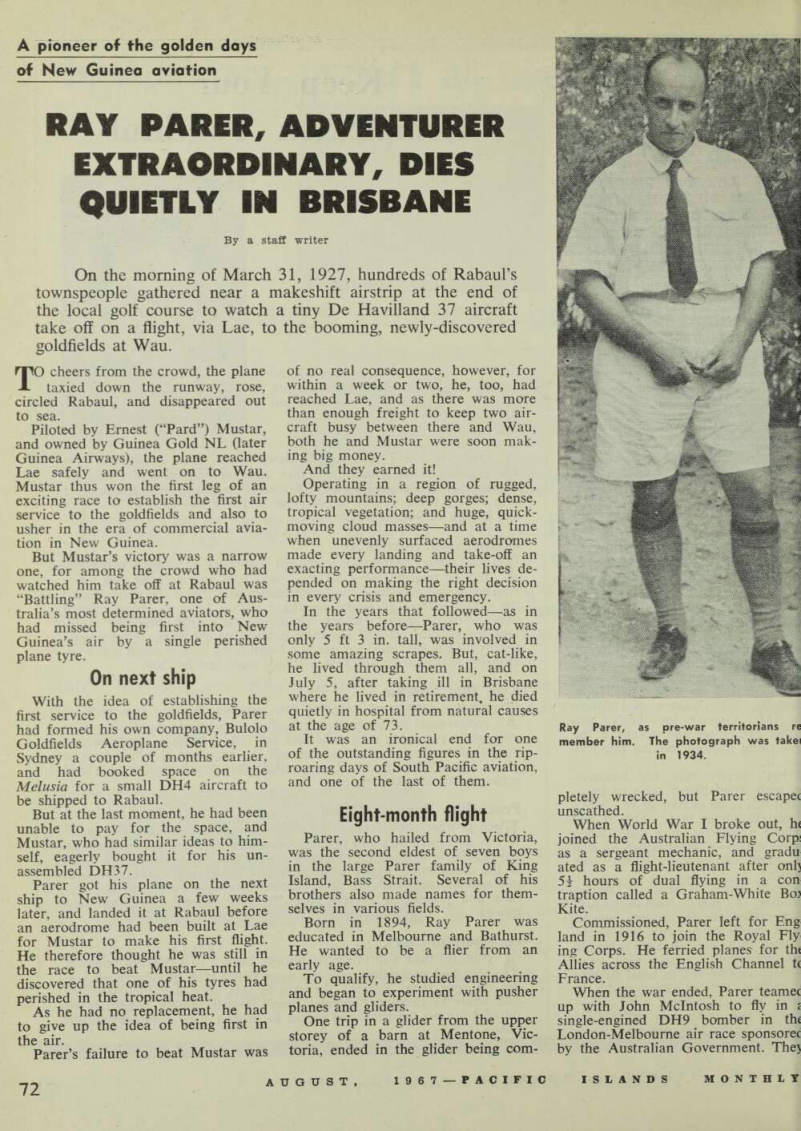
Ray Parer, as pre-war territorians re[?] member him. The photograph was take[?] in 1934.
:>egan their journey when the winners lad already reached Cloncurry, and ;herefore had virtually no hope of :oming in first.
Their flight took nearly eight nonths, and was the first in a single sngined plane from England to Aus ralia.
It was one of the most amazing lights in aviation history because the >lane was held together by fencing yire, boot laces and string, and it rashed dozens of times in landing ,nd taking off from non-existent air ields.
On reaching Melbourne, Parer /rote his only book, Flight and idventure (now a hard-to-get col ;ctors’ item) before beginning a series f barnstorming flights around Aus ralia which kept him going financially or the next six years.
In 1926, he joined in the Wau-Edie "reek gold rush, saw the possibilities f commercial aviation and returned o Australia where he floated his com any, Bulolo Goldfields Aeroplane ervice.
Having acquired his small DH4, he fas back in New Guinea within a ;w months and in profitable com etition with Mustar on the Lae-Wau oute.
More aircraft
Their charges were 1/- a lb for reight and £25 for passengers on le forward trip and £lO for the re irn trip.
Within a short time Parer returned > Australia, acquired a DH9 aircraft nd an old Bristol fighter and re irned to New Guinea with another ilot, Charlie Pratt.
At Port Moresby, they landed at la Beach, as there was no airstrip.
On January 12, 1928, they flew :ross the Owen Stanleys from Port loresby to Lae—the first flights be veen Papua and the mandated terri )ry.
In 1929, Parer established a second ompany, Pacific Aerial Transport td., based at Lae, with a fleet of one
W 34 Junker, two Fokkers, a DH9 and a Moth. Within two more years, he had also founded Morlae Airlines, with headquarters in Port Moresby.
His planes by this time were running from Lae to Salamaua, Port Moresby, Wau and other places on the goldheI D Parer had plenty of lucky escapes.
In September, 1930, while flying from Salamaua to Port Moresby the petrol ran out in his Fokker aircraft and he made a forced landing on a beach at Hism, 60 miles from Moresby.
Cow incident
Not long afterwards, he got into strife while carrying a cow in his Fokker from Lae to Wau. The cow, the first to be transported by air in New Guinea, was in the rear cabin.
Half-way to Wau she panicked. „ /it . „ , , , , With no one on board to calm her, the cow wrecked the rear cabin and forced her way towards the cockpit, crashing her head through the thin, three-ply partition.
Fortunately she did no further
damage, but Parer had a very critical passenger for the rest of the trip.
Some time later, while flying one of his four-a-day trips from Salamaua to Wau in a Fokker, he escaped un hurt in a crash although his passengers were slightly injured, He preferred at that time to use a strip at Galley Reach, west of Port Moresby, for one of his bases be cause of its big salt pan.
By February, 1932, the air trails ft a ‘ M “ and oth f s <? ad -Jj ad a tri l cted se .y eral other “' 7 ’P‘ lme * l ° the , temtoiy New and , new pios arri Y ed con ' " and mdny new routes were OP f« io?S* p ♦ , - In 1934, Parer took time off from New Guinea for the Melbourne Cen tenary Air Race from England. New Guinea goldminers subscribed £4OO so he could fly a Fairey Fox in the race, Of the 22 competitors, only 11 finished and Parer, with co-pilot
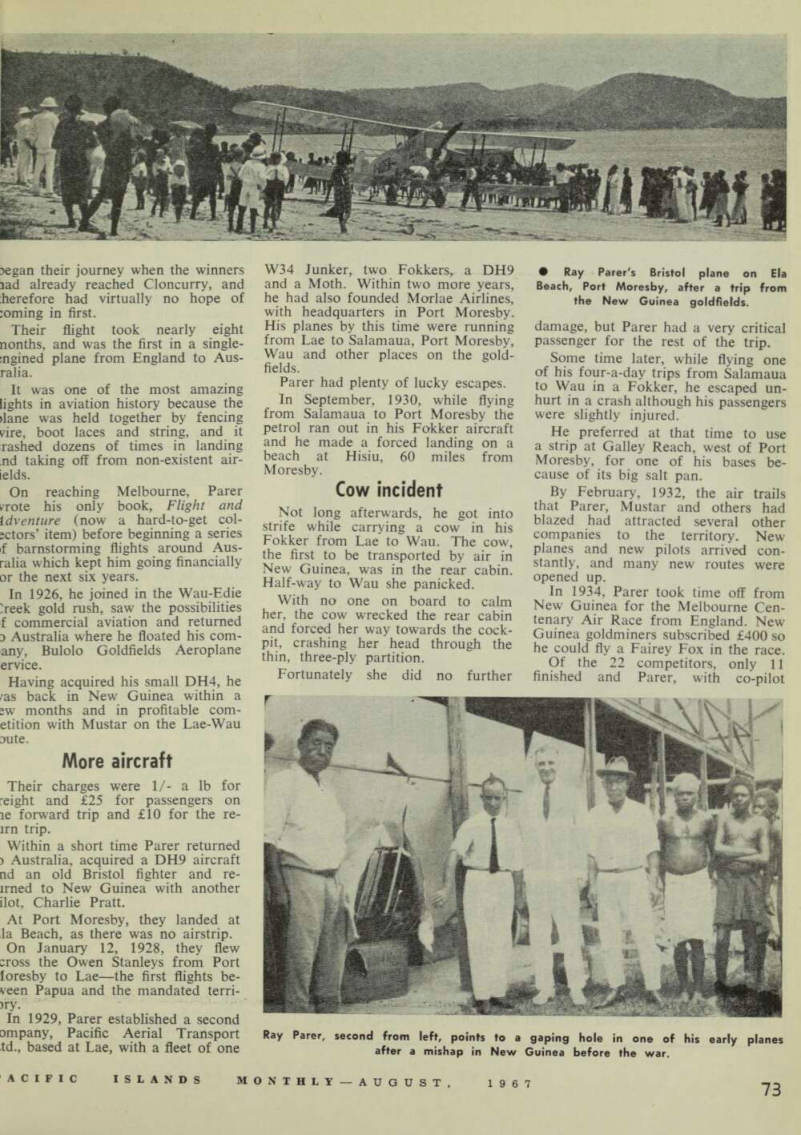
• Ray Parer's Bristol plane on Ela Beach, Port Moresby, after a trip from the New Guinea goldfields.
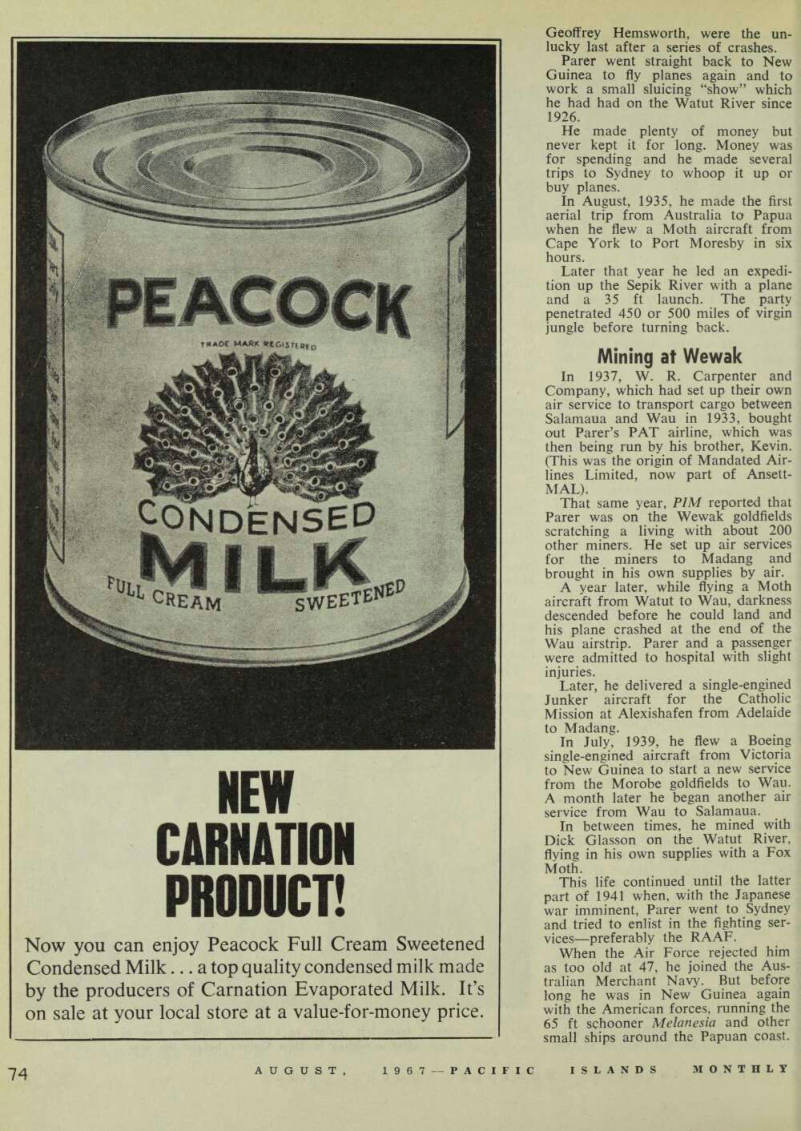
Ray Parer, second from left, points to a gaping hole in one of his early planes after a mishap in New Guinea before the war.
Geoffrey Hemsworth, were the un lucky last after a series of crashes.
Parer went straight back to New Guinea to fly planes again and to work a small sluicing “show” which he had had on the Watut River since 1926.
He made plenty of money but never kept it for long. Money was for spending and he made several trips to Sydney to whoop it up or buy planes.
In August, 1935, he made the first aerial trip from Australia to Papua when he flew a Moth aircraft from Cape York to Port Moresby in six hours.
Later that year he led an expedi tion up the Sepik River with a plane and a 35 ft launch. The party penetrated 450 or 500 miles of virgin jungle before turning back,
Mining at Wewak
In 1937, W. R. Carpenter and Company, which had set up their own air service to transport cargo between Salamaua and Wau in 1933, bought out Parer’s PAT airline, which was then being run by his brother, Kevin, (This was the origin of Mandated Air lines Limited, now part of Ansett-
Mal).
That same year, PIM reported that Parer was on the Wewak goldfields scratching a living with about 200 other miners. He set up air services for the miners to Madang and brought in his own supplies by air.
A year later, while flying a Moth aircraft from Watut to Wau, darkness descended before he could land and his plane crashed at the end of the Wau airstrip. Parer and a passenger were admitted to hospital with slight injuries.
Later, he delivered a single-engined Junker aircraft for the Catholic Mission at Alexishafen from Adelaide to Madang.
In July, 1939, he flew a Boeing single-engined aircraft from Victoria to New Guinea to start a new service from the Morobe goldfields to Wau.
A month later he began another air service from Wau to Salamaua.
In between times, he mined with Dick Glasson on the Watut River, flying in his own supplies with a Fox Moth.
This life continued until the latter part of 1941 when, with the Japanese war imminent, Parer went to Sydney and tried to enlist in the fighting ser vices—preferably the RAAF.
When the Air Force rejected him as too old at 47, he joined the Aus tralian Merchant Navy. But before long he was in New Guinea again with the American forces, running the 65 ft schooner Melanesia and other small ships around the Papuan coast.
Attacked by Japs
While serving aboard the Melanesia, Parer survived a heavy attack by Japanese Zeros at Douglas Harbour (near Buna) when the schooner’s engine was riddled with machine gun bullets and part of the ship caught fire. It was while repairs were being made to the Melanesia that Parer had another close shave.
He was walking among mangrove swamps when he tripped over a tree root and a hidden Japanese officer jumped at him with a hook protrud ing from a knuckle-duster. The Jap forced Parer’s head under the water and was trying to drown him when Parer drew his Bowie knife and stabbed his attacker in the head. He later told a friend that it was the only time he really felt scared.
In September, 1943, Parer was in Sydney—running, of all things, a grocery shop at Edgecliff. But with in a few months he was at sea again in northern waters, as chief engineer on a military ship.
After the war Parer worked for the New Guinea Department of Public Works salvaging wrecked ships and picking up stranded Japs along the coasts.
At one time he was on a small boat up the Fly River when the stove and scrub turkey that was cooking on it caught alight.
When the fire spread, everyone Jived overboard, but Parer stayed put, threw both stove and turkey over board, and muffed the fire.
Then he pulled stove and turkey aut of the river with a wire line, dried both, recooked the turkey and ate it.
Prospecting again
Later, he prospected up the Sepik and again at Wau.
In the early 1950’s Parer was nearly aurnt alive when he was trapped under an exploding utility in Queensland.
He received shocking third degree auras to most parts of his body and spent nearly three years recovering.
In 1955, he ran a tourist launch Tom Heron Island to Gladstone, Queensland, and then tried trawling md pearl fishing in Torres Strait.
From time to time he was back n New Guinea in small ships. He left [or the last time in 1958, and settled an about five and a half acres of farmland near Brisbane.
He used to tell friends he was ‘growing rocks” when they asked him kvhat he hoped to farm there.
Parer was twice married. He is survived by his 19-year-old son Michael.