Paintings of Fiji’s ex-leper artist
pp. 71-75 · Read in the full issue


fetch high sum at UK exhibition
From JANE GREGOR in London.
An exhibition in London recently of paintings by the Fijian artist Semisi Maya has raised the handsome figure of £Stg2,soo. Semisi, a leper for 14 years, has such terribly crippled hands that each of his paintings cost an enormous amount of painstaking care and skill (see p. 69).
-IHE exhibition of Semisi’s paint • ings, which lasted a fortnight, is held at the famous Bond Street allery in the heart of London’s est End.
Eighty paintings were on display, id 50 of them were sold for £5O ch —a price usually reserved for e work of artists with an established iropean reputation.
Novelist's part
One of the gallery’s owners, Sir anvers Osborne, told me he thought e paintings proved as popular as ey did because they were not the rtured, enigmatic, fevered products a sick mind, as so many currently /ith-it” paintings are, but a happy end of free imagination, sophisti ted colouring and harmony with ature.
The story of how Semisi, an in lid living in a rehabiliation home r lepers in the far-off Pacific, ould have an exhibition in Lon >n’s Mayfair reads rather like a >vel.
In fact, it was the noted British
novelist, Dennis Wheatley, who in spired it.
Early last year Mr. Wheatley and his wife were the guests in Suva of Fiji’s Governor, Sir Derek Jakeway.
While there, Lady Jake way took them to St. Elizabeth’s Home, where Semisi lives and works, to show them some of his remarkable work.
The writer immediately fell in love with the artist’s unique style, bought several of his paintings and, eventually, showed them to his life long friend, the gallery owner and art expert, Sir Danvers Osborne.
Smart, discreet
In his turn, Sir Danvers showed them to his partner, Mr. James Green, and the three men agreed that they were seeing the work of a rare artist and that the world should be given a chance to know his paint ings.
After a good deal of correspond ence and organisation, Semisi pro duced sufficient paintings for an exhibition; Sir Danvers had them framed, and the smart, discreet gal
lery, in one of the world’s most celebrated streets, opened its doors for art lovers to see the work of Fiji’s hitherto unknown genius.
I first heard the word “genius” used in reference to Semisi when chatting to Sir Danvers and Messrs.
Green and Wheatley at the end of the first week of the exhibition.
"Nothing short of genius"
These three wise, worldly gentle men were as excited as schoolboys before a feast.
Mr. Green said to me, “I’ve been dealing in paintings all my life . . . old masters more often than not , . . and I’m quite convinced that the man who painted these (and he waved his hand to Semisi’s paintings adorning the walls of the gallery) is nothing short of a genius.”
Mr. Wheatley interrupted eagerly.
“One thing proves it,” he said.
“That’s the way the paintings have sold, considering the good price we’ve charged for them.”
I asked Sir Danvers who was buy ing the paintings. (Over)
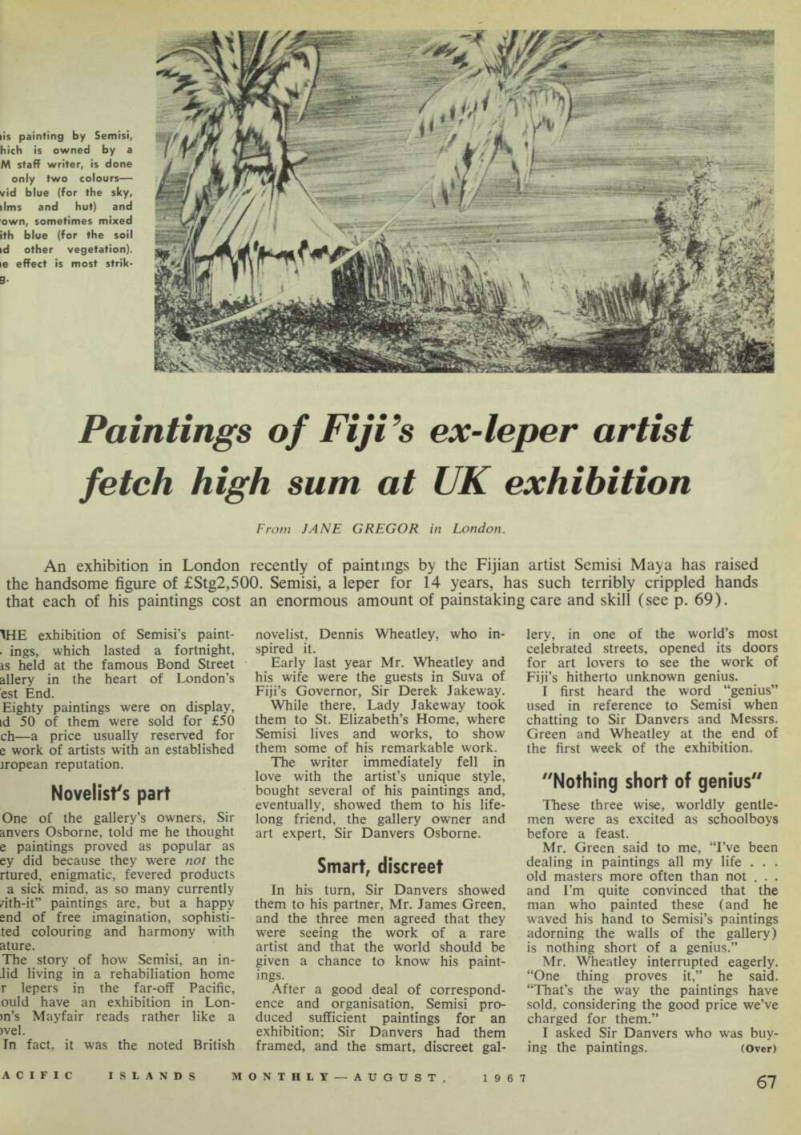
[?]is painting by Semisi, hich is owned by a M staff writer, is done only two colours— vid blue (for the sky, [?]lms and hut) and Town, sometimes mixed with blue (for the soil [?]d other vegetation), [?]e effect is most strik g-
“All sorts of people,” he said.
Mostly Londoners, but quite a few mtinental visitors and several mericans. One was bought by the esident of the British Leprosy Re f Association, Lord Boyd, to hang the society’s London head larters.”
And what type of painting did the lyers seem to prefer?
“Every kind,” Sir Danvers said, iffiether they are flower studies, a and landscapes, shell fantasies more abstract pictures, it just jms that Semisi turns in consistent good work, and that’s what people 10 know about painting go for.”
I suggested that Semisi’s unusual d well-nigh tragic story might per ps influence buyers.
Worth buying
‘Oh, no,” said Mr. Wheatley who, author of countless best-selling yds, is something of an expert on drawing powers of a good story. ‘People are interested, of course, I no doubt it adds to their plea e in possessing a fine painting to 3w that the artist overcame tre ndous handicaps and still could e to the world such beauty. But lovers buy only when they’re ivinced that a painting is worth dng, you know.”
Hien the famous author pointed a basket I’d hitherto overlooked, n it was some money with a all, discreet notice saying, “For ( Elizabeth’s Home.” ‘People who come in and have oyed looking at Semisi’s art,” he 1, “but who haven’t been able to )rd the fairly hefty figure which work commands, have been con futing their odd shillings and half (Over)
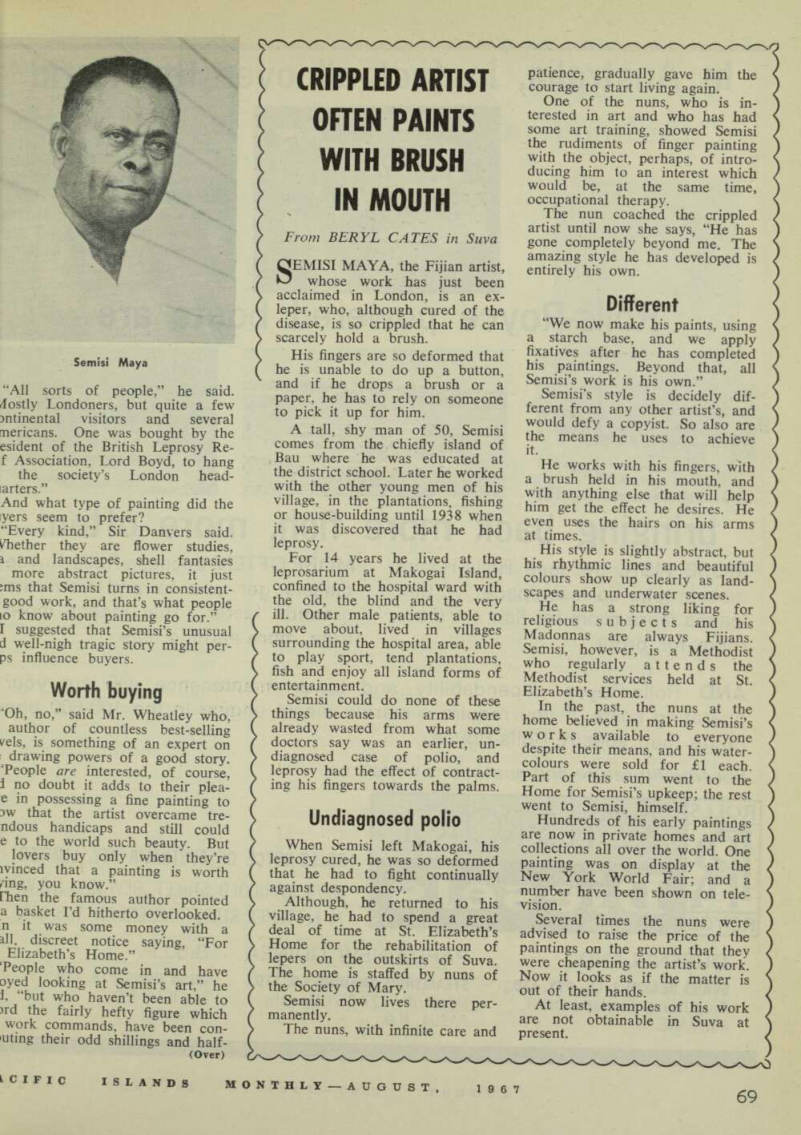
Semisi Maya
vns. And, do you know, already of such ‘widow’s mites’ we’ve scted more than £5O.
Fhat makes us all very happy, Sir Danvers and James s (Mr. Green) for they’ve put this exhibition and arranged the le thing without making one iota i it.
Hiat’s pretty rare for business with Bond Street rates to pay. 3ut this is no charity drive. Make mistake about that. This is one hose wonderful, rare times when 3od artist—a great artist, if you —finds recognition in his own ime.” or, it seems, is Semisi’s London bition a mere flash-in-the-pan. mpressed are the gallery owners he results of Semisi’s first show that they are already eager to n planning a repeat next year, negotiations are in hand to give gallery the exclusive right to He Semisi’s work. )r a man who has suffered so ly as Semisi, his present success be sweet indeed.