Suwarrow's hermit goes
pp. 26-27 · Read in the full issue
back to his island
From WALTER H. HAMBUECHEN on Rarotonga
After an absence of 3i years, during which he published his book An Island to Oneself ( PIM, March, p. 97), New Zea lander Tom Neale has returned to the peaceful isolation of his beloved Suwarrow Atoll in the Northern Cook Group.
who is now 65, has lived on -i- Suwarrow off and on since Sep tember, 1952. Except when he has been on it, the atoll has usually been uninhabited.
Suwarrow is 513 miles NNW of Rarotonga. Tom returned there early in July in the inter-island trader Tagua with five pearl divers, headed by Tekake Williams, holder of the world’s unofficial record for a deep free dive.
The Cook Islands Government has given Tom the job of caretaker of the island, but he has undertaken to return to Rarotonga when diving operations cease.
I was among those who travelled in the Tagua to Suwarrow with Tom and the divers.
Many birds
Two days and three nights’ sailing brought the lonely atoll off the port bow at daylight. The first motu seen was Motu Varu —the most eastern islet on the reef.
As the Tagua approached, hun dreds of sea birds—frigates, terns f and gannets—flew a silent convoy.
Far across the lagoon to the west, the low, black line of Motu Tou lay beckoning. To the north and south, Anchorage Island and Entrance Island showed evidence of abundant vegetation.
The strange, lonely spell of Suwarrow fell over the little ship; conversation was at a minimum; all eyes were fastened on the rust-red reef and tiny green motus.
Fishing lines went over the stern, but there were no strikes until the ship began her approach run through the passage on the north-east. Then within minutes four big albacore were being hauled in and the excite ment broke the spell.
During the week we were to spend on the island scores of albacore, tuna, trevally or cavalla, known as titiara or ru’i according to species,
were caught. These were cleaned, filleted, and salted in tins for ship ment back to Rarotonga.
The divers were not unaware of their family needs back in fish-scarce Rarotonga; nor did they forget that tins of salt fish bring a good price— over SNZ6 a cabin bread tin full.
Lush vegetation
As the Tagua glided to rest in the still, clear lagoon waters off the re mains of the Anchorage Island wharf, the almost incredible lushness of the atoll vegetation immediately struck the eye.
The soft, sweet scent of ngangie— a tough little beach shrub which will grow on bare rock; Tournefortia, known as tauhunu or tai’inu; and pandanus flower pervaded the air.
It was pleasantly warm. Sprouting nuts by the thousands lined the beach. Hundreds of bearing coconut trees flourished in the bush—the scene almost resembled a jungle.
It was almost beyond belief that this island, only 25 years ago, was little more than a sand bar, devas tated by an appalling hurricane which left only a few trees standing. A dozen people, including the American writer Robert Dean Frisbie, his young family, and fisheries officer Ron
Powell, were on the atoll at tl time, and they survived by lashi themselves to five great tamanu tr< in the centre of Anchorage Isla while 10 ft high waves swept t atoll from end to end.
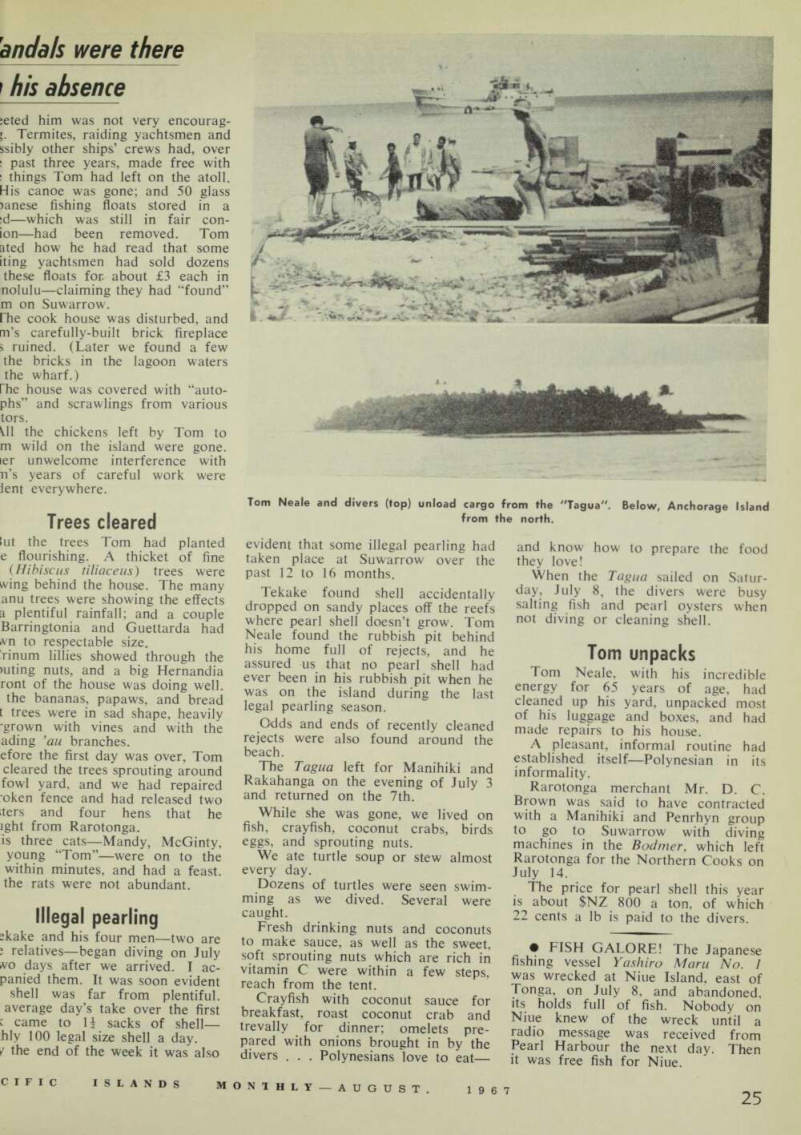
A few minutes after the Tag dropped anchor, the hatches w< opened and the divers’ and T( Neale’s cargo went over the si into four boats—Tekake Willian two of Tom’s, and the ship’s laum Tom was the first to set foot ba on the island.
Camp set up
Between boat loads, we went the side and began spear-fishing w the midday meal in mind. Hi groper, parrotfish, and trevally we bagged. They were easy to spe Tekake’s efficient men soon h fires going while some foraged i succulent, fat coconut crabs in 1 bush.
Sprouting nuts were husked a cooked, and by noon an envia feast lay ready for the hunj workers.
The divers set up camp in an < tent just behind the beach. Tt began clearing the overgrown in up to his house. The sight tl
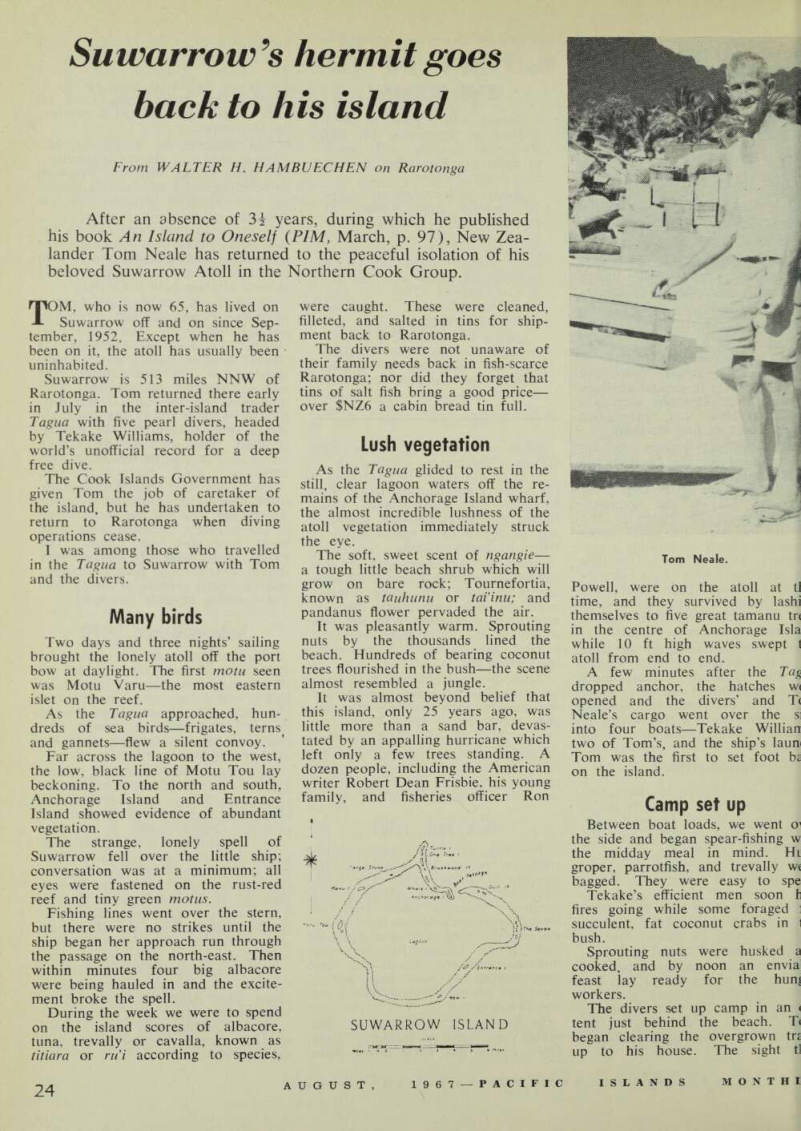
Tom Neale.
Suwarrow Island
anda/s were there ' his absence
;eted him was not very encourag- Termites, raiding yachtsmen and ssibly other ships’ crews had, over : past three years, made free with : things Tom had left on the atoll.
His canoe was gone; and 50 glass >anese fishing floats stored in a :d—which was still in fair con ion—had been removed. Tom ated how he had read that some iting yachtsmen had sold dozens these floats for about £3 each in nolulu —claiming they had “found” m on Suwarrow, rhe cook house was disturbed, and m’s carefully-built brick fireplace i ruined. (Later we found a few the bricks in the lagoon waters the wharf.) fhe house was covered with “auto phs” and scrawlings from various tors.
U 1 the chickens left by Tom to m wild on the island were gone, ter unwelcome interference with n’s years of careful work were lent everywhere.
Trees cleared
lut the trees Tom had planted e flourishing. A thicket of fine (Hibiscus tiliaceus ) trees were wing behind the house. The many anu trees were showing the effects a plentiful rainfall; and a couple Barringtonia and Guettarda had wn to respectable size.
'rinum lillies showed through the mting nuts, and a big Hernandia ront of the house was doing well, the bananas, papaws, and bread t trees were in sad shape, heavily ■grown with vines and with the ading ’au branches, efore the first day was over, Tom cleared the trees sprouting around fowl yard, and we had repaired *oken fence and had released two ;ters and four hens that he ight from Rarotonga, is three cats—Mandy, McGinty, young “Tom”—were on to the within minutes, and had a feast, the rats were not abundant.
Illegal pearling
“kake and his four men—two are ; relatives—began diving on July wo days after we arrived. I ac panied them. It was soon evident shell was far from plentiful, average day’s take over the first c came to U sacks of shell— hly 100 legal size shell a day. / the end of the week it was also
evident that some illegal pearling had taken place at Suwarrow over the past 12 to 16 months.
Tekake found shell accidentally dropped on sandy places off the reefs where pearl shell doesn’t grow. Tom Neale found the rubbish pit behind his home full of rejects, and he assured us that no pearl shell had ever been in his rubbish pit when he was on the island during the last legal pearling season. rviHc f „ , , d i d / re^ ent y cl s an £ d rejects were also found around the tv, t i c . r . , The Tagua left for Mamhiki and and ka retZed n nn he ,hr e 7l nß ° f lU ' y 3 1* u d th 7th ’
While she was gone, we lived on fish, crayfish, coconut crabs, birds eggs, and sprouting nuts.
We ate turtle soup or stew almost every day.
Dozens of turtles were seen swimmmg as we dived. Several were caught. rresh drinking nuts and coconuts to make sauce, as well as the sweet, vhamTn r °C in w g em Ut : t f iCh T in reach from The tent hm * fCW P§ ’
Pravfk? StJ ** f . , £ ay A h Wltl ? coconu sau ee for coconut J rab and C y - dmn l r; o" 16 ! 618 prepared with onions brought m by the divers . . . Polynesians love to eat—
and know how to prepare the food they love!
When the Tagua sailed on Satur da y.’ the divers were busy salting fish and pearl oysters when not diving or cleaning shell.
Tom UDPdcks
Xt . V ,
° m r Nea .f’ Wltb mcredible ener By for 65 years of age, had cleaned up his yard, unpacked most °f his luggage and boxes, and had made repairs to his house, A pleasant, informal routine had established itself—Polynesian in its informality * Rarotonga merchant Mr. D. C.
Brown was said to have contracted with a Manihiki and Penrhyn group to go to Suwarrow with diving machines in the Bodmer, which left Rarotonga for the Northern Cooks on July 14.
The price for pearl shell this year is about SNZ 800 a ton, of which 22 cents a lb is paid to the divers. • FISH r.ATORFi xin« i,nn na c ? aS wrecked at Niue Island > east of Tonga, on July 8, and abandoned. lts holds full of fish. Nobody on Niue knew of the wreck until a radio message was received from Pearl Harbour the next day Then it was free fish for Niue.
Tom Neale and divers (top) unload cargo from the "Tagua". Below, Anchorage Island from the north.