immigrants—permanently?
pp. 22-23 · Read in the full issue
Why shouldn't Australia take Gilbertese immigrants—permanently?
• The article in last month's PIAA (p. 31) by Gilbertese leader Amara Makaea about the "rather future" facing the people of the Gilbert and Ellice Islands Colony has evoked a response from a corr pondent who wants to know why Australia can't do more to help the colony out of its difficulties, goes further and suggests that Australia should accept Gilbert and Ellice Islanders as permanent imi grants. What the correspondent, an Australian, has to say is of special interest today.
So the Gilbert and Ellice Islands Colony needs help? It is facing a desperate economic position, as its atoll islands are too overcrowded? It certainly does and it certainly is, but what is Australia doing about it?
LETS take a proper look at this colony, which comprises 340 square miles of land in 37 atolls, yet the nominal area is two million square miles. The rest is sea.
Being scattered and remote from the ordinary pathways of trade and tourism, the Gilbert and Ellice Islanders have retained their native culture and their native economy.
They are a most attractive people, the Gilbertese being Micronesians and the Ellice Islanders, Polynesians,
Mission influence
The coral atolls on which they live, really submerged mountainous peaks, are only a few feet above sea level.
The soils are simply decomposed coral and sand mixed with organic matter built up over centuries from the vegetation. It is porous, holding neither water nor plant nutrients.
Coconuts however grow well; also pandanus, some breadfruit and babai (a kind of taro which takes three years to mature) which is grown in pits going down to the water level.
The traditional diet of the people is fish and coconuts with occasional babai and pandanus fruit. There are a few chickens and pigs.
The islanders are strong and healthy, the outdoor work involved in fishing and climbing coconut trees being important here. They live to day pretty much as they have always lived. Boys marry at 18, girls at 16, and they have large healthy families.
The British Government has paid little attention to the area until the last four or five years. Most of the business of social welfare and educa tion was left to the Roman Catholic mission and the Gilbert Islands Protestant Church (formerly London Missionary Society).
The mission schools have until re cently done practically all of their teaching in the native language,
which has resulted in the present situation that only about one in 20 of the local population speaks English, While one respects the motives for preserving the native language, the fact is that neither Gilbertese nor Ellice is a literary language. What can the people read?
Where can they go? In the French Pacific territories well over 90 per cent, of the native people speak French.
While the government is making some effort, the main burden of social welfare still falls on the missions. Most children of school age must still attend mission schools rather than government schools be cause there are simply not enough government schools.
The government is therefore sub sidising the missions by helping with the capital cost of new schoolrooms and with the salaries of the lay teachers. All schools are now teach ing English, which will help to facili tate migration (for example to the British Solomons) and also provide opportunities for Gilbertese to work outside their own island home.
Destitution the prospect
Thus there has been the realisation that something needs to be done for this part of the world. A critical economic situation will arise in the colony in 12 years time, when the deposits of phosphate are exhausted.
Ocean Island provides about half of the revenue (over SH million) in taxes for the GEIC Administration and employment for many Gilbertese.
The population will approach 80,000 in 1980 as against 52,000 now.
As the population grows the present reserve of coconuts will be required increasingly for home use, conse quently copra output, which now amounts to 8,000 tons a year, will be greatly reduced or eliminated.
Destitution is in prospect un something is done.
The British authorities have m funds available for the building schools and for developmental wc such as causeways. The commer centre at Betio is growing.
While the provision of airp< taxes land space in the islands, tl is a realisation that airports are only necessary for essential commi cation but also for the developrr of a tourist industry.
If a connecting service could established between Tarawa Majuro, in the Marshalls, a ro trip could be offered from Hono and from Japan, which could ] mote a good deal of tourist intei At present Tarawa is at the end the line.
The Columbus shipping line German line) has co-operated \ the government in providing a tr ing ship at Tarawa for the trail of ships’ crews. The Whole Society, a statutory corporation,
developing small-boat building
repair facilities at Betio where tl is now quite an attractive 1 harbour for lighters and small ci
Ocean-going ships cannot dock
Tarawa; they anchor in the lag and all goods are taken ashore
lighter.
Fishing
The fishing industry has not veloped commercially. Most of local fishing is done by individ taking out lines or nets into lagoon. There are, however, at dant resources of fish in these wal which is of course a potential toi attraction as well as an essei source of food.
Australia sells foodstuffs general stores to the Gilbert Elice Islands, the Columbus 1
isel calling there from Sydney :ry five weeks on the way to North lerica.
Because of US stubborness in not daring the Gilbert and Ellice mds a foot-and-mouth disease free a, in spite of the fact that there no cattle there, fresh foodstuffs mot be placed in freezer holds rying Australian meat to USA. stralian exporters must use aT ;zer locker on the deck, fhis is not satisfactory because re is no correct temperature adjust nts for different foods, e.g. fruit, at, butter, etc., and when goods all lumped in together they pick odours. Moreover the Wholesale iety is required to pay for 500 ic feet of locker space whether not it is all used. The Europeans, course, are very glad that there ome source of fresh foodstuffs, he services provided by the umbus Line are still fairly new. viously the service was mainly vided by British Phosphate Com sion vessels to Ocean Island, ads had to be transported from an Island to Tarawa atoll.
Causeways important
he Wholesale Society is virtually only importer in the Gilbert and ce Islands. It is a statutory cor ation with a board comprising or government officials and others, executive staff mainly comprises tralians who have shown con rable energy in developing the ral establishment at Betio, one of awa Atoll’s islets. he Wholesale Society has its own ping facilities, including a 500-ton el which communicates with the iches in outer islands, and even i Majuro, Most of the govern t people are located at Bairiki,
another of Tarawa’s islets. There is no causeway linking it with Betio.
In a small community such as this a causeway is of considerable social importance (such as preventing com mercial and government people from snapping at each other). This is a field where Australia could doubtless assist the government, by providing engineering or supervisory services, even if it could not provide the actual capital involved, which would be $500,000.
There are no commercial banking services in the Gilbert and Ellice Islands. An Australian bank would be welcomed. There is scope for a few million dollars worth of com mercial and savings bank business which may justify opening a branch.
Increasing poverty
Even under the most favourable circumstances the Gilbert and Ellice Islands, within 12 years, will face the prospect of increasing poverty and unemployment. They are poor al ready, but by then they will be poorer. Tourism will not save them.
What can Australia do to help?
The best way is to allow these people into Australia as permanent immigrants. Why not?
These people obviously cannot re main in their home islands once the islands become overpopulated. Some might indeed emigrate to the Solo mons, as that area is fairly empty, but it would not provide very much new opportunity, and may not be easy if the Melanesians in the Solo mons object, as some of them are.
The immigration of a few thousand a year would relieve the situation and their remittance would provide a source of income for relatives re maining in the islands. This is what happened with Cook Islanders living in New Zealand.
Gilbertese and Ellice Islanders are English-speaking Christians, hence their integration and work in Aus tralia would be facilitated.
Jobs here
In Australia the islanders could easily find jobs, the men on various skilled and unskilled tasks particu larly in the warmer northern areas; the women, properly trained, in various jobs including hotel work where there is a shortage of labour at present.
While such a solution may involve giving these people a preferred position in immigration, which may lead to protests from other racial groups, surely Australia should face up to that? But Australia cannot contemplate standing idly by while these fine island people sink into poverty.
It is true, of course, that the Gilbert and Ellice Islands Colony are at present Britain’s responsibility, in that Britain can and does support them.
But Britain can’t create living space, and in any case she has re cently suggested that we share the responsibility. Sooner or later these people must emigrate at a steady rate to avoid overpopulating their meagre islands.
If they would like to come to Australia we should be generous, and welcome them. At the moment the goodwill that Australia enjoys in the Gilberts and elsewhere is mostly derived from the good work of her missionaries.
It is time that the Australian Government woke up to the fact that Australia has very large economic and social interests in the islands and did something rather more positive than distribute a small amount of technical assistance.
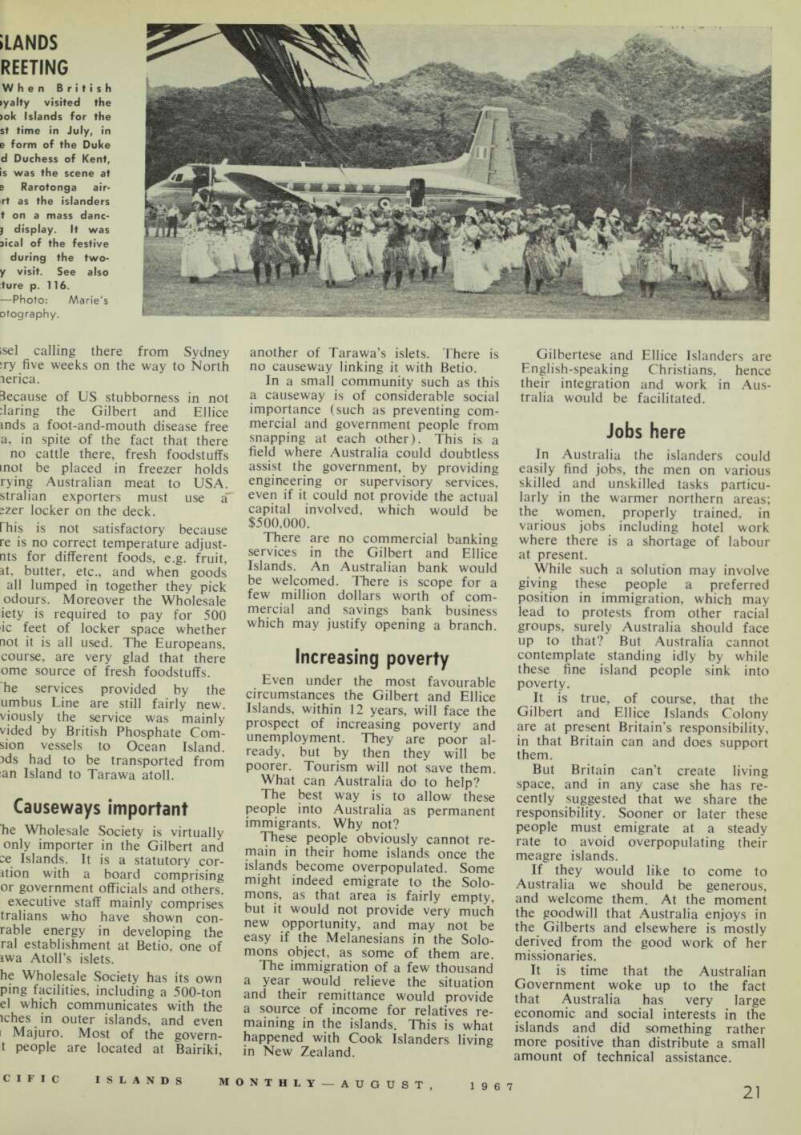
•Lands
Reeting
When British [?][yalty visited the [?]ok Islands for the [?]st time in July, in [?]e form of the Duke [?]d Duchess of Kent, is was the scene at [?] e Rarotonga air [?] rt as the islanders [?] t on a mass danc [?] display. It was [?] jical of the festive during the two [?] y visit. See also tore p. 116. —Photo: Marie's otography.