American Samoa's dramatic
p. 20 · Read in the full issue
Lee era ends; new man plans new deal for chiefs
After a record term in office of more than six years, Governor H. Rex Lee, American Samoa’s 44th governor, bade an emotional farewell to the territory in the early hours of July 18.
SHOWING signs of strain following
an impressive farewell party for him and his wife less than 48 hours earlier, and a last hectic week of clearing his desk, Governor Lee’s eyes were moist with tears as he boarded a plane for the US at Pago Pago International Airport. , , , , 0 , Several hundred Samoans and American government employees orsook an unbroken night s rest to be at the airport to see him off and his head was weighed down with numerous shell necklaces that they hung around his neck as parting gifts.
Governor Lee’s departure brought an end to a revolutionary period in American Samoa, during which more changes were wrought than at any time in the territory’s 67 years under the American flag.
His first job in Samoa being to tidy the place up and to provide accommodation for delegates to the Fifth South Pacific Conference in Pago Pago in mid-1962, Governor Lee went on to initiate and carry through a whole series of impressive projects which will ensure that he is not soon forgotten in American Samoa. Before his arrival, American Samoa was a slum, many of its people demoralised by the long neglect of Washington.
New roads, new harbour facilities, many new houses, a new hospital, the massive Lee Auditorium, electric light and sewerage schemes, fine schools, the Intercontinental Hotel in Pago Pago, the attractive terminal build ings at the airport, and, above all, educational TV, with its transmission towers perched impressively atop 1,700 f( Mt lava , these thin F gs and man y more came into being thanks , Q , he inspiration , tremendous drive and acit for work of Governor ee
New jobs, D6W Wealth
They created many new jobs and mU ch new wealth.
They also created social problems — as Samoans, from living under a primitive communal tribal system with a subsistence economy as they had done for centuries, were pitched into the individualistic, money-consci ous, material world of tne 20th century.
As with the Hawaiians under the impact of American traders, missionaries and settlers in the early part of the 19th century, Governor Lee’s new order penetrated every aspect of Samoan life and completely disorganised the old social system— to the dismay of some.
Only a couple of weeks befc Governor Lee’s departure, one of t Samoan leaders, Senate President P, Lauvao Lolo, told an audien at the Leone High School: “We are now engaged in a bat for survival of ourselves as a peop for the survival of the things that z dear to us, and for the preservati of the way of life that has sustain us well since the beginning of o history.
“Our matai system which for ma generations provided for the aged, t homeless, the sick, the hungry a even the delinquents—the syst( that prevented the poor and destiti from walking our streets as in otl countries, a system of control a guidance unequalled elsewhere in t South Pacific —is now being challeng by a new and strong individualis attitude.
“Our land tenure system that 1 for hundreds of years guaranteed every Samoan a plot of land for house and a piece of ground for garden is now gradually crumbli under the new vigorous drive 1 personal gain and ownership..
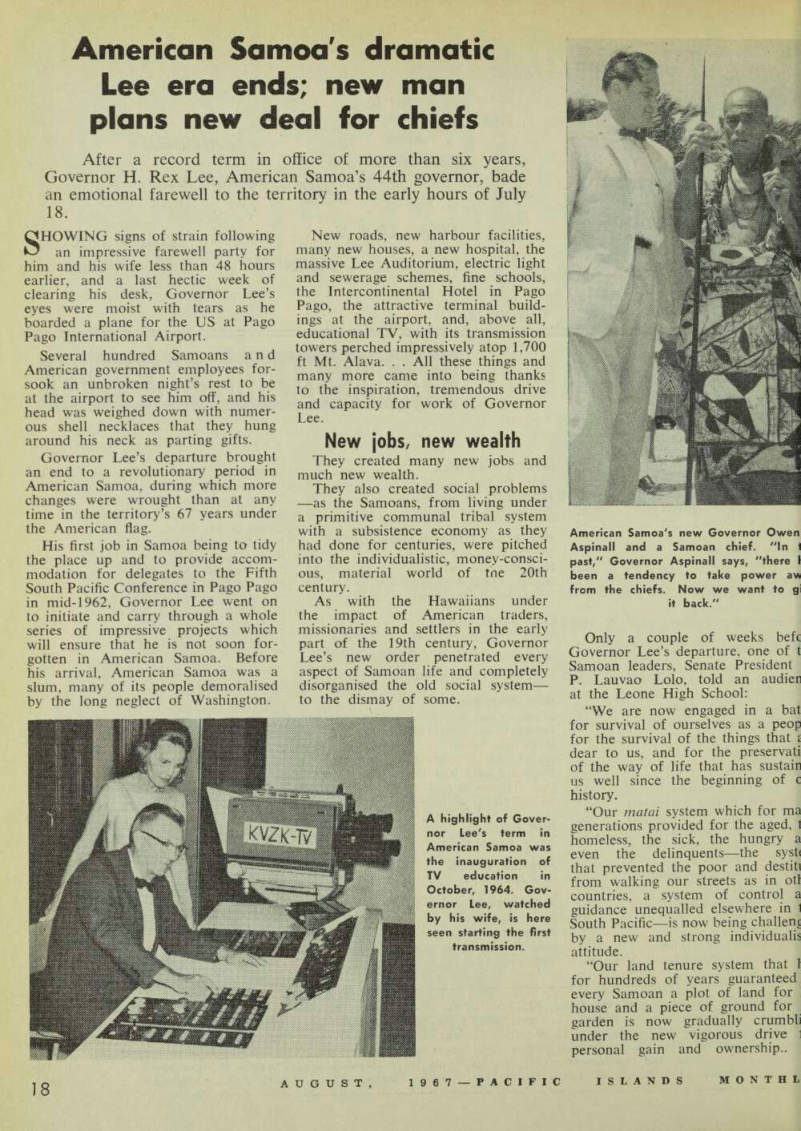
American Samoa's new Governor Owen Aspinali and a Samoan chief. "In t[?] past," Governor Aspinali says, "there [?] been a tendency to take power aw[?] from the chiefs. Now we want to give it back."
A highlight of Gover nor Lee's term in American Samoa was the inauguration of TV education in October, 1964. Gov ernor Lee, watched by his wife, is here seen starting the first transmission.