Principles of tobacco planting in Fiji
pp. 153-157 · Read in the full issue
The Practical Planter
By J. D. YELF, Deputy Director of Agriculture, Fiji.
Tobacco is one of the best paying crops grown in Fiji. But as it is a crop which suffers from many diseases and requires special soil conditions, it needs careful attention to produce a first-class crop.
HE five types of tobacco which have been grown in Fiji are it, burley, twist, Virginia and kish. Only twist and Virginia accos are grown today although erally the soils are more suitable twist, burley or cigar leaf, lie twist is grown on strong soils give it a good flavour but the ginia tobacco must be grown on dy soils to give it the lemon ow-orange colour and flavour ich is desired by the manufac ;rs. lie following procedures should followed throughout the tobacco p and from the start all tobacco 1 beds and fields should be fenced prevent damage from livestock.
Choice Of Land For Seed
BEDS: Because tobacco seed beds need watering they must be sited near a good supply. Preferably this water should be drawn from a well to pre vent the spread of eelworms which may be in the water from a river.
However, if the water is drawn from the middle of a running river it is usually safe. The eelworm is a tiny creature which cannot be seen but enters the roots and causes them to form knots. If seedlings are infected the crop will be ruined.
The seed beds should be on well drained land which will not be flooded by sudden rises of the river.
If no well is available for water, choose a site near a stream which
does not flow from cultivated land where the eelworm may come from potato or tomato crops.
Size of seed beds
Seed beds should be 30 yards long and 3 ft 6 in. wide. Beds this size will give enough plants for one acre and spares for gapping up. It may be more practical to have three beds 10 yards long.
Diseases or eelworms in the soil are killed by burning sticks on top of the beds. The sticks should be 1 ft deep and dry so that the soil will be well heated. The tobacco companies use a chemical, Methyl bromide, to sterilise the beds and this is more
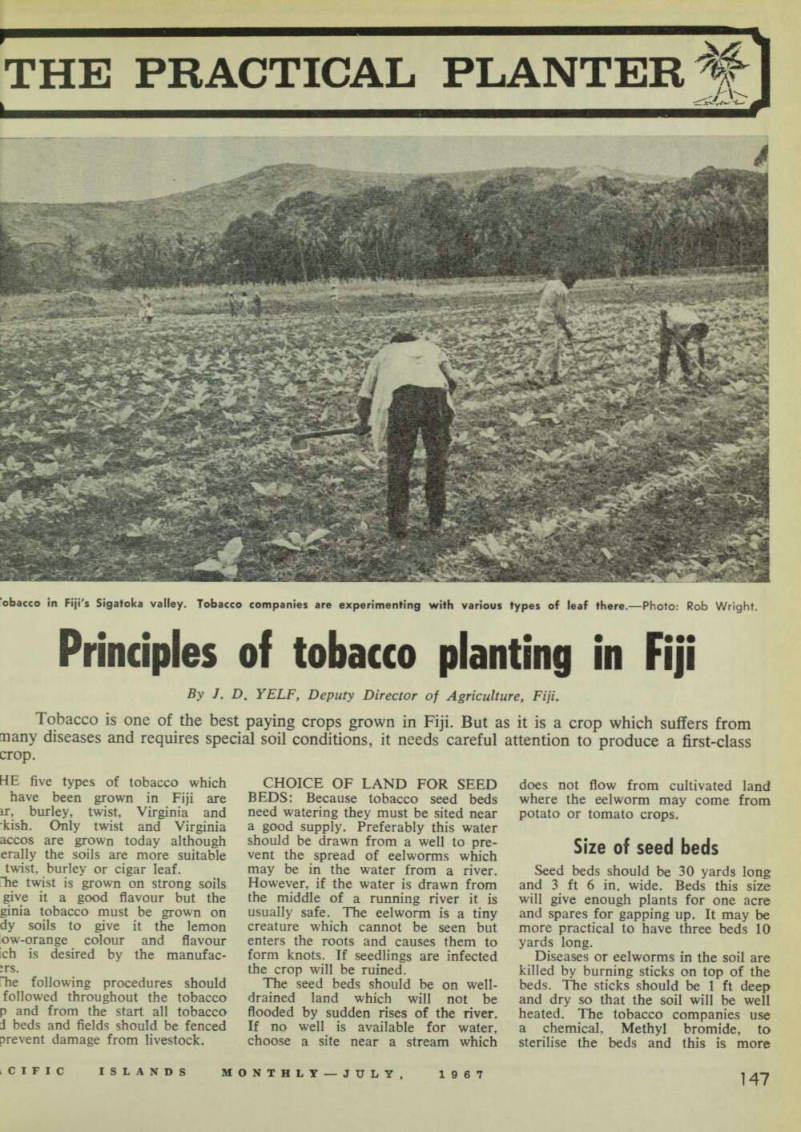
[?]obacco in Fiji's Sigatoka valley. Tobacco companies are experimenting with various types of leaf there.—Photo: Rob Wright.
jctive than the fire method and 3 controls nutgrass for the period uired to raise the seedlings, rhe tobacco seed is very small and icult to sow evenly so it is best water it on the beds with a water can through a rose. One level spoonful of seed is enough for a I 30 yards long x 3 ft 6 in. wide, fhe seed is stirred well into the ;er with a stick and holding the ;ering can in the hand the water stirred vigorously while the seed vatered on to the bed.
SEEDLINGS: Once the seed has n watered on to the bed the bed uld be covered with reed mats or ese cloth or a finely chopped grass Ich. The beds should be watered i-four times a day if rain does not to keep the soil moist but not Vhen the seedlings come up in :t them daily to look for diseases insects.
Vhen working in the seed beds do smoke cigarettes or a pipe be se some plant virus such as Mosaic y be carried on your fingers to leaves of the plants. The hands wery person working with tobacco its should be washed with soap water before they start working he seed beds. f any diseases or insects occur, tact your tobacco advisory officer >nce. f the seed bed has been sown rectly the plants will not be too k and will have leaves 3-4 in. y after six weeks. The plants □ld have a strong stumpy appear e and not be long and leggy. : stalk should be at least as thick a pencil and the growing point more than five inches above □nd.
Field preparation
Reparation Of Field: The
should be a sandy loam and your icco advisory officer will help you ose the best site.
'omatoes, potatoes, cabbage or ;r vegetables should not have n grown on the field for four rs. The weed Prickly Solaneum ► carries the same diseases as icco and these diseases may still in the soil.
Tie worst diseases of these plants Bacterial Wilt, which kills the icco as well as tomatoes and itoes. Do not use fields where know you have had bad results i vegetable crops, clworms are also bad on vege e crops and stay in the soil for ly years so that tobacco and vege es are not good companions in ning practice.
Practical Planter
The field should have been ploughed and harrowed twice to get a good tilth. Then the soil is made up into ridges with a ridging plough.
Depending on the type of tobacco and the soil the ridges should be from 3 ft 6 in. to 4 ft 6 in. apart.
The correct spacing for the soil type is important. The advantage of growing on ridges is that if there is heavy rain the roots of the tobacco will not get waterlogged. If a ridg ing plough is not available a ridge can be made by going in both direc tions with an ordinary plough.
How to transplant
TRANSPLANTING: At six weeks the plants should be big enough for transplanting and are pulled carefully and singly, not disturbing too much soil from the roots. They are placed tightly in baskets with the leaves up wards. Tobacco baskets can be made from bamboo or reeds and should be about 4 ft long by 2 ft 6 in. wide.
The plants in the baskets should be watered and then placed in the shade awaiting planting out in the field.
The planting holes are made with a short stick. It is useful to use a stick which is the length of the spac ing required between the plants in the row then the correct spacing from plant to plant can be checked.
Planting should be done after rain and, if possible, towards evening so that the plants will have time to recover before the sun gets on them next day. A wet day is ideal for transplanting.
If there is no rain for the main planting the plants will need i bottle of water at planting and also at three day intervals until adequate rain falls.
Normally, if the tap root is too long, it should be nipped off, because if the root is twisted in the hole the plant will not grow to its full size.
In areas where wilt disease is pre valent the planting hole should be made extra deep with the small plant ing stick and the top root should be carefully let into the hole so the root is not bent.
When the field has been completely planted it should be carefully in spected every day for the next week to see if any plants have died. These dead plants should be replaced quickly and if necessary watered so that they will catch up with the rest of the plants.
Spacing Along The Row:
Depending again on the variety of tobacco and the strength of the soil
it should be planted at 1 ft 6 in.- 2 ft 6 in. apart along the ridges. You should obtain advice on this point because the quality of the tobacco is very dependent on spacing.
Weeds and pests
WEEDING: Weeding should be carried out once the crop has estab lished and all weeds should be kept down all the time by hand hoeing.
Horse hoes or ridging ploughs can be used for the weeding up to the time that they will not break the leaves.
Remember it is the leaves that are the crop and they must be looked after at all times. Care must be taken at all times not to damage the roots as a damaged root is more likely to get diseases.
Insects And Pests: Cater
pillars, slugs, grasshoppers and cut worms may damage tobacco plants and should be watched for as leaves with holes in will be of less value.
Insects can be treated with DDT or various proprietary pesticides recom mended by the tobacco companies.
PRIMING: Heavily spotted leaves near the ground are taken off when the plant is about 1 ft tall. This is important to prevent disease from the leaves near the soil spreading up the plant. But if the leaves are not diseased they can be left to prevent rain splashing the soil on to the more valuable higher leaves.
TOPPING: Like suckers the flowers will take strength from the main leaves, and thus it is general practice to top the plant by cutting off the flower head when the flowers have started to open. If the plants are growing on very strong land you may be advised to leave the flowers for the first two or three pickings.
SUCKERING: Tobacco plants pro duce suckers in the axils of the leaves and these suckers take a lot of strength from the main leaves which will be sold. It is therefore general practice to break off the suckers care fully. If the crop is too strong your tobacco adviser may tell you to leave one or two on the top, but generally they should be broken off.
Picking and handling
PICKING: The exact time to pick the crop depends on many factors. It is very difficult to describe. Gener ally it is when the leaves become slightly more brittle and a yellowish tinge develops. However, this yellow ing can be caused by false ripening due to drought. After periods of drought sudden rain may cause a flush of new growth and it is advis-
e not to pick them as the leaf will difficult to cure.
Fhe tobacco advisory staff on the )t will give instructions about pick rhe sand lugs which are the bottom ves are reaped first and the uence is followed up the plant ing two or three leaves at each king.
HANDLING LEAVES: Leaves as y are picked should be handled efully as they are brittle and can r easily, which may spoil the ality of the tobacco.
Fhe leaves should be carefully laid baskets made from bamboo or d, covered with leaves and put in shade until they can be carried the tying shed before curing.
Conditions may vary
Ehe above notes are only intended a guide to general tobacco practice, cal conditions may require slight •difications due to varying climate soil and the firm which purchases ; tobacco will advise the altera ns.
Ml workers in tobacco fields should sh their hands with soap before rk and no smoking should be awed near growing tobacco. If
this rule is strictly obeyed many leaf spot diseases and Mosaic virus, which reduce the value of tobacco, will be avoided and the value of the crop will be higher.
When the crop has been reaped all tobacco stalks should be uprooted, dried and then burnt. If tobacco
plants are left in the fields they will carry diseases from one season to the next. It is therefore very important to remove them if tobacco farmers are to ensure that the future crops are of high quality.
Tobacco is a crop in which it PAYS to take care of the details.