Development
pp. 135-138 · Read in the full issue
Business and
[?]It should be [?] lain sailing [?] ow,” says King
rom a Nukualofa correspondent Tonga had “successfully negotiated troubled passage of overseas ids”, and now money shortages re things of the past, King ufa’ahau told the opening of the )7 session of the Tonga Legislative sembly on June 8.
I7E are looking forward to plain T sailing, in beautiful weather,”
J the King. He said that Tonga 1 reason to be pleased with its new jects—including the Dateline Hotel, ich is government-owned, the new ;t office building and the progress the new wharf, which is not yet aplete.
Cing Taufa’ahau pointed out that mated revenue from slipway fees the new year was something like £6O, which was quite insignificant. ; the slipway could take only small 3S and “if it could accommodate 00-ton ships we will then be able dip all our local vessels, except the ivakai, and save about £T564,000.
The slipway could also earn revenue from other vessels .
The king said while in England re cently he had been shown over a slip way capable of accommodating vessels up to 1,000 tons and it was quite possible to build such a slipway in Tonga.
“We must have well-trained en gineers and carpenters to do it,” he said. “But if we make up our minds to do it, no one can stop us. By building a slipway of this nature we could put a stop to the thousands of pa’angas now being spent overseas by the Government and the Tonga Copra Board on the slipping of the Hifofua and the Aoniu.”
Western Samoa
to go decimal
WESTERN SAMOA will convert to decimal currency on July 10, the same day that New Zealand and Niue change over from pounds, shillings and pence.
The new unit of currency in Western Samoa will be the tala (dollar) which will be on a par with the New Zealand dollar. This will be divided into 100 sene.
Banknotes in denominations of one, two and 10 tala will be introduced immediately. Later, there will also be notes for five and 50 tala. There will be coins for 1, 2, 5, 10, 20 and 50 sene.
Copra highest for
16 months
WORLD copra prices rose sharply in late May and early June because of the Middle East crisis.
Prices in London for Philippines FM copra reached a peak of £Stg.7B/6/4 a ton on June 6—the highest price for at least 16 months.
Prices had moved up steadily through May from £Stg.63/4/10 at the start of the month to £Stg.7o/10/- on May 31.
This was the first time for 15 months that copra had been worth more than £Stg.7o a ton.
The following prices show the trend of the market through May and the first half of June.
On June 23, the price stood at £Stg.72/19/l.
Mr. I. McDonald, chairman of the Papua and New Guinea Copra Marketing Board, said at the end of May the rise reflected sellers’ views rather than buyers, and little business
May 1 £Stg.63/4/10 a ton May 17 66/7/1 May 23 68/3/2 May 31 70/10/- June 2 70/10/11 June 5 76/13/8 June 6 78/6/4 June 7 76/13/- June 8 75/0/9 June 9 71/9/2 June 16 71/5/11
in copra was being written by oilseed brokers and dealers in London.
At the end of June, Sydney copra authorities agreed that this was still the case. Only “very miminal” sales had taken place at the top prices in New York, they said. However, they were optimistic on copra prices in the future and predicted that prices would remain firm in the £Stg.7o’s.
Mr. McDonald said that although current copra prices were almost entirely due to political reasons, other factors pointed to a generally steady to firm trend in the market for oil seeds over the next few months.
“There is not only a demand for
oilseeds required to build up con sumers’ stocks at the present time,” he said, “but on the production side pressure of edible oil supplies is lessening as a result of reduced plantings and recent unfavourable weather conditions.”
He said the political situation in Nigeria was also affecting supplies.
Production of Philippines copra was expected to be well below that of 1966, perhaps a drop of 15 per cent., because of typhoon damage and severe drought conditions last year.
Mr. McDonald said the estimate of a 15 per cent, drop could be
“on the high side” but even if were discounted by as much as ha it would still have a big effect c copra and coconut oil availability.
May deliveries of copra to Cop Board depots in P-NG amounted 9,363 tons—the usual tonnage.
Survey of Fiji's
land resources
A BRITISH firm, Fairey Surve] has been awarded a contract make an aerial photographic surv of Fiji as part of a land resourc survey.
The British Government has pi vided the funds for the aerial surve which will be carried out over the ne few months. A DC-3, which h already arrived in Fiji, will be us in the work.
Associated ground surveys are 1 ing carried out by officers of the La Resources Division of Britain’s Din torate of Overseas Surveys.
Meanwhile, a United States fir Crawford Marine Specialists, of S Francisco, have applied for prospecting licences to permit it make underwater surveys for miner: around the coasts of Viti Levu a Vanua Levu.
A representative of the firm s£ recently that preliminary studies h indicated that both islands were higl mineralised, and there was reasonal justification for thinking that depos might extend offshore.
Palm oil: Fiji's
interested again
WHILE work began on setting New Guinea’s palm oil indusl in June, a senior company executi said in Suva that his company mij spend £F2 million over 10 years develop a palm oil industry in F The executive in Suva, Mr. P.
Partridge, is the general manager
the Fiji Development Company,
subsidiary of the Commonweal
Development Corporation.
He said a palm oil project on acres at Navonu in the Buca B area of Vanua Levu was “so prom ing” that the CDC might spend £ million to establish a palm oil dustry at Buca Bay to produce 1 tween 6,000 and 9,000 tons of oil year for export.
The CDC was to review the proj« in 1968 with a view to the develc ment of a major scheme.
If CDC decided to go ahead, A Partridge said, it would use mo than 4.000 acres in the Buca B area. The cost of establishment 10 years would be £2 million. T
Duld include a factory to be built Buca Bay.
The idea of palm oil in Fiji is »t new. W. R. Caipenter and Co. perimented on Viti Levu some ars ago.
Meanwhile, P-NG’s palm oil in istry is under way.
Workers have begun clearing land the Cape Hoskins area of New itain for a joint venture between ; P-NG Administration and an erseas firm, Harrisons and Crosfield dSTZ) Ltd.
It is hoped to have 500 acres ;ared by the end of this year.
Eventually each partner in the nture will clear 5,000 acres of iber country around Cape Hoskins, le combined 10,000-acre plantation considered the ideal size for an mill which Harrisons and Cros- Id have undertaken to build at ipe Hoskins ( PIM , Mar., p. 144).
By the middle of June, palm oil ;d gardens had been set up in dters at Cape Hoskins for the Dject—the first palm oil venture in 5 South Pacific.
Two of Harrisons and Crosfield’s ndon experts, Mr. J. Brown, who maged the company’s plantations in alaya for several years, and Mr. D. tampion, a managing-director, made two-week trip to New Guinea in e June to look at company interests New Guinea and check preliminary >rk at Cape Hoskins.
The two partners in the Cape >skins project have formed a com ny called New Britain Palm Oil velopment Limited.
The directors are Messrs. D. ampion and D. Fleming, nomina -1 by Harrisons and Crosfield (ANZ) 1., and Messrs. W. L. Conroy J A. P. J. Newman, nominated the Administration. Mr. D. ampion is the first chairman of i board.
Disquieting" future
>r W. Samoa
rESTERN SAMOA’S Minister of ' Finance, Mr. G. F. D. Betham, d Parliament in mid-June that the intry faced a “disquieting” financial lation in which little improvement ild be expected over the rest of year. rle was presenting his Supple ntary Estimates in which he has Jgeted for a deficit of £70,000 ving reserves of £200,000.
Vlr. Betham described the fall in country’s exports as “staggering”, blamed the fall mainly on the sr-effects of last year’s hurricane i the ravages of pests and disease. 2opra exports to the end of May
were 4,600 tons and £300,000 below the figures for the same period last year. As against exports of 14,019 tons worth £821,491 last year, pre dictions for this year are 10,000 tons worth less than £600,000.
Cocoa exports to the end of May at 823 tons were down almost 50 per cent, on last year’s tonnage, although improved prices kept earnings at almost the same level. There were, in addition, considerable stocks on hand, and Mr. Betham estimated that last year’s total cocoa earnings of some £600,000 could this year be exceeded by £200,000.
From previous high exports of 800,000 cases and more, banana
exports last year totalled only 62,000 cases and to the end of May this year only 30,000 cases had been shipped.
Mr. Betham said the rehabilitation of the industry since the hurricane has been slow, (Agriculture Department officials estimate increases from now until the end of the year to be about 1,000 cases per ship, with a probable total in the vicinity of 80,000 cases.) On the credit side, Mr. Betham said that Cabinet had been busy lately considering the Potlatch pro posals for the development of the Savaii timber industry.
These offered “tremendous pos sibilities” and it was hoped that
Parliament would reach a firm decision on the proposals during its present session.
He added that the tourist industry stood to gain much from the recent “Heart of Polynesia” visitor develop ment conference (see p. 45).
PI M’s Apia correspondent says that if the public is worried about the country’s economic situation, nobody shows it. The queues at the bank and post office seem to grow longer every day; business still seems buoyant; a start has been made in Apia on a new £20,000 picture theatre; Polynesian Airlines has decided to buy a DC4 to add to its fleet of two DC3’s; the sale of build ing materials is going on at an un precedented rate; and the Public Service Association has asked for a 20 per cent, pay increase.
Islands trading
less buoyant
ARISE of 10.7 per cent, in the net profit of Burns Philp (SS) Co.
Ltd. did not altogether satisfy the directors. They reported a lack of buoyancy as a feature of trading in the year ended January 31.
This trading was a reflection of lower returns from the Fiji sugar in dustry, reduced copra prices, and im port restrictions in Samoa and Tonga.
The net profit for the group was £F224,096 ($A504,216), which was £21,759 more than in the previous financial year.
The company’s profit has risen each year since 1961.
The dividend for the year is 10 per cent., including a final of 5 per cent.
P-NG discovery
on coconuts
THE chief of the division of plant industry, in the P-NG Depart ment of Agriculture, Mr. Allan Charles, said in Port Moresby in June that tests had established that sulphur deficiency was prevalent in many territory plantations.
The research had been undertaken by an officer of the department, senior chemist Mr. P. Southern, who had found also that sulphur deficiency caused low yields and was responsible for the production of abnormal, “rubbery” copra.
Mr. Charles said this was the first time sulphur deficiency had been reported in association with copra production in any of the coconut producing countries.
Mr. Southern, himself commenting on the results of his research pro-
affecting coconut production in the countries.
Mr. Southern will attend a Sou Pacific Commission technical meed] on coconut production to be held Tahiti from August 4 to August 1 He will leave Port Moresby in Ju to start his visits to the South Paci; countries.
PI Mines shares
drop sharply
SHARES in Pacific Islands Min Ltd., which is looking for gc on Misima Island, Papua, with Cult Exploration Ltd., of Canada, fi sharply in June.
This followed an announceme on June 14 that Cultus, which w earn a 60 per cent, interest in ti Misima project when it has spent : million (Canadian) on exploratio said it was “experiencing a shorta of funds and is negotiating for furth finance.”
Cultus has already spent abo $600,000 (Canadian) on the project The announcement also said th Pacific Islands Mines Ltd. had sr ficient funds to complete the prese programme of proving the mine this became necessary.
From a May high of 40 cents « the Sydney Stock Exchange, Pacit Islands Mines 25 cent shares dropp« to a 1967 low of 27 cents on June 2
gramme undertaken over the past four years, said well over 100 plantations in the territory had been recorded as producing “rubbery” copra from time to time.
He said it was estimated that over two per cent, of shipments passing through inspection centres in the territory had contained a significant proportion of this type of copra.
A number of experiments had produced spectacular responses to sulphur. Palms with yellowing foliage had become greener in as short a period as three months, while increased production of nuts and improvement in quality had been obtained in 12 months.
Current research had revealed that sulphur deficiency occurred also in tea and coffee crops.
“This deficiency is one of the limiting factors to healthy growth and good production, particularly in the Highlands areas,” Mr. Southern said. “As a result of our research we have developed methods in the department’s laboratories to diagnose sulphur deficiency in all our territory crops,” he added.
The South Pacific Commission has invited Mr. Southern to act as its consultant on coconut production. In this capacity he has been invited by the Governments of the British Solomon Islands, New Hebrides, Fiji, Western Samoa and Tonga, to visit and advise on nutrition problems
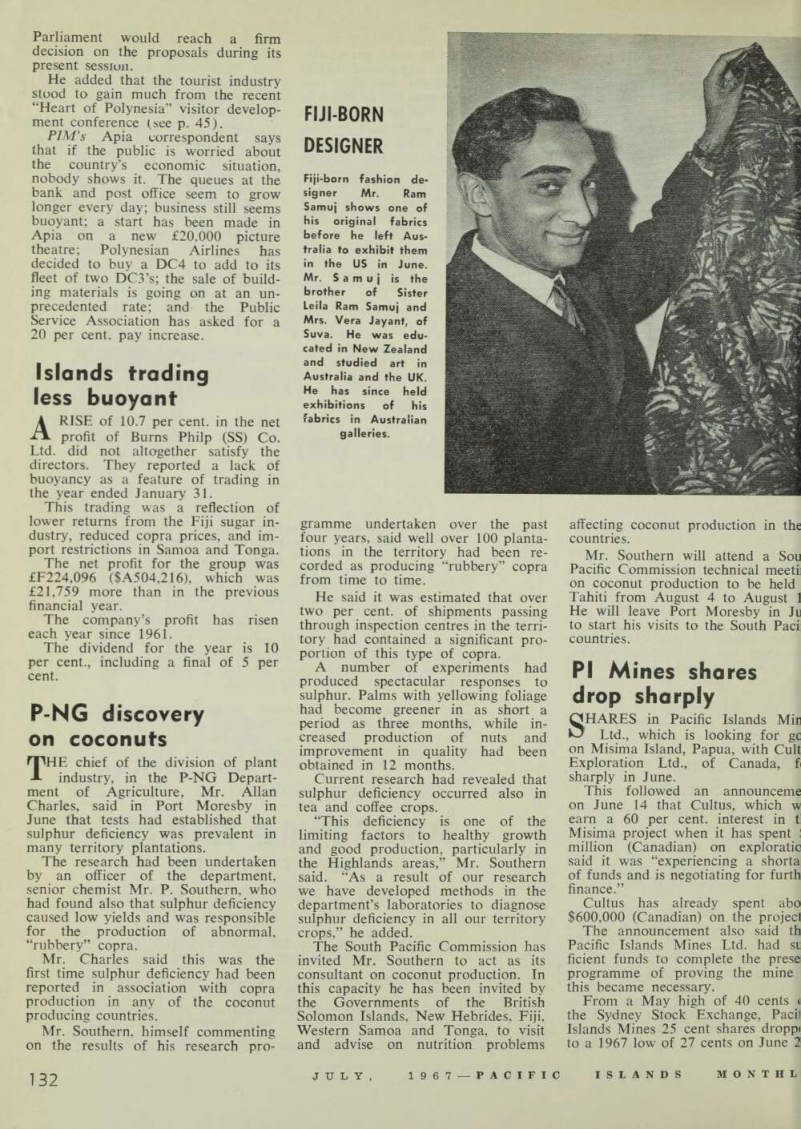
Fiji-Born
Designer
Fiji-born fashion de signer Mr. Ram Samuj shows one of his original fabrics before he left Aus tralia to exhibit them in the US in June.
Mr. Samuj is the brother of Sister Leila Ram Samuj and Mrs. Vera Jayant, of Suva. He was edu cated in New Zealand and studied art in Australia and the UK.
He has since held exhibitions of his fabrics in Australian galleries.