With 60 White Settlers,
pp. 95-96 · Read in the full issue
"Times" Man Saw Rosy
Future For Suva
From FRANK RYAN in Suva Figures from a census taken in Fiji last September and issued in Suva recently show that the total population for the City of Suva is 54,150. Of this number 5,000 or 6,000 are Euro peans.
THESE figures contrast markedly with those established nearly 100 years ago by the Suva correspondent of The Fiji Times, which was then published in Fiji’s old capital of Levuka.
Writing in The Fiji Times for December 20, 1871, the newspaper’s Suva man said that the European population of Suva was then about 60 and that he had every reason to be optimistic about the town’s future prosperity and progress.
The new cotton plantations were bearing well, and there were good prospects for the recently-established sugar mill.
“The branches of the cotton plants are loaded with pods and promise an excellent harvest,” he said. “On one plantation upwards of five tons of cotton have lately been picked.”
Referring to sugar, the corres pondent said: “The planting of sugar cane has already commenced and a few of the planters have already undertaken to have at least 60 acres
planted before March 1 next. This is in consequence of the establish ment by Brewer & Joske of the Suva Sugar Co., which was so successfully started two months ago.”
Warming to his theme about Suva’s prospects for development, the corres pondent went on: “The shores and the fine Bay of Suva are admirably suited for a large town. There is good natural drainage from the low rolling hills and on the sloping foreshore. And the bay is usually as calm as a mill pond, being protected on the north-east and west by high hills and on the south by the reef forming a natural breakwater.
“Consequently the discharge of cargo is a matter of little or no consequence, as was proved lately by the landing of a heavy engine and machinery for the new Suva Sugar Co.’s mill.”
Still in optimistic vein, but unable to foresee the size of some of the large overseas passenger liners which now berth at King’s Wharf, the
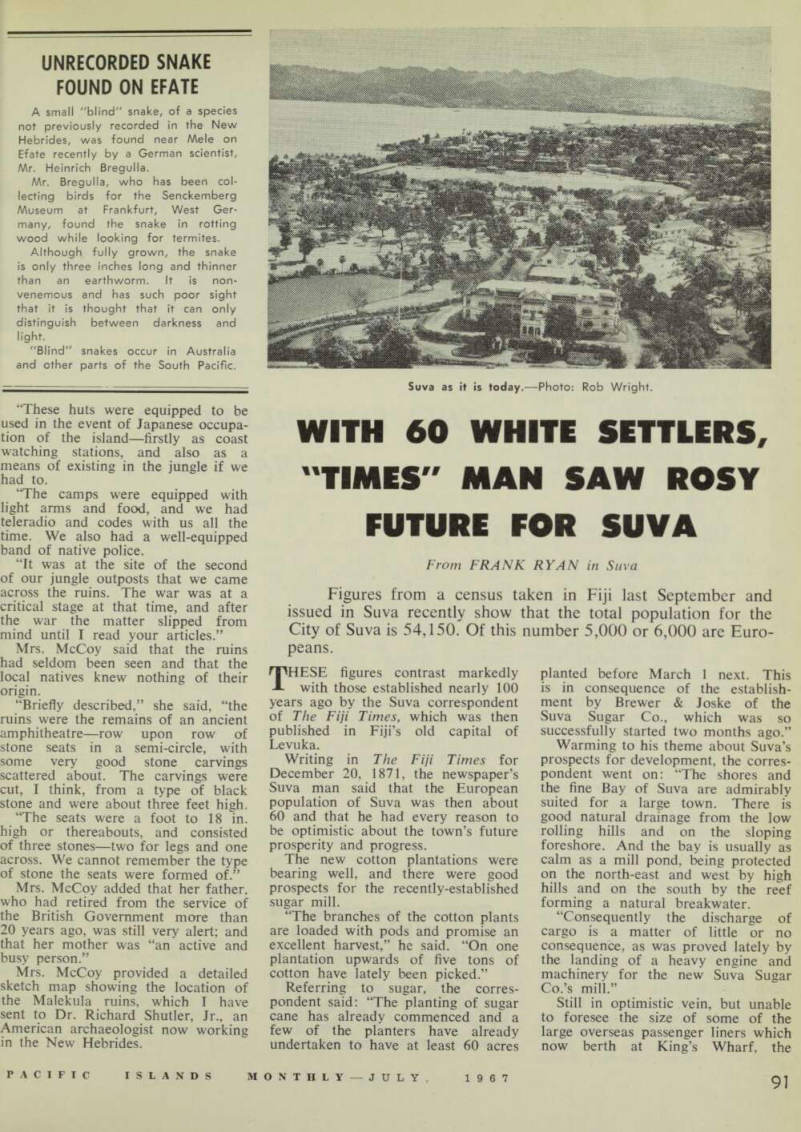
Suva as it is today.—Photo: Rob Wright.
correspondent added: “It is proposed to erect a short jetty, alongside of which vessels of the largest size may be moored”.
The correspondent could not foresee, either, that a number of factors would soon arise that would ruin Suva’s cotton industry along with many of the growers.
These factors included the end of the American Civil War, which saw the resumption of cotton growing in the Southern States; the Franco- Prussian war, which blocked the sale of cotton to Lyons and other manu facturing centres; and the high cost of transport.
Sugar went the same way as cotton, but for another reason. Suva’s climate was too wet and the soil too shallow, and by December, 1875, the crops already standing were abandoned, and the mill was left derelict.
Nowadays, the site of the old mill is marked by a large cog wheel, which was found buried in the earth when foundations were being built for a large modern building.
It has been set in a low concrete wall at the rear of a building erected for the Fiji Development Co. Ltd.
The name given to the old mill site was “Naiqaqi”, which means “to crush, to bruise or to grind”.
Sailor's "tribute"
Some years after the demise of the sugar industry, the area known as Naiqaqi became the site of a settlement of rather ramshackle cottages, where certain ladies of the town lived.
On land inclined to be wet, the cottages had high verandahs with rather steep steps.
Sometimes, under the influence of whisky, rum and yaqona (kava), the male visitors to these ladies would fall off the verandahs, and have to be carried back inside for revival.
Later, that part of Naiqaqi was demolished to make way for the new Government Buildings, which gave rise to a story about an old sailor who had returned to Suva after many years.
He found his way to what had once been the Naiqaqi that he knew only to be confronted with a massive block of buildings.
Dumbfounded for a moment, he then managed to mutter: “My word, those girls have done well!”
Long before that—in 1877—Suva had become Fiji’s capital, thus more than justifying the rosy optimism of The Fiji Times man in 1871.
As trade drifted away from Levuka to Suva, The Fiji Times did too, Suva has been a city since 1952.