And he’s off to South Africa
p. 73 · Read in the full issue
By Jim Huxley
When Norman O’Neill, the re recently retired Australian Test
:ricketer, was in Papua-New
Guinea two years ago on a :oaching tour for the Rothman
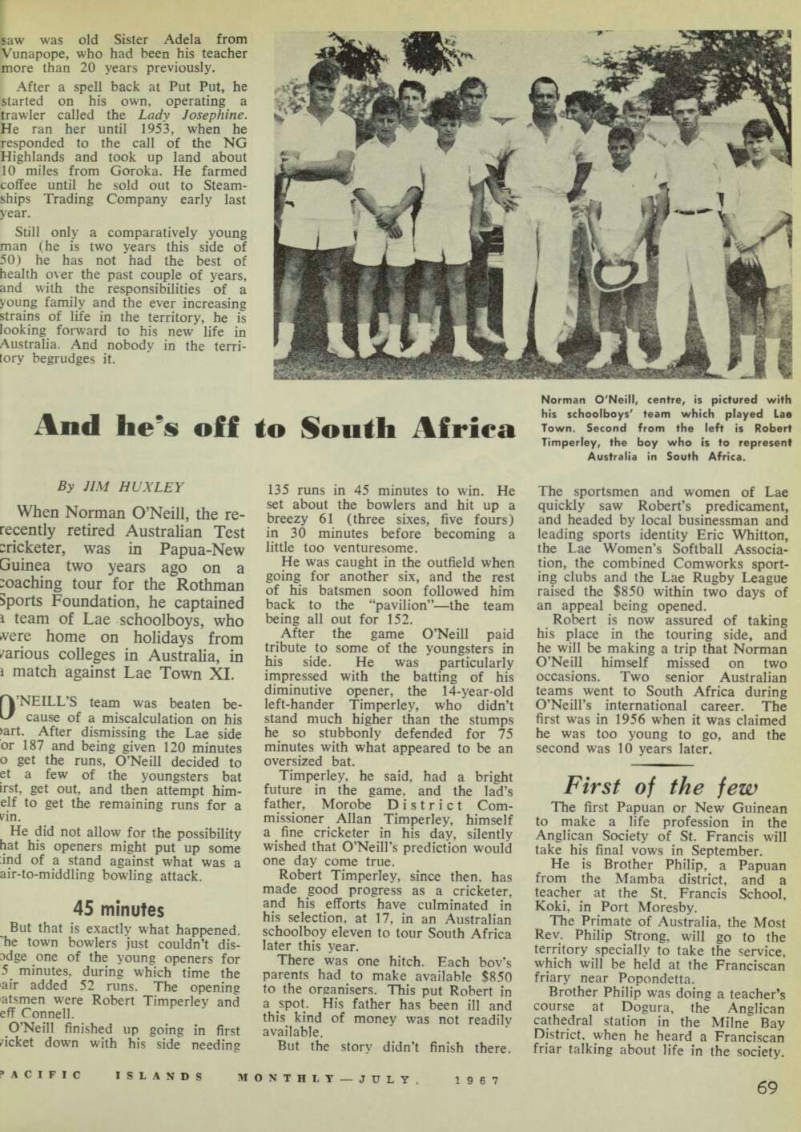
Sports Foundation, he captained
i team of Lae schoolboys, who >vere home on holidays from
/arious colleges in Australia, in
i match against Lae Town XL fVNEILL’S team was beaten because of a miscalculation on his >art. After dismissing the Lae side or 187 and being given 120 minutes o get the runs, O’Neill decided to et a few of the youngsters bat irst, get out, and then attempt him elf to get the remaining runs for a yin.
He did not allow for the possibility hat his openers might put up some :ind of a stand against what was a air-to-middling bowling attack.
45 minutes
But that is exactly what happened, he town bowlers just couldn’t dis adge one of the young openers for 5 minutes, during which time the air added 52 runs. The opening atsmen were Robert Timperley and eff Connell.
O’Neill finished up going in first dcket down with his side needing
135 runs in 45 minutes to win. He set about the bowlers and hit up a breezy 61 (three sixes, five fours) in 30 minutes before becoming a little too venturesome.
He was caught in the outfield when going for another six, and the rest of his batsmen soon followed him back to the “pavilion”—the team being all out for 152.
After the game O’Neill paid tribute to some of the youngsters in his side. He was particularly impressed with the batting of his diminutive opener, the 14-year-old left-hander Timperley, who didn’t stand much higher than the stumps he so stubbonly defended for 75 minutes with what appeared to be an oversized bat.
Timperley, he said, had a bright future in the game, and the lad’s father, Morobe District Com missioner Allan Timperley, himself a fine cricketer in his day, silently wished that O’Neill’s prediction would one day come true.
Robert Timperley, since then, has made good progress as a cricketer, and his efforts have culminated in his selection, at 17, in an Australian schoolboy eleven to tour South Africa later this year.
There was one hitch. Each bov’s parents had to make available $B5O to the organisers. This put Robert in a spot. His father has been ill and this kind of money was not readily available.
But the story didn’t finish there.
The sportsmen and women of Lae quickly saw Robert’s predicament, and headed by local businessman and leading sports identity Eric Whitton, the Lae Women’s Softball Associa tion, the combined Comworks sport ing clubs and the Lae Rugby League raised the $B5O within two days of an appeal being opened.
Robert is now assured of taking his place in the touring side, and he will be making a trip that Norman O’Neill himself missed on two occasions. Two senior Australian teams went to South Africa during O’Neill’s international career. The first was in 1956 when it was claimed he was too young to go, and the second was 10 years later.
Norman O'Neill, centre, is pictured with his schoolboys' team which played Lae Town. Second from the left is Robert Timperley, the boy who is to represent Australia in South Africa.