Fiji Church Capture
pp. 65-67 · Read in the full issue

Little-Known Murals Of
Essence Of Countryside
From JANE GREGOR in Suva It was a cup of coffee that led me to one of Viti Levu’s lesser known beauties. Soon after arriving in Fiji I was at a dinner party where I was given a particularly delicious cup of coffee and learned from my hostess that the coffee beans had been grown at a mission station on the north coast of Viti Levu.
T didn’t take me long to become one more customer at the store iere the mission coffee from Nai relagi is on sale and where devotees a cup of good, fresh coffee know at they can get the real McCoy.
But coffee is the lesser of Naise lagi’s claims to fame.
By far its greatest treasure and one lich should be more widely ac crued, is the magnificent mural mpleted two years ago by the mous French painter, Chariot.
It’s a pleasant 50-mile drive along e King’s Road from Suva to Nai relagi, through open pasture land owing vignettes of rural life. The ad is less oppressively bush-hung an the Queen’s Road to the south; d a pleasant stopping place for a Drning refresher is the only hotel e yet encountered which boasts a •ge sign at the foot of its garden, ying, “All Drinks Free”.
The thirsty traveller, spurred on by
this fascinating legend, can hardly be blamed if his laugh is less than whole-hearted when he then reads, on closer inspection, the punch line be low, which proclaims . . . “from contamination”.
A few miles further on, if you’re in no hurry, you can make a detour to visit the Wainivesi Falls and the Wailotua limestone caves.
Naiserelagi lies within sight of the beautiful Viti Levu Bay but you need to keep a sharp lookout for the turn inland, which takes you uphill past neat bures and swarms of bare bottomed babies.
As you draw up before the large grey stone church which dominates
Inspired work of French painter at Naiserelagi
the open grassy square around which the Catholic Mission buildings stand, you are immediately struck by its incongruously European appearance; it might be a church from Austria, from Italy, from Spain, with its gables, stained-glass windows and flight of stone steps. It was, in fact, built some 50 years ago by the French fathers who blasted the whole place level with dynamite to create their mission station. The school buildings, the mission house, the dispensary— all these are weatherboard midgets beside its four-square solidity.
Yet it is this odd migrant from Europe which houses murals which are the most vivid representation of the true heart of Fiji that I have yet seen.
Musical links
Chariot, the French painter, came to Fiji at the invitation of Monsignor Wasner, the Austrian priest whose musical knowledge inspired the crea tion, just before World War 11, of the von Trapp family into a group of travelling singers whose dramatic story has been immortalised in the film, “The Sound of Music”.
An odd coincidence, by the way, is that the name “Naiserelagi” means,
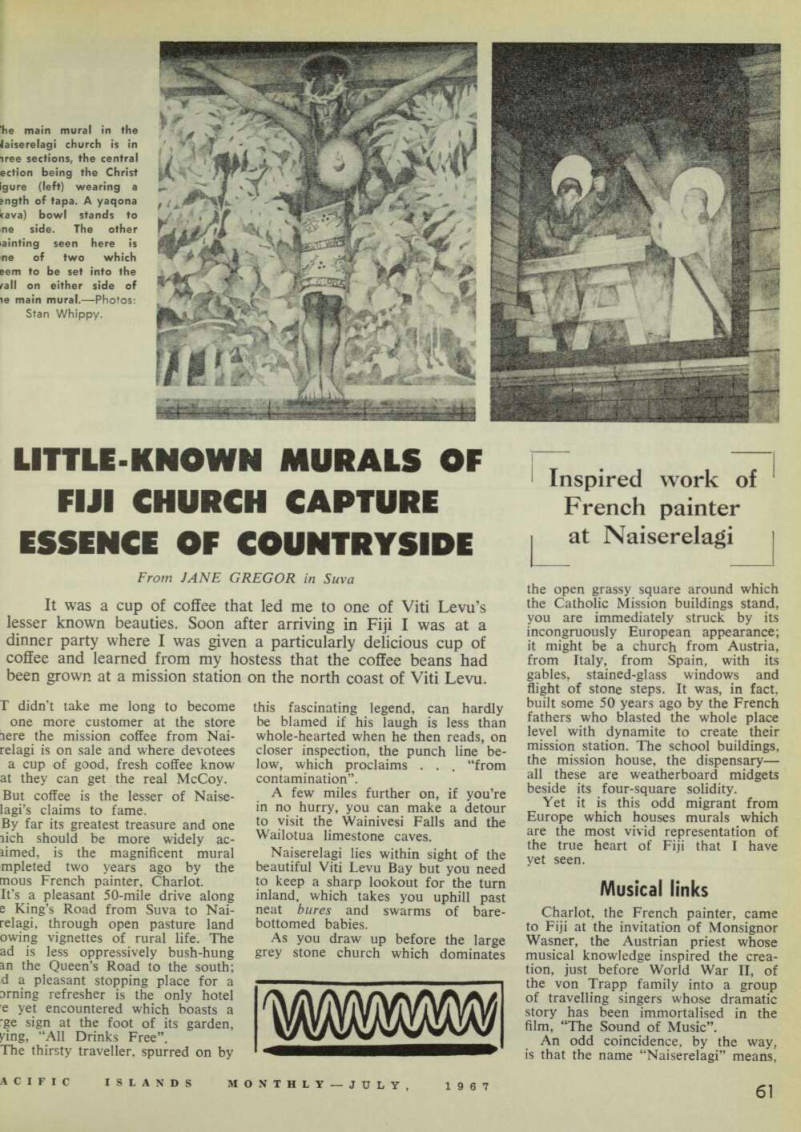
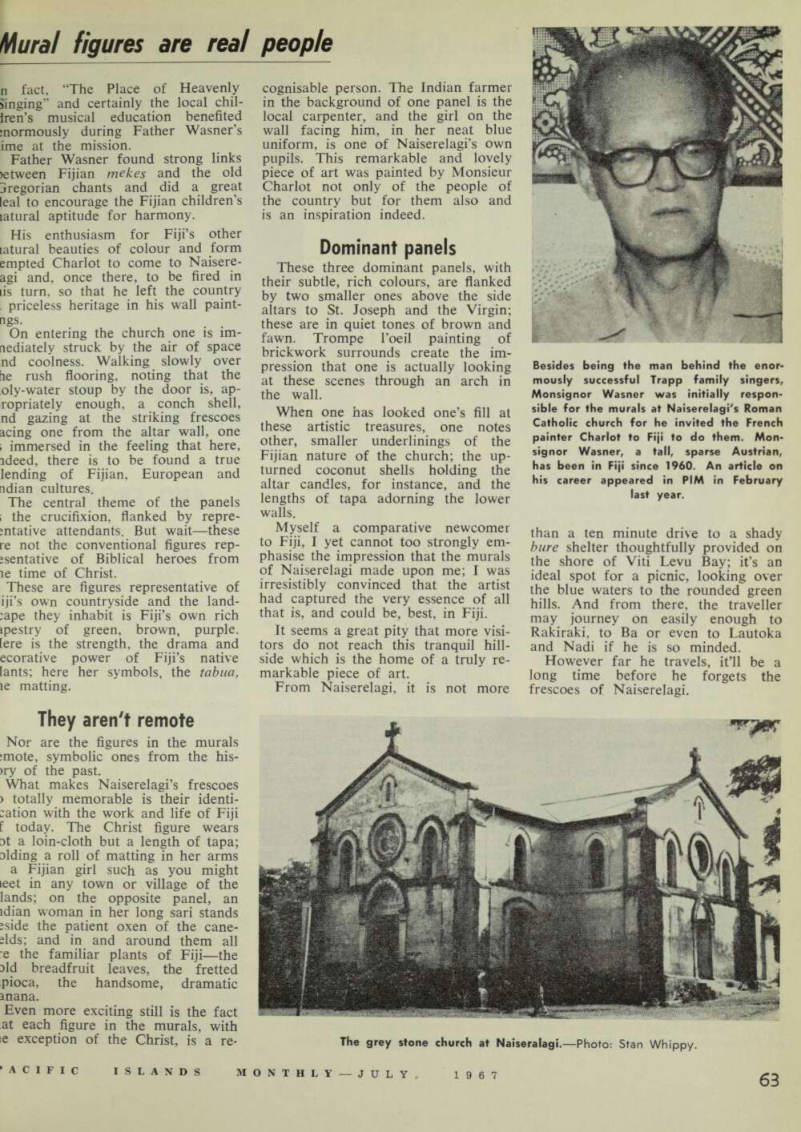
The main mural in the [?] aiserelagi church is in three sections, the central [?] ection being the Christ [?] gure (left) wearing a [?] ngth of tapa. A yaqona [?] kava) bowl stands to [?] ne side. The other [?] ainting seen here is [?] ne of two which [?] eem to be set into the [?] wall on either side of [?]ne main mural. —Photos: Stan Whippy.
Mural figures are real people
n fact, “The Place of Heavenly singing” and certainly the local chil iren’s musical education benefited mormously during Father Wasner’s ime at the mission.
Father Wasner found strong links >etween Fijian mekes and the old Tregorian chants and did a great leal to encourage the Fijian children’s latural aptitude for harmony.
His enthusiasm for Fiji’s other latural beauties of colour and form empted Chariot to come to Naisere agi and, once there, to be fired in lis turn, so that he left the country . priceless heritage in his wall paint tigs.
On entering the church one is im lediately struck by the air of space nd coolness. Walking slowly over tie rush flooring, noting that the oly-water stoup by the door is, ap ropriately enough, a conch shell, nd gazing at the striking frescoes acing one from the altar wall, one ; immersed in the feeling that here, ideed, there is to be found a true lending of Fijian, European and tidian cultures.
The central theme of the panels i the crucifixion, flanked by repre mtative attendants. But wait—these re not the conventional figures rep jsentative of Biblical heroes from le time of Christ.
These are figures representative of iji’s own countryside and the land :ape they inhabit is Fiji’s own rich ipestry of green, brown, purple, [ere is the strength, the drama and ecorative power of Fiji’s native lants; here her symbols, the tabua, le matting.
They aren't remote
Nor are the figures in the murals ;mote, symbolic ones from the his >ry of the past.
What makes Naiserelagi’s frescoes ) totally memorable is their identi :ation with the work and life of Fiji f today. The Christ figure wears at a loin-cloth but a length of tapa; aiding a roll of matting in her arms a Fijian girl such as you might leet in any town or village of the lands; on the opposite panel, an idian woman in her long sari stands jside the patient oxen of the cane slds; and in and around them all e the familiar plants of Fiji—the aid breadfruit leaves, the fretted pioca, the handsome, dramatic anana.
Even more exciting still is the fact at each figure in the murals, with e exception of the Christ, is a re
cognisable person. The Indian farmer in the background of one panel is the local carpenter, and the girl on the wall facing him, in her neat blue uniform, is one of Naiserelagi’s own pupils. This remarkable and lovely piece of art was painted by Monsieur Chariot not only of the people of the country but for them also and is an inspiration indeed.
Dominant panels
These three dominant panels, with their subtle, rich colours, are flanked by two smaller ones above the side altars to St. Joseph and the Virgin; these are in quiet tones of brown and fawn. Trompe I’oeil painting of brickwork surrounds create the im pression that one is actually looking at these scenes through an arch in the wall.
When one has looked one’s fill at these artistic treasures, one notes other, smaller underlinings of the Fijian nature of the church; the up turned coconut shells holding the altar candles, for instance, and the lengths of tapa adorning the lower walls.
Myself a comparative newcomer to Fiji, I yet cannot too strongly em phasise the impression that the murals of Naiserelagi made upon me; I was irresistibly convinced that the artist had captured the very essence of all that is, and could be, best, in Fiji.
It seems a great pity that more visi tors do not reach this tranquil hill side which is the home of a truly re markable piece of art.
From Naiserelagi, it is not more
than a ten minute drive to a shady bare shelter thoughtfully provided on the shore of Viti Levu Bay; it’s an ideal spot for a picnic, looking over the blue waters to the rounded green hills. And from there, the traveller may journey on easily enough to Rakiraki, to Ba or even to Lautoka and Nadi if he is so minded.
However far he travels, it’ll be a long time before he forgets the frescoes of Naiserelagi.
Besides being the man behind the enor mously successful Trapp family singers, Monsignor Wasner was initially respon sible for the murals at Naiseretagi's Roman Catholic church for he invited the French painter Chariot to Fiji to do them. Mon signor Wasner, a tall, sparse Austrian, has been in Fiji since 1960. An article on his career appeared in PIM in February last year.
The grey stone church at Naiseralagi.— Photo: Stan Whippy.