TONGA: An awakening sleepy hollow?
pp. 41-42 · Read in the full issue
» As Tonga crowns its fourth monarch, the time is apt to take a closer look at how this small independent kingdom is managing in its emergence from a sleepy Polynesian state. It has its problems, and under King Taufa'ahau Tupou IV they will continue to grow—just as they have since King George Tupou I became king of all Tonga in 1845.
By DOROTHY LAVIN, formerly “ PIM” correspondent in Nukualofa
Nobody can begin to understand present-day Tonga under King Taufa’ahau unless he first takes look at the past —for the past is recent enough in Tonga to have a considerable influence on the resent. The past and the present in Tonga are interwoven.
/TNG Taufa’ahau does not have V the power of life and death over is subjects, but only in the last mtury the chiefs, under temporal ings, did have that power, and dngans do not forget it, Tongan vil wars of earlier times were as loody as any in history anywhere.
Christianity came last century as mixed blessing, for the various cts threw themselves into the civil ars—on opposing sides. Peace, an leasy peace, did not come until the 350’s, under King George I.
It was uneasy because the issionaries, too, turned their atten- Dn to affairs of state, and one man particular, the Rev. Shirley Baker,
finally acquired so much influence that he ruined himself, and almost ruined Tonga.
Baker was Premier of Tonga, and in full control of its internal and external affairs, when Britain deported him from the country in 1890—and the mess took a long time to clean up. Christianity and European in fluence thus struck Tonga initially with a decided thump.
Superstitions still
Baker had given the Tongans a European form of government, with a parliament and a constitution, but they had no real experience with it; and the brand of Christianity they were given left room for old super stitions and traditions. These still survive today; some Tongan cere monies have their roots in pre- Christian beliefs.
Incorporated in the Rev. Shirley Baker’s original constitution is the clause, “The Sabbath Day shall be sacred in Tonga for ever and it shall not be lawful to do work or play games or trade on the Sabbath”. This reminder of early missionary days is still strictly enforced for both Tongans and Europeans, and pity help anyone caught fishing, weeding his garden or building a boat on a Sunday.
It is also illegal for any male over the age of 16 to be seen without a shirt, and both sexes swim fully clad in their long valas and shirts or blouses. Tonga of the 20th century still clings to the old brand of Christianity with all its restrictions, to many of her old traditions, and certainly to her hereditary nobles.
This brings us to the power of the nobles in Tonga. Parliament consists of 15 nobles appointed by the monarch, 15 appointed by the nobles and 15 peoples’ representatives. The government of the country is thus very much in the hands of the nobles.
They and their families are still held in considerable awe by the people; the desires of the nobles are too often met at the expense of the people, and in disregard of rules and regulations.
Unrest developing
This may be fine for a community which is happy to serve blindly and to leave the planning of its life in the hands of the noble of the village.
But as higher education becomes more common, so will the desire for individual independence increase, and the people will naturally demand a greater voice in the running of their country. This is already happening.
There are signs of unrest throughout the kingdom, but any solution" will be a peaceful one.
The people are intensely proud of their independence, and they know that any undue internal troubles could
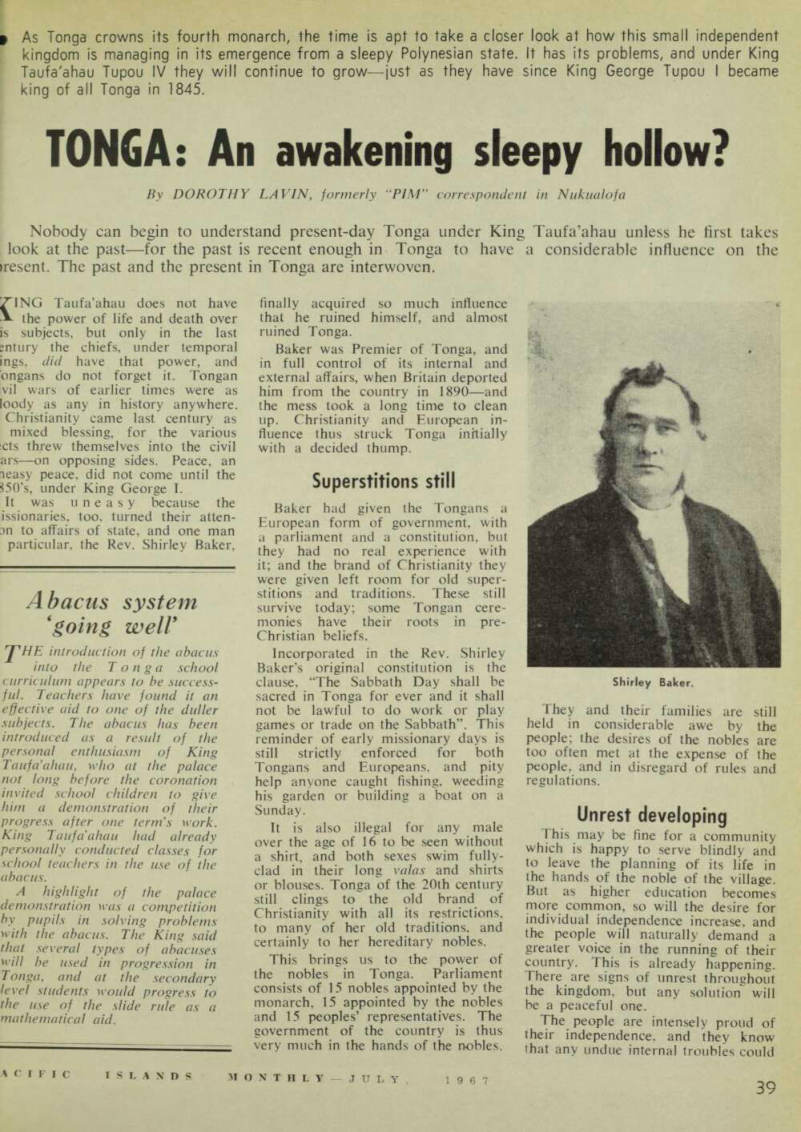
Shirley Baker.
centre unwanted international atten tion on them.
As with most small emerging countries, Tonga has had to rely a great deal on Europeans in key positions.
In the field of education, where the largest group of Europeans is to be found, mission schools have played a big part. But secondary schooling has been in the hands of New Zealand teachers to a great extent, and because of lack of Government finance, it has not always been possible to employ overseas teachers with degrees, or to have many Tongan students brought up to this qualification.
You find a European teacher without a degree teaching high school on an incentive salary considerably higher than the basic salary of a Tongan teacher with a degree. This has caused discontent among Tongans, but until the Government can afford to have sufficient Tongans trained to take over completely, this feeling will persist.
The level of education must mean while suffer, and already it has be come a vicious circle in Tonga, With the population explosion, more and more children are needing schooling, more wanting higher education, but with the employment figure at about 20 per cent., education appears to have no direction for many.
New problems
Although differences in salaries be tween Tongans and Europeans are considerable, so too is the cost of liv ing between the two, and this has brought problems of a different kind.
Despite the British Overseas Service
Aid Scheme, which provides for an increase in salaries for European Government employees, plus an in centive allowance to attract people to work in the developing countries, the past two years has shown an in crease in Europeans in Tonga break ing their contract before their term of employment is completed.
They can get higher salaries else where. Of course, costs are also higher in Australia and New Zealand, but the trouble is that these higher living costs have been reflected in Tonga, which imports such a lot, and where prices for imported food and clothing have jumped, but salaries re mained low. The Tongan, with his very different diet and way of life, has been little affected by this world in crease in prices and freight, but the average European has found his salary won’t stretch.
"The Tongan way"
If Tonga expects to continue using overseas experts, she will have to take a second look at salaries—or accept second best, which seems the trend at the moment.
Today, too many trained Tongans are returning to the kingdom to take up top positions, filled with enthusiasm and the passionate desire to make improvements in their field of work, only to lapse finally into a Polynesian state of somnolence again, with the attitude—“well, this is Tonga, let’s do it the Tongan way”.
It is often difficult to decide whether this attitude is caused by frustration from higher-up, or the inherent Polynesian attitude to life.
Whatever the cause, it’s a sad waste of money and effort.
One of the difficulties of highei education for Tongans is that selectee scholars sent overseas for furthe training seldom have a say in thei chosen careers. To force a man t( do perhaps accountancy when hi inclinations and abilities tend toward agriculture, is to end up with i frustrated individual. And anothe tendency is to give as many a possible a little expert training, rathe than spend the money on getting ; few through to qualifying degrees followed by practical experience over seas.
This is particularly evident ii medicine. With a modern, fully equipped hospital now on the draw ing boards, here again higher salarie will need to be offered if sufficien fully-qualified Europeans are to b attracted to its staff.
Money troubles
Tonga’s ultimate aim is to hav Tongans in all key positions, and i: fact, in all jobs. But until the Gov ernment does more to aid and en courage her own. students, much o the present money spent on highe education is going down the drain.
Economically, Tonga has beei going through a tight spot, and th UK has had to help out. With th inauguration of the Five-yea Development Plan in 1965, practice steps are now being taken to improv the economy, with an expenditure o over ST4 million planned over th five years. Part of the money i provided by the British Governmen in the form of a grant and a loar and the remainder from the Tongai Government and, it is hoped, over seas investors.
Projects under this plan includ the rehabilitation of the coconut in dustry and modernisation and stimu lation of agricultural productioi generally—the basis of Tonga’ economy.
The expansion of educationa facilities includes the Teachers Training College and technical am agricultural training. Hospital service throughout the group, water re sources, tourism, the expansion o public works and modernisation o the police force, are all budgeted fo in the Five-year Plan, and should ii time, bring employment to man; more and better living conditions.
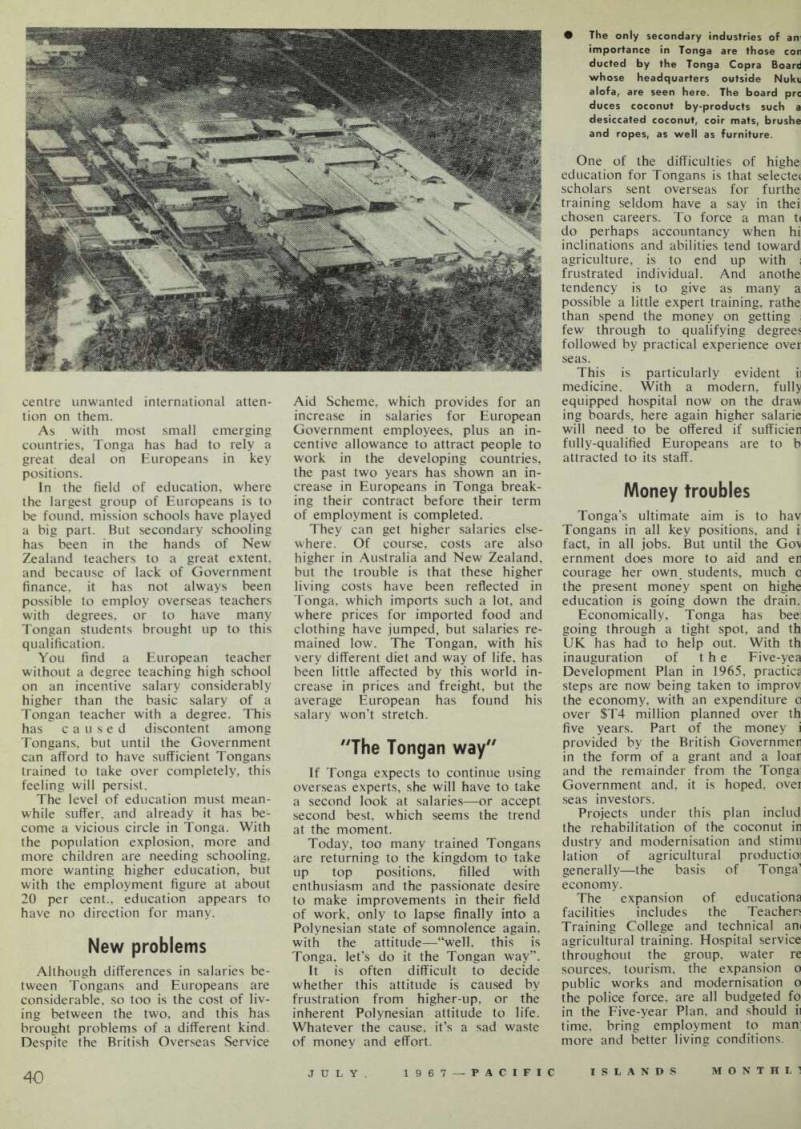
• The only secondary industries of any importance in Tonga are those con[?] ducted by the Tonga Copra Board[?] whose headquarters outside Nuku[?] alofa, are seen here. The board pro duces coconut by-products such a desiccated coconut, coir mats, brushed and ropes, as well as furniture.