Sorry, Chaps, But
pp. 39-130 · Read in the full issue
That Big Bay
Wall Really Is A
Relic Of Quiros!
By Robert Langdon
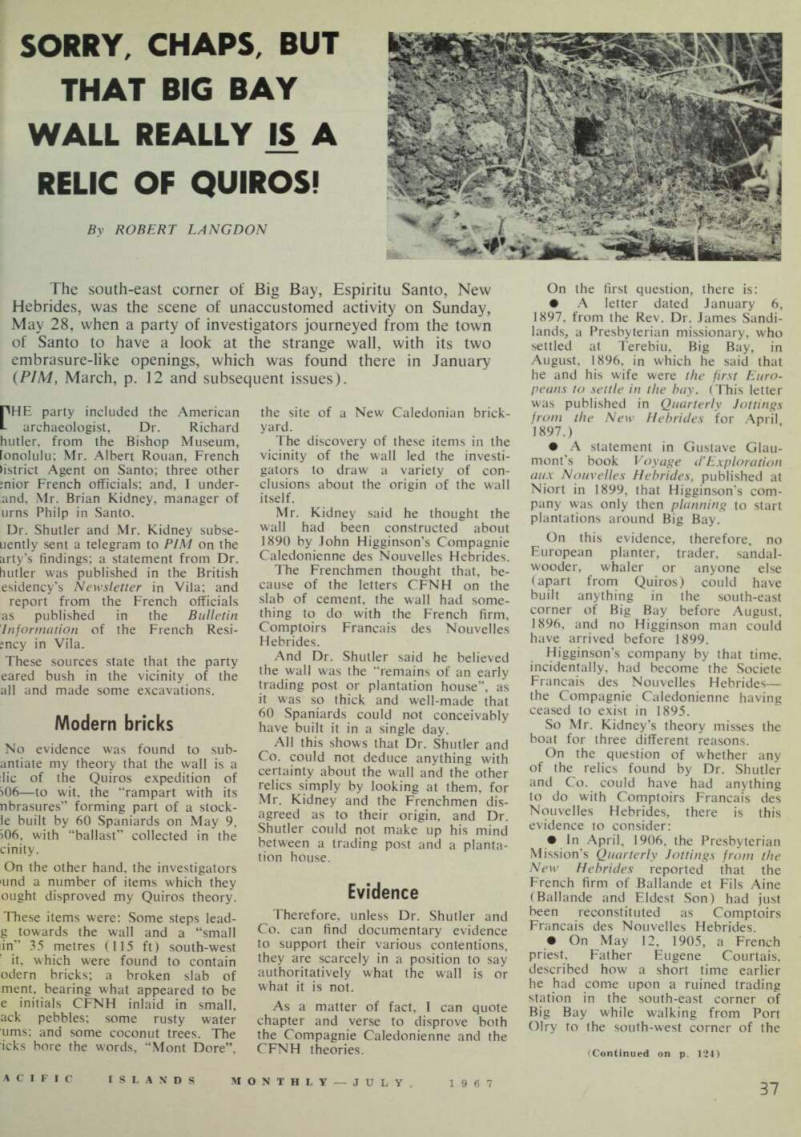
The south-east corner of Big Bay, Espiritu Santo, New Hebrides, was the scene of unaccustomed activity on Sunday, May 28, when a party of investigators journeyed from the town of Santo to have a look at the strange wall, with its two embrasure-like openings, which was found there in January ( PIM, March, p. 12 and subsequent issues).
rHE party included the American archaeologist, Dr. Richard hutler, from the Bishop Museum, lonolulu; Mr. Albert Rouan, French district Agent on Santo; three other mior French officials; and, I under and, Mr. Brian Kidney, manager of urns Philp in Santo.
Dr. Shutler and Mr. Kidney subse uently sent a telegram to PIM on the arty’s findings; a statement from Dr, butler was published in the British esidency’s Newsletter in Vila; and report from the French officials as published in the Bulletin Information of the French Resi mcy in Vila.
These sources state that the party eared bush in the vicinity of the all and made some excavations.
Modern bricks
No evidence was found to sub antiate my theory that the wall is a lie of the Quiros expedition of )06 —to wit, the “rampart with its nbrasures” forming part of a stock le built by 60 Spaniards on May 9, >O6, with “ballast” collected in the cinity.
On the other hand, the investigators und a number of items which they ought disproved my Quiros theory.
These items were: Some steps lead g towards the wall and a “small in” 35 metres (115 ft) south-west it, which were found to contain odern bricks; a broken slab of ment, bearing what appeared to be e initials CFNH inlaid in small, ack pebbles; some rusty water urns; and some coconut trees. The icks bore the words, “Mont Dore”,
the site of a New Caledonian brick yard.
The discovery of these items in the vicinity of the wall led the investi gators to draw a variety of con clusions about the origin of the wall itself.
Mr. Kidney said he thought the wall had been constructed about 1890 by John Higginson’s Compagnie Caledonienne des Nouvelles Hebrides.
The Frenchmen thought that, be cause of the letters CFNH on the slab of cement, the wall had some thing to do with the French firm, Comptoirs Francais des Nouvelles Hebrides.
And Dr. Shutler said he believed the wall was the “remains of an early trading post or plantation house”, as it was so thick and well-made that 60 Spaniards could not conceivably have built it in a single day.
All this shows that Dr. Shutler and Co. could not deduce anything with certainty about the wall and the other relics simply by looking at them, for Mr. Kidney and the Frenchmen dis agreed as to their origin, and Dr.
Shutler could not make up his mind between a trading post and a planta tion house.
Evidence
Therefore, unless Dr. Shutler and Co. can find documentary evidence to support their various contentions, they are scarcely in a position to say authoritatively what the wall is or what it is not.
As a matter of fact, I can quote chapter and verse to disprove both the Compagnie Caledonienne and the CFNH theories.
On the first question, there is: • A letter dated January 6, 1897, from the Rev. Dr. James Sandi lands, a Presbyterian missionary, who settled at Terebiu, Big Bay, in August, 1896, in which he said that he and his wife were the first Euro peans to settle in the bay. (This letter was published in Quarterly Jottings from the New Hebrides for April 1897.) • A statement in Gustave Glau mont’s book Voyage d’Exploration aux Nouvelles Hebrides, published at Niort in 1899, that Higginson’s com pany was only then planning to start plantations around Big Bay.
On this evidence, therefore, no European planter, trader, sandal wooder, whaler or anyone else (apart from Quiros) could have built anything in the south-east corner of Big Bay before August, 1896, and no Higginson man could have arrived before 1899.
Higginson’s company by that time, incidentally, had become the Societe Francais des Nouvelles Hebrides— the Compagnie Caledonienne having ceased to exist in 1895.
So Mr. Kidney’s theory misses the boat for three different reasons.
On the question of whether any of the relics found by Dr. Shutler and Co. could have had anything to do with Comptoirs Francais des Nouvelles Hebrides, there is this evidence to consider: • In April, 1906, the Presbyterian Mission’s Quarterly Jottings from the New Hebrides reported that the French firm of Ballande et Fils Aine (Ballande and Eldest Son) had just been reconstituted as Comptoirs Francais des Nouvelles Hebrides. • On May 12, 1905, a French priest. Father Eugene Courtais, described how a short time earlier he had come upon a ruined trading station in the south-east corner of Big Bay while walking from Port Olry to the south-west corner of the
(Continued on p. 124)
bay. “The station is abandoned, and nothing remains but the house,”
Father Courtais said in his letter, which was published in Vol. XI of the A/males des Missions de I'Oceanie.
It is evident from this that the ruined building found by Father Courtais could not have had any thing to do with Comptoirs Francais des Nouvelles Hebrides as this com pany would scarcely have been using the initials CFNH before it was even formed!
Mr. Kidney’s French colleagues, therefore, are also barking up the wrong tree.
It is obvious, however, that an explanation must now be found for the rusty water drums. New Cale donian bricks, etc., found by Dr.
Shutler and Co., so I am glad to say that further research on my part has revealed one.
This is that the drums and bricks are the remains of a trading post which the Societe Francais des Nouvelles Hebrides established in Big Bay some time after April, 1900 (when a Presbyterian missionery walked past the spot and saw nothing) and which was abandoned in 1903.
The earliest reference to the station that I have been able to find is mid- August, 1901, when a party of six Frenchmen visited it during an ex ploring expedition and stayed over night.
Of the two accounts of the ex pedition that I have seen, neither of them describes the station and neither of them speaks of anyone being in residence there.
Pillaged
Certainly, the station seems never to have amounted to much, for in November, 1901, Father Pierre Bochu, a Catholic missionary, called there with two of his followers on a walking trip from the western side of Big Bay to Port Olry and found the place guarded by a solitary black man. This man was so happy to have visitors that “he received us impressively”, Father Bochu later wrote.
Fourteen months later, in February, 1903, apparently when the station was unoccupied, and when SFNH had leased it to Alfred Rosiers, it was pillaged by the natives.
Rosiers, a successful French planter at Mele. Efate, later got most of his trade goods back through the intervention of one of the mis
sionaries; but he then abandoned the station. It was never reoccupied.
The station, therefore, did not exist for more than a couple of years or so; and all the indications are that it never housed more than a New Hebridean or two. All that re mained of it when Father Courtais passed by early in 1905 was a single building—a house, which he said was full of mosquitoes.
To me, it is inconceivable (to use Dr. Shutler’s word) that SFNH would have built a solid wall (which Dr. Shutler says 60 men could not build in a day, and, which, by the same token, one man could not build in 60 days) if it was merely to form part of a trading establishment to be occupied by a solitary native, or not to be occupied at all.
Where would SFNH have got the skilled labour to build the wall, any way? And what purpose could it have served?
It certainly could not have been connected physically with the other “small ruin” that Dr. Shutler and Co. found 115 ft away, for if it was, the building seen by Father Courtais would have been a good deal bigger than Woolworth’s in Pitt Street.
Sydney.
Objections
Moreover, a building with a wall of coral rocks faced with mortar would have been completely out of keeping with the type of architecture then employed by SFNH, three photographs of which may be found in Charles Lemire's book, Les Interets Francois dans le Pacifique (Paris, 1904).
These photographs show that the SFNH stores in Vila and the Banks Group at that time were of corru gated iron and timber, and that the one at Segond Channel, Santo, was of wattle and daub, and timber.
There are many other objections I can think of to any theory that the wall was built as part of a trading station. For example: • If walls with embrasure-like openings in them were the fashion in New Hebrides trading stations at the turn of the century, why are no other examples of them to be found in the New Hebrides today? • Why is there only one such wall at Big Bay, and not four, or perhaps three, to form a room? • Why (apart from the wall) are there only a few bricks and water drums left to indicate the former presence of the SFNH store?
• How could the late Captai Frank Whitford, of Vanua Lav; Banks Group, have seen the wall i 1882 or 1883 ( PIM, June, p. 25) the first settler did not arrive in tl bay until 1896?
The obvious explanation for a these factors is that the wall, wit its embrasure-like openings, h< nothing to do with the bricks and tl rusty water drums.
The wall, it is quite plain, is tl “rampart with its embrasures” bui by the Quiros expedition on May 1 1606.
Impermanent material
The bricks, the water drums ar the slab of cement (the initials ai probably “SFNH”) are all that n mains of the SFNH trade post, whic was no doubt made of impermanei local materials that have long sine rotted, disintegrated and blown awa; It is quite likely that the peop who built and ran the store never eve knew of the wall’s existence, sine 115 ft is a very long way in the den< jungle that grows on Santo, The wall, judging from Fathe Manilla’s journal, is exactly whei one would expect it to be, and answers precisely to his descriptioi It is therefore fruitless for D Shutler or anyone else to argue th; 60 Spaniards could not have bui such a wall in a day, for to do s is to deny that the Spaniards did whj they said they did.
To build the wall would scarce! have been a tax on their energit anyway, for the wall is only aboi 25 ft long, four feet high, and 1 inches wide. This works out at onl two cubic feet of wall per man surely a “pushover” even for the moi rabidly go-slow stone mason in thes days of enlightened trade unionisn In short, there is—as I have sai before—absolutely no shadow c doubt that the wall is a relic of th Quiros expedition of 1606, and tha as such, it is the oldest relic c European penetration yet found in th South Pacific-Australia areas.
Footnote: An aerial photograph c part of Big Bay, reproduced fror Father Celsus Kelly’s book Calendo of Documents on Spanish Voyages i the South Pacific, was published i April PIM, p. 41. Father Kelly ha asked PIM to say that this photc graph may not be reproduced in an other publication without permissior His book was published by Fran ciscan Historical Studies (Australia in conjunction with the Archiv.
Ibero-Americano. Madrid.