Gloomy future for GEIC
pp. 33-34 · Read in the full issue
as Banabans "get best of two worlds"
By Amara Makaea
The Banaban people of Rabi have gained a good deal of publicity for their complaint about the income from Ocean Island phosphate. It is time that the people of the Gilbert and Ellice Islands Colony gave some kind of answer.
CHE phosphate industry on Ocean Island is controlled by Aus alia, New Zealand and the United
kingdom. The present political
evelopment in this Colony means lat decisions about financial policy re still in the hands of the British rovernment and its servants, so I annot claim to write as a policy laker.
But as a member of the Advisory
Council I have joined in discussion on this subject, and, on behalf of the Gilbertese and Ellice people, I support the decisions that the Gov ernment has made.
As far as I know, the revenues from Ocean Island phosphate are based on two rights—the rights of the Banabans as landowners of the areas that are being quarried, and the rights of the Colony Government to impose taxation on any products from the Colony. Both of these rights are acknowledged by us here, and I hope would be acknowledged also by the Banabans.
Proportions
The amount of the two revenues has been a matter of frequent dis cussion. At the negotiations in Wellington in September, 1966, the only figure agreed on was the total figure per ton of phosphate which was available for both Banabans and
Geic.
The parties could not agree on the proportions each should receive. So it was decided to submit the matter to the Secretary of State for a decision.
This was announced in October, 1966, and the present figures are: 70 cents per ton to the Banabans and $3,50-5/6 per ton to the GEIC (PIM, Nov., 1966, p. 154).
It seems a reasonable proportion.
The amount that the landowner re ceives for quarrying on his land is very rarely a high percentage of the total price per ton, I believe that in the discussion in Port Moresby about Bougainville copper, the percentage for the land owners has been fixed at five per cent., and I wonder what the original landowners of other mining areas in the Pacific receive.
The Banabans, as landowners, re ceive over 16 per cent, of the revenues from Ocean Island phos phate—three times as much as the people of Bougainville.
With the present percentage, the Banabans are doing very well. At 70 cents per ton, their income will be $315,000 per year at an extraction rate of 450,000 tons a year and there are only about 2,000 Banaban people.
In addition, the landowners have received handsome payments for the mining leases on Ocean Island and the phospate industry has given them Rabi Island, which is very fertile, already capable of producing about 800 tons of copra a year and with plenty of areas for development.
They have every opportunity to develop their land economically with the help of the Government of Fiji.
With the money that they have been receiving from the phosphate, they
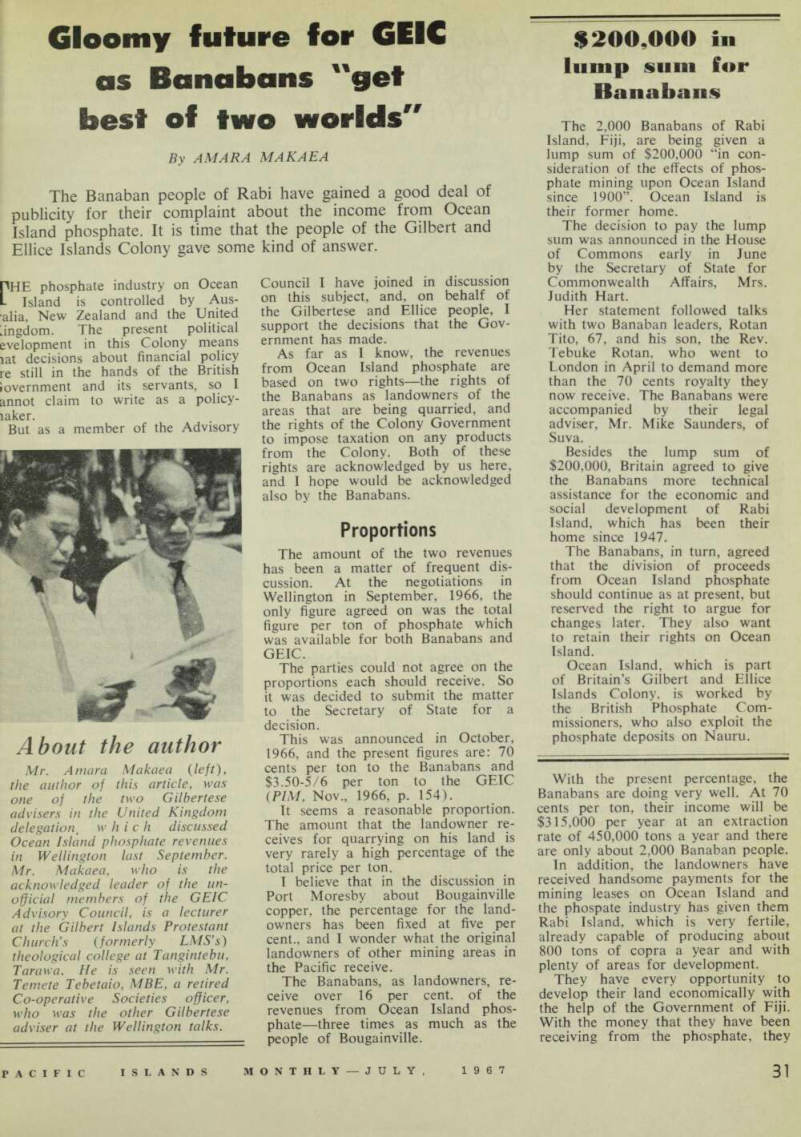
About the author
Mr. Amara Makaea (left), the author of this article, was one of the two Gilbertese advisers in the United Kingdom delegation , which discussed Ocean Island phosphate revenues in Wellington last September.
Mr. Makaea, who is the acknowledged leader of the un official members of the GEIC Advisory Council, is a lecturer at the Gilbert Islands Protestant Church’s (formerly LMS’s ) theological college at Tangintebu, Tarawa. He is seen with Mr.
Temete Tebetaio, MBE, a retired Co-operative Societies officer, who was the other Gilbertese adviser at the Wellington talks.
should now live far better than most GEIC people as they have been on Rabi for more than 20 years.
The fact that none of them ever dream of returning to live in the Colony indicates that living con ditions in Rabi are more favourable than in the Colony.
The 55,000 people of the GEIC are not in such a favourable position, since their atoll islands are too over crowded and too infertile to raise economic crops other than copra.
Most of them live close to poverty and malnutrition, but are working very hard and being taxed hard to better themselves and their islands.
Just the same, with the phosphate finishing after 11 years, the GEIC is heading towards a rather gloomy future. If we look at comparative need, then the people of Rabi have no cause for complaint.
But we would not wish to base our case on need. As Ocean Island is part of the Colony, we would claim that the Colony Government has a right in this matter, and that its right has been exercised with fairness. It seems that the Banabans, in demanding for more income from the phosphate, are attempting to get the best of two worlds—Fiji and the
Geic.
• Dr. Albert C. Smith, Wilder Professor of Botany at the University of Hawaii, arrived in Suva in June to work on the flora of Fiji in the herbarium and will identify those which have not yet been named.