party after another
p. 22 · Read in the full issue
In New Guinea They're Having
A Ball . . .
Now it’s just one darn party after another
From a Port Moresby correspondent Party politics have been slow in coming to New Guinea, and up to the time of the June meeting of the House of Assembly attempts to set up parties had not aroused much en thusiasm or achieved much success. A couple of years ago, after an initial burst of publicity, Gala Gala Rama’s New Guinea United National Party lapsed into a coma from which little attempt seems to have been made to rouse it. But the picture
has changed.
EARLY this year a new party got away to rather a fumbling start in the Sepik District. After several changes of name it finally settled for “United Christian Democratic Party”, and announced a platform which combined Seventh-Statism with a promise of cake for all and no clear indication of where the money to buy the cake was to come from.
Although its New Guinean leaders deny that the U.C.D.P. is a church party, it seems clear that it has a Catholic background and has received advice and guidance from Catholic clergy.
After establishing itself in the Sepik area, it has sent out “missionaries” to various parts of the New Guinea mainland and also to New Britain, and claims to have recruited members in these places, though whether these are “locals” or Sepik people working in those areas is not clear.
The party does not appear to have gained any following in Papua, or to have tried to do so, and one gets the impression that its leaders will need to acquire a good deal more political know-how before it can get off the ground.
Seventh State "out"
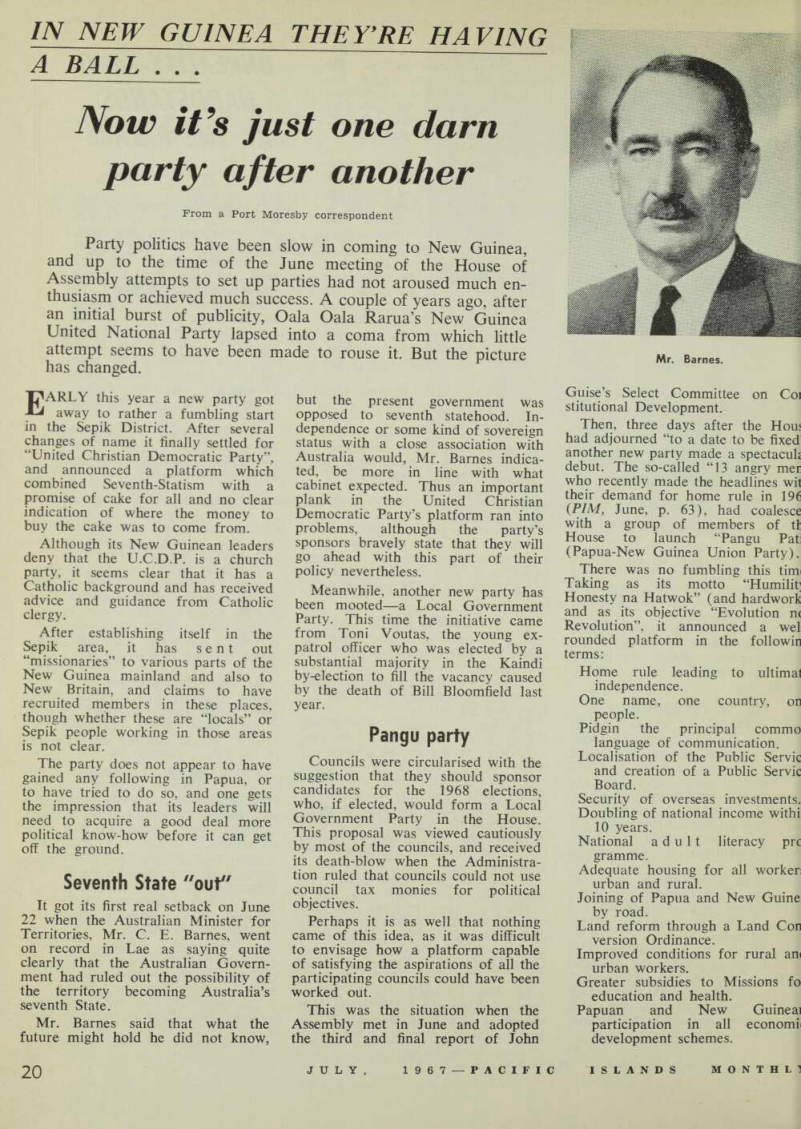
It got its first real setback on June 22 when the Australian Minister for Territories, Mr. C. E. Barnes, went on record in Lae as saying quite clearly that the Australian Govern ment had ruled out the possibility of the territory becoming Australia’s seventh State.
Mr. Barnes said that what the future might hold he did not know,
but the present government was opposed to seventh statehood. In dependence or some kind of sovereign status with a close association with Australia would, Mr. Barnes indica ted, be more in line with what cabinet expected. Thus an important plank in the United Christian Democratic Party’s platform ran into problems, although the party’s sponsors bravely state that they will go ahead with this part of their policy nevertheless.
Meanwhile, another new party has been mooted—a Local Government Party. This time the initiative came from Toni Voutas, the young ex patrol officer who was elected by a substantial majority in the Kaindi by-election to fill the vacancy caused by the death of Bill Bloomfield last year.
Pangu party
Councils were circularised with the suggestion that they should sponsor candidates for the 1968 elections, who, if elected, would form a Local Government Party in the House.
This proposal was viewed cautiously by most of the councils, and received its death-blow when the Administra tion ruled that councils could not use council tax monies for political objectives.
Perhaps it is as well that nothing came of this idea, as it was difficult to envisage how a platform capable of satisfying the aspirations of all the participating councils could have been worked out.
This was the situation when the Assembly met in June and adopted the third and final report of John
Guise’s Select Committee on Coi stitutional Development.
Then, three days after the Horn had adjourned “to a date to be fixed another new party made a spectacuh debut. The so-called “13 angry men who recently made the headlines wit their demand for home rule in 196 ( PIM, June, p. 63), had coalesce with a group of members of tt House to launch “Pangu Pati (Papua-New Guinea Union Party).
There was no fumbling this tirm Taking as its motto “Humilib Honesty na Hatwok” (and hardwork and as its objective “Evolution nc Revolution”, it announced a wel rounded platform in the followin terms: Home rule leading to ultimal independence.
One name, one country, on people.
Pidgin the principal commo language of communication.
Localisation of the Public Servic and creation of a Public Servic Board.
Security of overseas investments.
Doubling of national income withi 10 years.
National adult literacy prc gramme.
Adequate housing for all worker; urban and rural.
Joining of Papua and New Guine by road.
Land reform through a Land Con version Ordinance.
Improved conditions for rural am urban workers.
Greater subsidies to Missions fo education and health.
Papuan and New Guinea] participation in all economy development schemes.
Mr. Barnes.